
 by
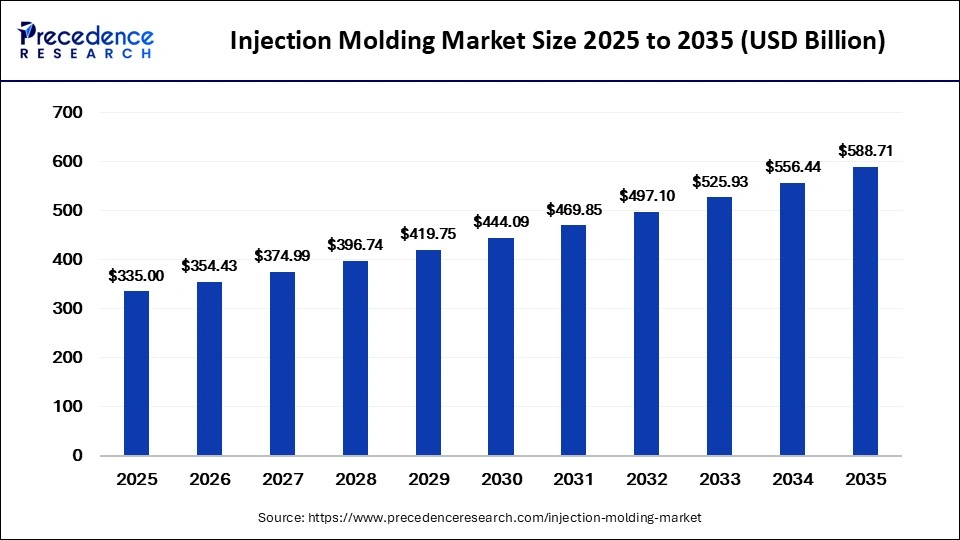
by The global injection molding market is projected to grow from USD 357.62 billion in 2026 to USD 511.78 billion by 2035 at a CAGR of 4.10%. Explore market trends, drivers, regional insights, competitive landscape, and future opportunities in injection molding technologies.
Introduction
The global injection molding market is experiencing strong industrial demand as manufacturers increasingly prioritize lightweight materials, mass production efficiency, design flexibility, and cost-effective manufacturing processes. Injection molding remains one of the most widely used manufacturing technologies for producing plastic components across automotive, packaging, healthcare, electronics, consumer goods, and industrial sectors.
The growing shift toward electric vehicles, sustainable packaging, miniaturized electronics, and precision medical devices is significantly increasing demand for advanced injection molding technologies worldwide. Manufacturers are rapidly adopting automation, AI-powered quality control systems, and smart manufacturing solutions to improve productivity, reduce waste, and enhance production efficiency.
According to Precedence Research, the global injection molding market size was valued at USD 343.53 billion in 2025 and is expected to increase from USD 357.62 billion in 2026 to approximately USD 511.78 billion by 2035, expanding at a CAGR of 4.10% during the forecast period.
Read Also: Metal Coil Lamination Market
Injection Molding Market Overview
Injection molding is a manufacturing process used to produce plastic components by injecting molten materials into molds under high pressure. The process enables large-scale production of complex and precision-engineered products with high consistency and efficiency.
Injection molding technologies are extensively used for manufacturing automotive parts, packaging containers, medical devices, consumer electronics, industrial equipment, and household products. The process supports a wide variety of thermoplastics, thermosetting polymers, elastomers, and composite materials.
The market is increasingly benefiting from advancements in AI-powered automation, smart robotics, energy-efficient machinery, and sustainable material technologies that improve manufacturing productivity and environmental performance.
Key Market Drivers
Rising Demand for Lightweight Automotive Components
The automotive industry remains one of the largest consumers of injection molded components.
Automakers increasingly use lightweight plastic parts to improve fuel efficiency, reduce emissions, and enhance electric vehicle performance. Injection molding enables production of complex automotive parts such as dashboards, bumpers, battery housings, interior panels, and under-the-hood components with high precision and durability.
The rapid expansion of electric vehicle production is further accelerating demand for advanced injection molding solutions.
Expansion of Sustainable Packaging Industry
The packaging industry is witnessing strong growth driven by e-commerce expansion, food delivery services, and increasing demand for lightweight and recyclable packaging materials.
Injection molding technologies are extensively used for producing food containers, caps, closures, bottles, and industrial packaging products. The packaging segment accounted for 32% market share in 2025 due to increasing global consumption of plastic packaging products.
Manufacturers are increasingly adopting biodegradable polymers and recycled plastics to support sustainability goals.
Growth in Healthcare and Medical Device Manufacturing
Healthcare applications are becoming increasingly important for the injection molding industry.
Medical manufacturers rely on precision injection molding technologies to produce syringes, surgical instruments, inhalers, diagnostic devices, and disposable medical products. The growing global healthcare industry and increasing demand for medical disposables are creating significant growth opportunities for injection molding manufacturers.
The rise of personalized healthcare and advanced diagnostics is further strengthening demand.
Increasing Adoption of Consumer Electronics
Miniaturized and precision-engineered electronic products require high-performance injection molded components.
Manufacturers use injection molding to produce smartphone casings, connectors, wearable devices, appliance components, and industrial electronics with superior accuracy and durability.
The expansion of smart devices and IoT technologies continues to support market growth.
Impact of Artificial Intelligence on the Injection Molding Market
Artificial intelligence is transforming the injection molding industry through smart manufacturing, predictive maintenance, automated inspection, and process optimization technologies.
AI-powered systems continuously monitor temperature, pressure, material flow, cycle time, and machine performance to improve production efficiency and minimize defects. Machine learning algorithms analyze production data in real time to optimize molding parameters and reduce material waste.
AI-enabled robotics are also improving automation in material handling, assembly, packaging, and quality inspection processes across injection molding facilities.
Market Trends
Growing Adoption of Electric Injection Molding Machines
Electric injection molding machines are gaining strong popularity because of their energy efficiency, precision control, and lower operational costs.
Unlike hydraulic systems, electric machines offer faster cycle times, reduced energy consumption, lower noise levels, and improved environmental performance. The electric machine segment is projected to witness the fastest CAGR of 5.8% through 2035.
Manufacturers are increasingly replacing conventional hydraulic systems with electric and hybrid alternatives.
Rising Use of Recycled and Bio-Based Plastics
Sustainability initiatives are accelerating adoption of recycled plastics and biodegradable polymers in injection molding applications.
Governments and manufacturers are increasingly focusing on circular economy strategies, waste reduction, and environmentally friendly packaging solutions. (precedenceresearch.com)
Bio-based plastics are expected to gain wider adoption across packaging and consumer product industries.
Expansion of Smart Manufacturing and Industry 4.0
Injection molding facilities are increasingly integrating Industry 4.0 technologies such as IoT sensors, AI analytics, cloud platforms, and robotics into manufacturing operations.
Smart factories improve operational visibility, reduce downtime, optimize production scheduling, and enhance quality management.
Digital transformation is becoming a key competitive advantage within the industry.
Increasing Demand for Precision Medical Components
Medical device manufacturers increasingly require precision-engineered plastic components with strict quality standards.
Micro-injection molding technologies are witnessing growing adoption in diagnostic devices, drug delivery systems, and minimally invasive surgical equipment.
Market Restraints
Environmental Concerns Related to Plastic Waste
Growing concerns regarding plastic pollution and environmental sustainability remain major challenges for the injection molding industry.
Governments worldwide are introducing stricter regulations on single-use plastics, waste management, and recycling practices. Manufacturers must increasingly adopt sustainable materials and eco-friendly production processes.
Volatility in Raw Material Prices
Fluctuating prices of petrochemical-based resins and polymers continue to impact manufacturing costs and profitability.
Supply chain disruptions and geopolitical uncertainties can also affect raw material availability and pricing stability.
High Initial Equipment Investment
Advanced injection molding machines, robotics systems, and AI-powered automation technologies often require substantial capital investment.
Small and medium-sized manufacturers may face financial barriers when upgrading manufacturing infrastructure.
Emerging Opportunities
Growth of Electric Vehicle Manufacturing
The rapid expansion of electric vehicle production is creating significant opportunities for lightweight injection molded components.
Manufacturers increasingly use advanced polymers in battery systems, charging infrastructure, and vehicle interiors to improve efficiency and reduce weight.
Expansion of Medical and Pharmaceutical Industries
The healthcare industry continues to create strong demand for high-precision injection molding technologies.
Rising production of disposable medical products, diagnostic devices, and drug delivery systems is expected to support long-term market growth.
Rising Adoption of Automation and Robotics
Manufacturers are increasingly investing in AI-driven automation systems, collaborative robots, and smart manufacturing technologies to improve productivity and reduce labor dependency.
Automation is expected to play a critical role in future injection molding operations worldwide.
Segmental Analysis
By Material
Plastic Segment Dominance
Plastic materials dominated the market with 88% share in 2025 because of their affordability, flexibility, durability, and extensive industrial applications.
Thermoplastics Leadership
Thermoplastics accounted for 72% market share in 2025 due to their recyclability, ease of processing, and superior mechanical properties.
Engineering Plastics Expansion
Engineering plastics are witnessing growing demand across automotive, aerospace, and electronics industries because of their heat resistance and structural performance.
By Machine Type
Hydraulic Machines Dominance
Hydraulic injection molding machines continue to dominate the market due to their high clamping force and suitability for large-scale industrial applications.
Electric Machines Growth
Electric injection molding machines are projected to witness the fastest CAGR of 5.8% during the forecast period because of their energy efficiency and precision capabilities.
By Application
Packaging Segment Leadership
The packaging segment accounted for 32% market share in 2025 because of rising demand for food packaging, industrial containers, and e-commerce packaging solutions. (precedenceresearch.com)
Automotive Segment Growth
The automotive segment represented 28% of market share in 2025 due to increasing production of lightweight vehicle components.
Medical Applications Expansion
Medical applications are expected to witness rapid growth driven by increasing healthcare infrastructure development and rising medical device manufacturing.
Regional Analysis
Asia-Pacific
Asia-Pacific dominated the injection molding market with 45% share in 2025 and is expected to maintain strong growth during the forecast period.
China, India, Japan, and South Korea remain major manufacturing hubs because of strong industrial infrastructure, growing automotive production, and expanding consumer electronics industries.
China continues to lead the regional market due to large-scale plastic manufacturing capacity and rising investments in smart manufacturing technologies.
North America
North America continues to witness stable growth due to increasing adoption of automation technologies, advanced medical manufacturing, and sustainable packaging solutions.
The United States remains a major market because of rising demand for precision-engineered components and electric vehicle production.
Europe
Europe is increasingly focusing on sustainable manufacturing, recyclable plastics, and energy-efficient injection molding systems.
Germany, France, and Italy are major centers for automotive and industrial manufacturing applications.
Latin America and Middle East & Africa
These regions are gradually witnessing increased adoption of injection molding technologies as industrialization and packaging industries continue to expand.
Key Companies in the Injection Molding Market
Major companies operating in the market include:
- Husky Technologies
- ENGEL
- Arburg
- Milacron
- Sumitomo Heavy Industries
- Nissei Plastic Industrial
- KraussMaffei
- FANUC
- Toshiba Machine
- JSW Plastics Machinery
These companies are focusing on AI-powered automation, electric injection molding machines, sustainable materials, and Industry 4.0 technologies to strengthen their market positions.
Get a Sample Copy: https://www.precedenceresearch.com/sample/8410
For inquiries regarding discounts, bulk purchases, or customization requests, please contact us at [email protected]
