
 by
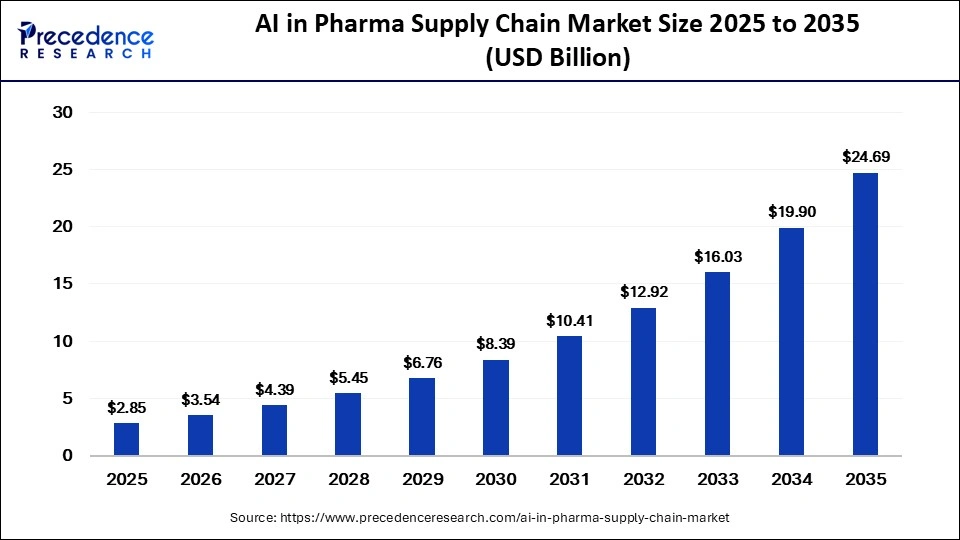
by The global AI in pharma supply chain market is projected to grow from USD 3.84 billion in 2026 to USD 31.42 billion by 2035 at a CAGR of 26.30%. Explore key market trends, drivers, regional insights, competitive landscape, and future opportunities.
Introduction
The pharmaceutical industry is undergoing a major digital transformation as companies increasingly adopt artificial intelligence to improve supply chain visibility, operational efficiency, inventory management, and regulatory compliance. AI technologies are rapidly reshaping pharmaceutical supply chains by enabling predictive analytics, intelligent forecasting, automated logistics, and real-time decision-making.
The growing complexity of global pharmaceutical networks, rising demand for temperature-sensitive biologics, and increasing pressure to reduce operational costs are driving adoption of AI-powered supply chain solutions across the healthcare sector. Pharmaceutical companies are leveraging AI to enhance inventory optimization, minimize disruptions, improve demand forecasting accuracy, and strengthen product traceability.
According to Precedence Research, the global AI in pharma supply chain market size was valued at USD 3.05 billion in 2025 and is projected to increase from USD 3.84 billion in 2026 to approximately USD 31.42 billion by 2035, expanding at a CAGR of 26.30% during the forecast period.
Read Also: Multilingual LLM Market
AI in Pharma Supply Chain Market Overview
AI in pharma supply chain refers to the use of artificial intelligence, machine learning, predictive analytics, automation, and intelligent monitoring technologies to optimize pharmaceutical supply chain operations.
These solutions are widely used for inventory management, warehouse automation, logistics optimization, cold chain monitoring, supplier risk analysis, demand forecasting, compliance management, and counterfeit drug detection. AI-powered systems help pharmaceutical companies improve efficiency, reduce costs, enhance patient safety, and strengthen resilience against supply chain disruptions.
The increasing adoption of cloud computing, IoT-enabled sensors, robotics, and advanced analytics platforms is accelerating AI integration across pharmaceutical supply networks worldwide.
Key Market Drivers
Increasing Complexity of Pharmaceutical Supply Chains
Global pharmaceutical supply chains involve multiple suppliers, distributors, regulatory agencies, logistics providers, and healthcare facilities operating across different regions.
Managing inventory, cold chain logistics, compliance requirements, and product traceability manually has become increasingly difficult. AI-powered supply chain platforms help pharmaceutical companies optimize operations through predictive analytics, automated monitoring, and intelligent risk management.
The growing complexity of biologics and specialty drug distribution is further accelerating AI adoption.
Rising Demand for Accurate Forecasting and Inventory Optimization
Demand forecasting remains one of the most important applications of AI in pharmaceutical supply chains.
Machine learning algorithms analyze historical sales data, seasonal trends, epidemiological patterns, and market conditions to improve forecasting accuracy and optimize inventory management. The demand forecasting segment accounted for 26% market share in 2025 due to increasing need for real-time supply chain planning.
AI-driven forecasting systems help companies reduce stock shortages, minimize waste, and improve supply chain responsiveness.
Expansion of Cold Chain Logistics
The increasing production of biologics, vaccines, and temperature-sensitive pharmaceuticals is driving demand for AI-enabled cold chain monitoring systems.
AI-powered sensors and IoT devices continuously track temperature, humidity, and transportation conditions throughout the supply chain. Real-time monitoring systems help pharmaceutical companies prevent spoilage and ensure product integrity
The rapid growth of personalized medicine and biologics manufacturing continues to strengthen this trend.
Growing Focus on Counterfeit Drug Prevention
Counterfeit pharmaceuticals remain a major challenge for global healthcare systems.
AI technologies help companies improve product authentication, track shipments, detect anomalies, and strengthen supply chain transparency. AI-powered analytics systems can identify suspicious distribution patterns and improve regulatory compliance.
Increasing government regulations regarding drug traceability are accelerating investments in AI-based supply chain security infrastructure.
Impact of Artificial Intelligence on Pharma Supply Chains
Artificial intelligence is transforming pharmaceutical supply chains by enabling real-time visibility, predictive decision-making, and intelligent automation.
AI-powered systems analyze large volumes of operational data to identify disruptions, forecast demand fluctuations, optimize logistics routes, and improve warehouse efficiency. Machine learning models continuously improve supply chain performance through adaptive learning and predictive analytics.
AI is also helping pharmaceutical companies automate repetitive tasks such as invoice processing, procurement analysis, and compliance documentation.
Market Trends
Growing Adoption of Cloud-Based Supply Chain Platforms
Cloud deployment continues to dominate the market because of scalability, centralized data management, and remote accessibility.
Cloud-based AI platforms allow pharmaceutical companies to monitor global supply chain operations in real time while improving collaboration between suppliers, manufacturers, and distributors. Cloud deployment accounted for 64% market share in 2025.
Increasing Integration of IoT and Smart Sensors
IoT-enabled sensors are becoming essential components of pharmaceutical supply chain monitoring systems.
Smart sensors continuously track environmental conditions, inventory levels, shipment status, and warehouse operations. AI analytics platforms process sensor data to improve operational visibility and predictive maintenance capabilities.
Expansion of Autonomous Warehousing and Robotics
Pharmaceutical companies are increasingly adopting robotics and AI-powered warehouse automation systems to improve efficiency and reduce labor dependency.
Autonomous robots help optimize order fulfillment, inventory tracking, and warehouse logistics while improving operational accuracy and scalability.
Rise of Predictive Risk Management
Predictive risk management technologies are becoming increasingly important in pharmaceutical supply chain operations.
AI systems can identify potential disruptions caused by geopolitical instability, weather events, supplier failures, or transportation delays, enabling proactive mitigation strategies.
Market Restraints
Data Security and Privacy Concerns
Pharmaceutical supply chains handle highly sensitive business and patient-related information.
The increasing use of cloud platforms and connected devices raises concerns regarding cybersecurity threats, data breaches, and unauthorized access. Companies must invest heavily in cybersecurity infrastructure and regulatory compliance systems.
High Implementation Costs
Deploying AI-powered supply chain systems often requires substantial investment in software platforms, cloud infrastructure, IoT devices, analytics systems, and workforce training.
Small and medium-sized pharmaceutical companies may face financial barriers during digital transformation initiatives.
Integration Complexity
Many pharmaceutical organizations continue to operate legacy enterprise systems that may not integrate easily with modern AI platforms.
System integration challenges can increase deployment timelines and operational complexity.
Emerging Opportunities
Growth of Personalized Medicine and Biologics
The rapid expansion of biologics, gene therapies, and personalized medicine is creating strong demand for intelligent supply chain systems.
These products often require specialized storage, handling, and temperature monitoring, increasing the importance of AI-enabled logistics management.
Expansion of Emerging Pharmaceutical Markets
Rapid healthcare infrastructure development across Asia-Pacific, Latin America, and the Middle East is creating substantial opportunities for AI-powered pharmaceutical supply chain solutions.
Governments and healthcare organizations are increasingly investing in digital healthcare ecosystems and modern pharmaceutical infrastructure.
Increasing Use of Blockchain with AI
The integration of blockchain technology with AI is improving pharmaceutical traceability, authentication, and supply chain transparency.
Blockchain-based systems help pharmaceutical companies improve compliance, reduce counterfeit risks, and enhance operational security.
Segmental Analysis
By Component
Software Segment Dominance
The software segment dominated the market with 68% share in 2025 because pharmaceutical companies increasingly adopted AI-powered analytics, forecasting, and logistics management platforms.
Services Segment Growth
The services segment is expected to witness strong growth due to rising demand for AI consulting, system integration, cybersecurity management, and cloud deployment services.
By Deployment Mode
Cloud Deployment Leadership
Cloud deployment held 64% market share in 2025 due to increasing demand for scalable and centralized supply chain management infrastructure.
On-Premise Solutions
On-premise systems remain important for organizations requiring strict data control and customized enterprise integration.
By Technology
Machine Learning Dominance
Machine learning accounted for 34% market share in 2025 because of its extensive use in forecasting, predictive analytics, logistics optimization, and risk management.
Natural Language Processing Expansion
Natural language processing technologies are increasingly being used for compliance automation, document analysis, and procurement management.
Regional Analysis
North America
North America dominated the AI in pharma supply chain market with 41% share in 2025.
The region benefits from advanced pharmaceutical infrastructure, rapid AI adoption, strong healthcare investments, and extensive cloud technology deployment.
The United States remains a major growth center because of its large pharmaceutical manufacturing base and increasing focus on digital transformation.
Europe
Europe continues to witness strong growth due to increasing regulatory focus on drug traceability, supply chain transparency, and sustainability.
Germany, the United Kingdom, and France are investing heavily in AI-enabled pharmaceutical logistics and smart manufacturing infrastructure.
Asia-Pacific
Asia-Pacific is projected to witness the fastest CAGR of 28.1% during the forecast period.
China, India, Japan, and South Korea are emerging as major pharmaceutical manufacturing and logistics hubs supported by rapid healthcare digitization and infrastructure expansion.
India is becoming an important market because of its expanding pharmaceutical export industry and increasing investments in AI-powered logistics systems.
Latin America and Middle East & Africa
These regions are gradually adopting AI-driven pharmaceutical supply chain technologies as healthcare modernization initiatives continue to expand.
Key Companies in the AI in Pharma Supply Chain Market
Major companies operating in the market include:
- IBM
- Microsoft
- Oracle
- SAP
- Amazon Web Services
- NVIDIA
- Blue Yonder
- Kinaxis
- Project44
- Accenture
These companies are focusing on predictive analytics, cloud-based supply chain platforms, AI-driven logistics optimization, and intelligent automation technologies to strengthen their market positions.
Get a Sample Copy: https://www.precedenceresearch.com/sample/8408
For inquiries regarding discounts, bulk purchases, or customization requests, please contact us at [email protected]
