
 by
by The global 3D printing medical devices market size is calculated at USD 5.59 billion in 2025 and is predicted to increase from USD 6.60 billion in 2026 to approximately USD 28.07 billion by 2035, expanding at a CAGR of 17.51% from 2026 to 2035.
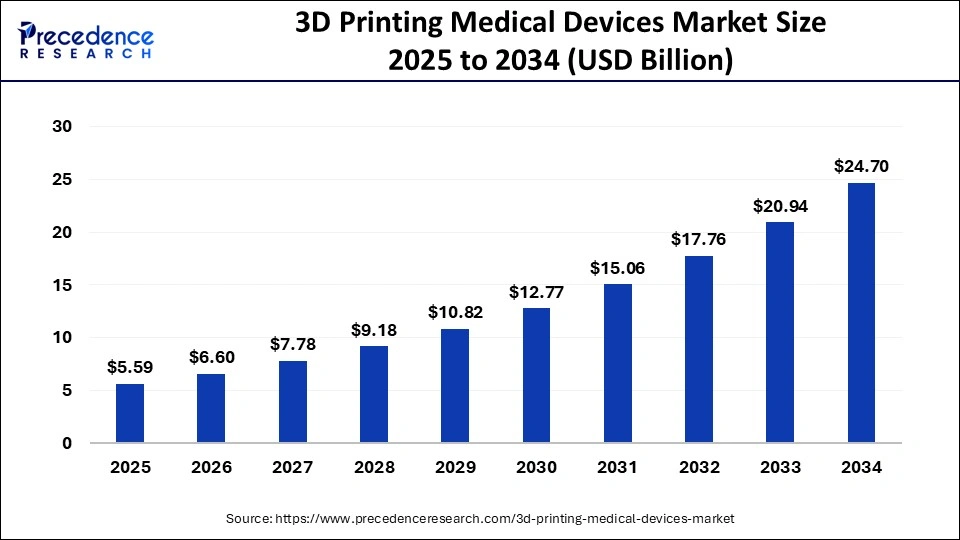
3D Printing Medical Devices Market Overview
The global 3D printing medical devices market is experiencing robust growth as healthcare providers increasingly seek customized, cost-effective, and technologically advanced treatment solutions. The technology is being used across various medical specialties including orthopedics, dentistry, cardiology, craniofacial reconstruction, and surgical planning.
Medical professionals are leveraging 3D printing to create patient-specific implants, prosthetics, dental restorations, hearing aids, surgical instruments, anatomical models, and even bioengineered tissues. As regulatory frameworks become more supportive and material technologies continue to improve, the commercialization of 3D-printed medical devices is accelerating worldwide.
Get Sample Link: https://www.precedenceresearch.com/sample/3098
3D Printing Medical Devices Market Growth
The market continues to witness significant expansion due to increasing demand for personalized medicine and minimally invasive surgical procedures. Traditional manufacturing methods often struggle to produce customized medical devices quickly and economically. In contrast, 3D printing enables rapid prototyping and low-volume production with exceptional precision, making it particularly valuable for individualized patient care.
Healthcare providers are also recognizing the economic benefits of additive manufacturing. Hospitals can produce surgical models and customized devices on-site, reducing dependency on external suppliers and shortening treatment timelines. As healthcare systems prioritize efficiency, quality, and patient satisfaction, the adoption of 3D printing technologies is expected to grow steadily across both developed and emerging markets.
Key 3D Printing Medical Devices Market Trends
- Rise of Personalized Medical Devices: Personalized healthcare has become one of the strongest trends driving market growth. Using patient imaging data from CT and MRI scans, manufacturers can create implants and prosthetics that perfectly match an individual’s anatomy. This customization improves surgical outcomes, reduces complications, and enhances patient comfort.
- Increasing Adoption of AI-Powered Design: Artificial intelligence is transforming the design process by automatically optimizing medical device structures for strength, weight, and functionality. AI algorithms can generate highly efficient implant geometries while minimizing material consumption and production time.
- Expansion of Hospital-Based 3D Printing Centers: Many hospitals are establishing in-house additive manufacturing laboratories that enable clinicians to produce surgical guides, anatomical models, and customized implants within healthcare facilities. This point-of-care manufacturing approach significantly shortens production cycles and improves collaboration between surgeons and engineers.
Case Study
Customized Titanium Jaw Implant Improves Surgical Success
A patient requiring extensive jaw reconstruction due to traumatic injury underwent treatment using a patient-specific titanium implant manufactured through 3D printing. Surgeons first converted CT scan data into a detailed digital model of the patient’s facial anatomy. Engineers then designed an implant that precisely matched the missing bone structure.
The customized implant significantly reduced operating time since minimal intraoperative modifications were required. The precise fit improved facial symmetry, enhanced functional recovery, and reduced postoperative complications. This case illustrates how additive manufacturing enables highly personalized treatment that would be difficult to achieve using conventional manufacturing techniques.
Read More: Medical Carts and Workstations Market
3D Printing Medical Devices Market Regional Analysis
North America
North America dominates the market due to advanced healthcare infrastructure, high healthcare spending, widespread adoption of digital technologies, and strong presence of leading medical device manufacturers. Significant research funding and favorable regulatory developments continue supporting innovation across the region.
Europe
Europe represents another major market driven by increasing investment in medical research, supportive government initiatives, and widespread adoption of personalized healthcare. Countries such as Germany, the United Kingdom, France, Italy, and the Netherlands are expanding additive manufacturing capabilities within hospitals and research institutions.
Asia-Pacific
Asia-Pacific is expected to witness the fastest growth owing to rapidly improving healthcare infrastructure, growing medical tourism, rising healthcare expenditures, and increasing investments in advanced manufacturing technologies. China, Japan, South Korea, India, and Singapore are becoming important centers for medical 3D printing research and commercialization.
Latin America
Healthcare modernization, expanding private healthcare services, and growing awareness of advanced medical technologies are gradually increasing adoption across Latin America. Brazil and Mexico remain the leading contributors to regional growth.
Middle East & Africa
The Middle East and Africa region is steadily adopting additive manufacturing technologies through investments in smart hospitals, digital healthcare initiatives, and specialized medical centers. Government efforts to improve healthcare quality are expected to create new opportunities over the coming years.
Competitive Landscape
The market is highly competitive, with companies focusing on product innovation, strategic collaborations, mergers and acquisitions, and expansion of material portfolios. Manufacturers are investing heavily in research and development to improve printing speed, accuracy, material compatibility, and regulatory compliance.
Collaboration between hospitals, universities, software developers, and medical device companies is accelerating innovation and enabling faster commercialization of advanced 3D-printed healthcare solutions.
Future Outlook
The future of the 3D printing medical devices market appears exceptionally promising. Continued advances in artificial intelligence, robotics, digital imaging, biomaterials, and cloud manufacturing will further improve production efficiency and device performance. Point-of-care manufacturing is expected to become increasingly common, allowing hospitals to produce customized medical devices directly within healthcare facilities.
Bioprinting is likely to emerge as one of the most transformative areas of healthcare innovation, with future applications extending beyond tissue models to functional organs and regenerative therapies. As regulatory pathways mature and production costs decline, 3D printing is expected to become a mainstream manufacturing technology across the global medical device industry.
??? ??? ????? ?? ????? ?? ??? ??? ?????????, ?????? ???? ???? ?? ??????? ?? ?? ?????@??????????????????.???
