
 by
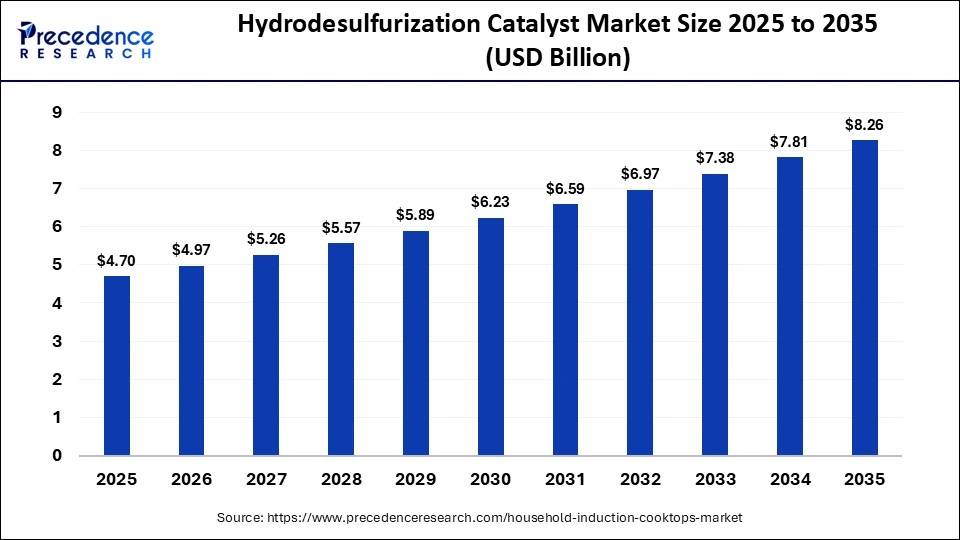
by The global hydrodesulfurization catalyst market is experiencing steady growth, driven by increasing environmental regulations and the rising demand for cleaner fuels. The market was valued at USD 4.70 billion in 2025 and is expected to grow from USD 4.97 billion in 2026 to approximately USD 8.26 billion by 2035, registering a CAGR of 5.80% during the forecast period.
Hydrodesulfurization (HDS) catalysts are critical chemical agents used in petroleum refining to remove sulfur from fuels such as gasoline, diesel, and jet fuel. These catalysts operate by reacting sulfur compounds with hydrogen to produce hydrogen sulfide, ensuring compliance with environmental standards and reducing harmful emissions.
Read Also: Emotion AI Market
Key Market Highlights
- Market size projected to reach USD 4.97 billion in 2026
- Expected to hit USD 8.26 billion by 2035
- Growing at a CAGR of 5.80% (2026–2035)
- North America dominated with 38% market share in 2025
- Petroleum refining accounted for 72% of application share
- Oil & gas segment led with 65% share
- Cobalt molybdenum catalysts dominated with 38% share
Market Trends
Increasing Demand for Deep Desulfurization
Refineries are focusing on removing refractory sulfur compounds from heavy crude oil. Advanced catalysts with enhanced active sites are being developed to achieve deeper desulfurization efficiently.
Development of Nanostructured Catalysts
Innovations such as MoS₂ nanoflakes and edge-enriched catalyst structures are improving catalytic activity and efficiency by increasing surface area and active site density.
Growing Focus on Catalyst Regeneration
Refineries are adopting regeneration technologies to reuse spent catalysts, reducing waste and improving sustainability.
Expansion into Biofuels and Petrochemicals
Hydrodesulfurization catalysts are increasingly used in bio-based feedstocks and petrochemical applications, expanding their market scope beyond traditional fuels.
Impact of Artificial Intelligence on the Market
Artificial intelligence is playing a transformative role in optimizing refinery operations. AI-enabled systems provide real-time monitoring of catalyst performance, helping predict degradation and optimize replacement cycles.
These technologies reduce downtime, improve operational efficiency, and contribute to the development of more durable and high-performance catalysts, enhancing overall sustainability in refinery operations.
Market Dynamics
Driver: Stringent Environmental Regulations
Strict global regulations mandating ultra-low sulfur fuels are a major driver of market growth. Governments and environmental agencies are enforcing limits on sulfur emissions to reduce air pollution, compelling refineries to adopt advanced hydrodesulfurization catalysts.
Restraint: Raw Material Price Volatility
Fluctuations in the prices of metals such as platinum, palladium, and molybdenum create cost uncertainties for manufacturers. Additionally, catalyst deactivation due to contaminants increases operational costs and downtime.
Opportunity: AI Integration and Advanced Catalyst Development
The integration of AI and machine learning in refinery operations presents significant opportunities. Additionally, the development of non-precious metal catalysts and high-performance formulations is expected to reduce dependency on expensive materials.
Segment Insights
By Catalyst Type
The cobalt molybdenum (CoMo) segment dominated the market with a 38% share in 2025, owing to its cost-effectiveness, stability, and strong performance in sulfur removal processes.
Nickel molybdenum (NiMo) catalysts held the second-largest share (32%) and are widely used for deeper desulfurization due to their higher hydrogenation activity. Platinum group metals (PGMs) are gaining traction for their superior catalytic efficiency and durability.
By Application
Petroleum refining led the market with a 72% share in 2025, driven by the need to comply with global fuel quality standards. Refineries are increasingly processing heavier crude oils, which require advanced desulfurization techniques.
The chemical production segment held an 18% share and is expected to grow steadily, as sulfur-free feedstock is essential for downstream chemical processes.
By End-User Industry
The oil & gas segment dominated the market with a 65% share in 2025, as refineries are the primary consumers of hydrodesulfurization catalysts.
The chemicals segment accounted for 20% share and is growing due to increasing demand for high-purity feedstocks in petrochemical production. The energy sector is also witnessing steady growth due to regulatory pressure to reduce emissions.
Regional Insights
North America: Market Leader
North America held the largest share of 38% in 2025, driven by strict environmental regulations and advanced refinery infrastructure. The region benefits from continuous investments in refinery modernization and catalyst innovation.
Europe: Second-Largest Market
Europe accounted for approximately 28% share, supported by stringent emission norms and a strong focus on sustainability. Regulations such as the IMO sulfur cap have increased demand for high-performance catalysts.
Asia Pacific: Fastest Growing Region
Asia Pacific is expected to witness the fastest growth due to rapid industrialization, expanding refining capacity, and increasing demand for cleaner fuels. Countries like China and India are investing heavily in refining infrastructure and environmental compliance.
Competitive Landscape
The hydrodesulfurization catalyst market is highly competitive, with key players focusing on innovation, partnerships, and product development. Major companies include:
- Albemarle Corporation
- BASF SE
- Clariant AG
- Johnson Matthey PLC
- Honeywell UOP
- ExxonMobil Chemical Company
- Haldor Topsoe A/S
- Shell Global Solutions International B.V.
- Sinopec Limited
- Saudi Aramco
These companies are investing in advanced catalyst technologies and expanding their global presence to strengthen market positioning.
Recent Developments
- In June 2025, Clariant introduced its ShiftMax 100 RE catalyst for e-fuels production, supporting sustainable fuel development.
- In November 2025, SONATRACH partnered with Sinopec for refinery expansion to enhance gasoline production capacity.
Conclusion
The hydrodesulfurization catalyst market is set for steady growth, driven by increasing environmental regulations, rising demand for cleaner fuels, and advancements in refinery technologies. The integration of AI, development of high-performance catalysts, and expansion into biofuels and petrochemicals are expected to reshape the market landscape.
As global efforts to reduce sulfur emissions intensify, hydrodesulfurization catalysts will remain essential in ensuring compliance and improving fuel quality, positioning the market for sustained long-term growth.
Get Sample Link: https://www.precedenceresearch.com/sample/8285
For inquiries regarding discounts, bulk purchases, or customization requests, please contact us at [email protected]
