
 by
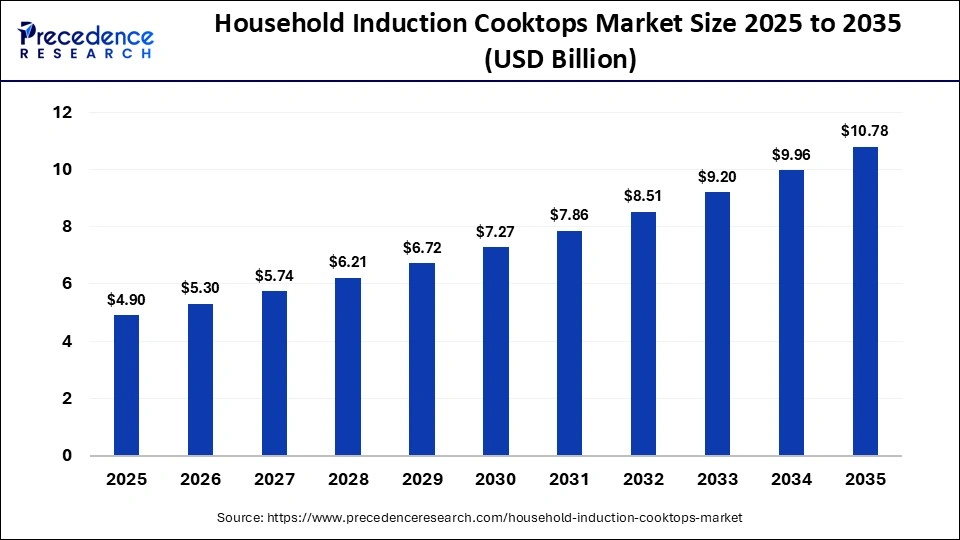
by The global household induction cooktops market is witnessing strong growth, fueled by increasing demand for energy-efficient, safe, and technologically advanced cooking solutions. The market size was valued at USD 4.90 billion in 2025 and is projected to grow from USD 5.30 billion in 2026 to approximately USD 10.78 billion by 2035, expanding at a CAGR of 8.20% during the forecast period.
Induction cooktops use electromagnetic energy to directly heat cookware, offering faster cooking, improved safety, and higher energy efficiency compared to traditional gas and electric stoves. These advantages are driving widespread adoption in modern households globally.
Read Also: Hydrodesulfurization Catalyst Market
Key Market Highlights
- Market expected to reach USD 5.30 billion in 2026
- Forecast to hit USD 10.78 billion by 2035
- Growing at a CAGR of 8.20% (2026–2035)
- North America dominated with 40% market share in 2025
- Built-in cooktops led with 45% share by product type
- Residential applications accounted for 60% share
- Supermarkets & hypermarkets dominated with 45% share
Market Trends
Rise of Smart and Energy-Efficient Cooking
Consumers are increasingly adopting induction cooktops due to their energy efficiency and safety. These appliances consume less power and reduce heat loss, aligning with global sustainability goals.
Growth of Modular and Compact Kitchen Designs
Urbanization and smaller living spaces are driving demand for compact and integrated kitchen appliances. Built-in and modular induction cooktops are gaining traction in modern housing projects.
Expansion of Smart Grid Integration
Next-generation induction cooktops are being integrated with smart grids and time-of-use electricity pricing, enabling optimized energy consumption and cost savings.
Increasing Disposable Income
Rising income levels, especially in emerging economies, are boosting consumer spending on premium kitchen appliances, including induction cooktops.
Impact of Artificial Intelligence on the Market
Artificial intelligence is playing an increasingly important role in enhancing the functionality of induction cooktops. AI-powered systems optimize power usage in real time, adjust temperature automatically, and improve cooking precision.
Additionally, AI integration enables smart features such as auto-cooking programs, safety monitoring, and predictive maintenance, making induction cooktops more user-friendly and efficient.
Market Dynamics
Driver: Rising Demand for Energy-Efficient Appliances
Growing environmental concerns and government initiatives promoting energy-efficient appliances are driving the adoption of induction cooktops. These devices offer faster cooking, reduced energy consumption, and improved safety compared to traditional methods.
Restraint: High Initial Cost and Infrastructure Requirements
The higher upfront cost of induction cooktops and the need for compatible cookware and electrical infrastructure can limit adoption, particularly in developing regions.
Opportunity: Smart Kitchens and Technological Advancements
The emergence of smart kitchens and connected appliances presents significant growth opportunities. Integration with IoT and AI technologies is expected to drive innovation and enhance user experience.
Segment Insights
By Product Type
The built-in induction cooktops segment dominated the market with a 45% share in 2025, driven by increasing adoption of modular kitchen designs and premium housing projects.
Portable induction cooktops held a 38% share and are gaining popularity due to affordability, compact size, and ease of use, especially in smaller households and rental spaces.
Modular cooktops are also witnessing growth due to rising demand for customized kitchen solutions, while commercial cooktops are expanding in professional kitchens due to efficiency and safety benefits.
By Power Capacity
The 1500–3000 watts segment dominated the market with a 50% share, offering an optimal balance between performance and energy efficiency.
Higher-capacity cooktops (above 3000 watts) are gaining traction for heavy-duty cooking applications, while lower-capacity models are preferred for basic household use.
By Application
The residential segment led the market with a 60% share in 2025, driven by increasing adoption of modern cooking appliances in households.
The commercial segment is expected to grow significantly due to rising demand for energy-efficient cooking solutions in restaurants and cloud kitchens.
By Distribution Channel
Supermarkets and hypermarkets dominated the market with a 45% share, offering a wide range of products and hands-on shopping experiences.
Online retailers accounted for 35% share and are expected to grow rapidly, driven by convenience, competitive pricing, and access to product reviews.
Specialty stores also play a key role by offering premium products and expert guidance.
Regional Insights
North America: Market Leader
North America held the largest share of 40% in 2025, supported by strong consumer awareness, advanced infrastructure, and government initiatives promoting energy-efficient appliances.
The U.S. market is particularly strong due to electrification policies and incentives encouraging the adoption of induction cooking.
Europe: Second-Largest Market
Europe accounted for a significant share, driven by strict environmental regulations and a strong focus on sustainable energy solutions.
Asia Pacific: Fastest Growing Region
Asia Pacific is expected to witness the fastest growth due to rapid urbanization, rising disposable income, and increasing adoption of modern kitchen appliances.
Countries like China and India are emerging as key markets, supported by expanding middle-class populations and improving access to electricity.
Competitive Landscape
The household induction cooktops market is highly competitive, with major players focusing on product innovation, energy efficiency, and smart features. Key companies include:
- Whirlpool Corporation
- LG Electronics Inc.
- Panasonic Corporation
- Philips
- Samsung Electronics
- Bajaj Electricals Ltd.
- TTK Prestige Ltd.
- Electrolux AB
These companies are investing in advanced technologies and expanding their product portfolios to meet evolving consumer demands.
Recent Industry Developments
- Governments are promoting induction cooking to reduce reliance on fossil fuels and improve energy efficiency.
- Rising LPG shortages in some regions have accelerated the adoption of induction cooktops as an alternative cooking solution.
- Manufacturers are introducing smart, multi-functional cooktops with integrated ventilation and advanced controls.
Conclusion
The household induction cooktops market is set for strong growth, driven by increasing demand for energy-efficient, safe, and smart cooking solutions. Technological advancements, rising disposable income, and the shift toward modern kitchen designs are transforming the market landscape.
As sustainability becomes a global priority and smart home adoption increases, induction cooktops are expected to play a crucial role in the future of household cooking, ensuring convenience, efficiency, and environmental benefits.
Get Sample Link: https://www.precedenceresearch.com/sample/8286
For inquiries regarding discounts, bulk purchases, or customization requests, please contact us at [email protected]
