
 by
by The global AI in networking and edge platform market is witnessing exponential growth as enterprises increasingly demand real-time data processing, low latency, and intelligent network automation. The market was valued at USD 12.30 billion in 2025 and is projected to grow from USD 15.04 billion in 2026 to USD 92.08 billion by 2035, expanding at a remarkable CAGR of 22.30% during the forecast period.
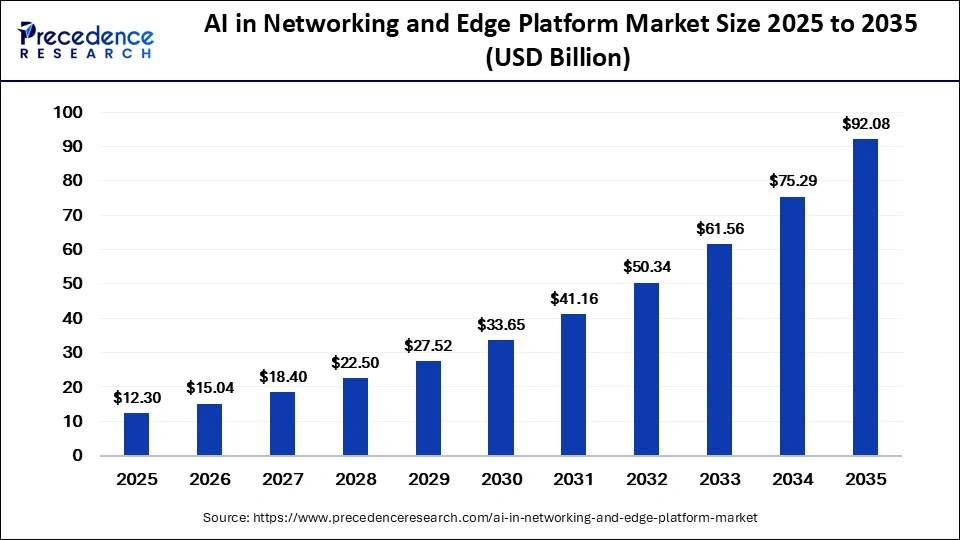
The surge in connected devices, rising data traffic, and rapid deployment of 5G networks are key factors accelerating market growth. Organizations are adopting AI-driven networking solutions to enhance performance, improve security, and enable real-time decision-making across distributed environments.
Read Also: Biosafety and Biosecurity Market
Quick Insights
The AI in networking and edge platform market generated USD 12.30 billion in 2025 and is expected to reach USD 92.08 billion by 2035, growing at a CAGR of 22.30%. Hardware dominated the market with a 52% share in 2025, followed by software at 30% and services at 18%. Cloud deployment led with 52% share, while telecommunications emerged as the leading end-use industry with 33%, highlighting strong demand from 5G infrastructure and network modernization initiatives.
How is Artificial Intelligence Redefining Networking and Edge Platforms?
Artificial intelligence is transforming networking by enabling autonomous, self-optimizing systems capable of real-time decision-making. AI-powered platforms analyze massive volumes of network data, detect anomalies, and automatically adjust configurations to optimize performance and reduce downtime.
Additionally, AI at the edge allows data processing closer to its source, reducing latency and improving efficiency. This is particularly beneficial for applications such as autonomous vehicles, industrial automation, and smart cities, where real-time responsiveness is critical.
What are the Key Growth Drivers of the Market?
The primary driver is the increasing demand for real-time analytics and low-latency processing across industries. The rapid growth of IoT devices generating continuous data streams requires advanced AI-powered edge platforms for efficient data handling.
Another major factor is the global rollout of 5G networks, enabling high-speed connectivity and supporting AI-driven network optimization. Rising concerns around data privacy are also pushing organizations to process data locally at the edge rather than relying solely on centralized cloud systems.
What Opportunities and Trends are Shaping the Market?
Is Edge AI Becoming Essential for Real-Time Applications?
Yes, edge AI is becoming a critical component for applications requiring instant data processing, such as smart manufacturing, autonomous systems, and connected healthcare environments.
Are Hybrid Cloud-Edge Architectures Gaining Popularity?
Absolutely. Enterprises are increasingly adopting hybrid models that combine cloud scalability with edge efficiency, enabling better workload distribution and performance optimization.
Is AI-Driven Security a Key Market Trend?
Yes, AI-powered security systems are gaining traction as cyber threats increase. These systems can detect anomalies, identify intrusions, and respond to threats in real time, ensuring robust protection for distributed networks.
Expert Insight
A Principal Consultant at Precedence Research comments:
“AI in networking and edge platforms is transforming digital infrastructure by enabling intelligent, autonomous systems. As real-time data processing becomes critical, this market will play a central role in shaping future connectivity ecosystems.”
Regional Analysis
North America dominates the AI in networking and edge platform market due to advanced technological infrastructure, early adoption of AI, and strong investments in data centers and cloud computing.
Asia Pacific is expected to witness the fastest growth, driven by rapid digital transformation, increasing IoT adoption, and expanding telecom infrastructure in countries such as China and India.
Europe also remains a key market, supported by regulatory initiatives and growing investments in AI-driven networking technologies.
Segmental Analysis
By Component
| Component | 2025 Share | 2035 Forecast |
|---|---|---|
| Hardware | 52% | 42% |
| Software | 30% | 38% |
| Services | 18% | 20% |
Hardware dominated due to increased adoption of AI-enabled devices such as edge servers and intelligent networking equipment, while software is expected to grow rapidly with the rise of AI-driven analytics platforms.
By Deployment Mode
| Deployment Mode | 2025 Share | 2035 Forecast |
|---|---|---|
| Cloud | 52% | 46% |
| On-Premises | 28% | 22% |
| Hybrid | 20% | 32% |
Cloud deployment leads due to scalability and cost efficiency, while hybrid models are gaining traction for balancing performance and data control.
By Infrastructure Type
| Infrastructure Type | 2025 Share | 2035 Forecast |
|---|---|---|
| Hyperscale Data Centers | 46% | 36% |
| Enterprise Data Centers | 32% | 26% |
| Edge Data Centers | 22% | 38% |
Edge data centers are expected to witness the fastest growth as organizations shift toward decentralized computing and real-time processing.
By Application
| Application | 2025 Share | 2035 Forecast |
|---|---|---|
| Network Optimization | 28% | 24% |
| Security & Threat Detection | 20% | 23% |
| Traffic Management | 17% | 15% |
| Edge Analytics / Real-time AI | 18% | 20% |
| Predictive Maintenance | 12% | 14% |
Network optimization dominates the segment, while security and edge analytics are emerging as high-growth areas.
Competitive Landscape and Key Companies
Key players operating in the AI in networking and edge platform market include:
- Cisco Systems, Inc.
- Juniper Networks
- NVIDIA Corporation
- Intel Corporation
- Hewlett Packard Enterprise
- IBM Corporation
- Huawei Technologies
- Ericsson
- Nokia
- Arista Networks
These companies are focusing on AI-driven networking solutions, edge computing infrastructure, and strategic partnerships to strengthen their global presence.
What Challenges are Impacting Market Growth?
Are High Infrastructure Costs a Barrier?
Yes, deploying AI-enabled networking infrastructure requires significant investment in hardware, data centers, and integration services, which can limit adoption for smaller enterprises.
Is Integration Complexity Slowing Adoption?
Integrating AI into existing network environments requires specialized expertise and interoperability, posing challenges for large-scale deployment.
Case Study: AI-Powered Edge Networks in Smart Cities
Smart city projects are increasingly leveraging AI-powered edge platforms to manage traffic, energy consumption, and public safety systems. By processing data locally, these systems enable real-time decision-making, reduce latency, and improve urban efficiency—demonstrating the transformative potential of edge AI in large-scale environments.
Conclusion
The AI in networking and edge platform market is poised for exponential growth as organizations transition toward intelligent, decentralized computing systems. With advancements in AI, 5G, and IoT, the market is set to redefine global networking infrastructure over the next decade.
Get Sample Link: https://www.precedenceresearch.com/sample/8344
For inquiries regarding discounts, bulk purchases, or customization requests, please contact us at [email protected]
