
 by
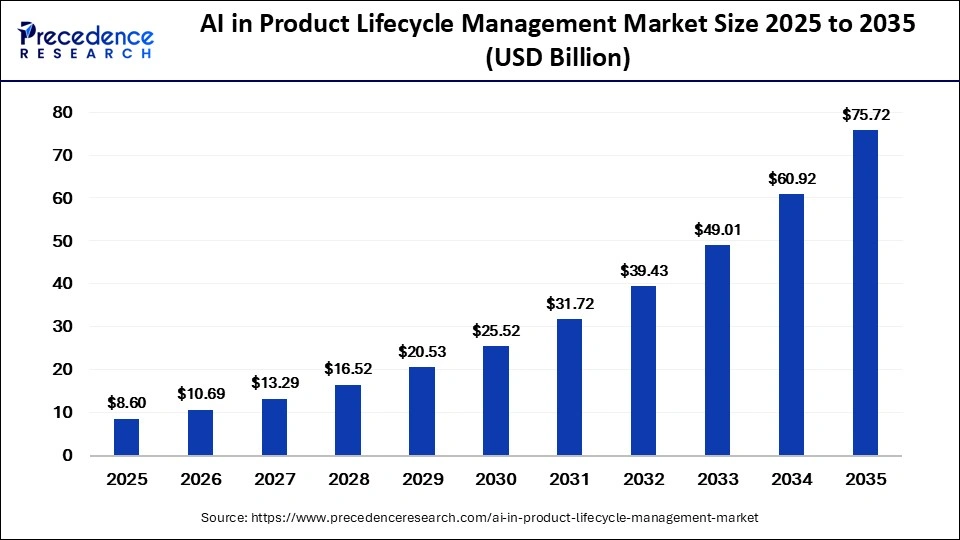
by The global AI in Product Lifecycle Management market is expected to grow from USD 10.69 billion in 2026 to USD 75.72 billion by 2035, driven by generative AI, cloud-based PLM solutions, digital twins, predictive analytics, and Industry 4.0 initiatives.
Read Also: Human Centric Lighting Market
Why AI is Becoming the Backbone of Modern Product Lifecycle Management
Traditional PLM systems primarily focus on managing product data and engineering workflows. However, modern enterprises require far more than data storage and process management. They need intelligent systems capable of predicting outcomes, automating decisions, and enhancing collaboration across global teams.
AI-powered PLM platforms are enabling organizations to:
- Automate engineering and design processes
- Improve product quality through predictive insights
- Accelerate product development cycles
- Enhance collaboration across departments
- Optimize supply chain operations
- Enable real-time decision-making
- Reduce operational risks and costs
As businesses strive to launch innovative products faster while maintaining quality and compliance, AI is becoming a critical component of next-generation PLM strategies.
Key Market Highlights
- North America accounted for 38% of global revenue in 2025.
- Asia Pacific is expected to grow at the fastest CAGR of 29.6% through 2035.
- The software segment held a dominant 76% market share in 2025.
- Cloud-based deployment captured 56% of total market revenue.
- Machine learning led the technology segment with a 31% share.
- Generative AI is forecast to grow at the fastest CAGR of 37.2%.
- Product Design & Development accounted for 29% market share.
- Electronics & Semiconductor is expected to witness the fastest growth at 29.4% CAGR.
Generative AI is Revolutionizing Product Engineering
One of the most influential developments in the AI PLM market is the emergence of generative AI.
Generative AI enables engineers and product teams to create product designs, technical documentation, simulations, and specifications using simple natural language instructions. Instead of manually developing multiple design iterations, engineers can leverage AI to generate optimized concepts in minutes.
This capability significantly accelerates innovation cycles and allows organizations to focus more on strategic decision-making and less on repetitive design tasks.
As a result, the generative AI segment is projected to expand at an impressive CAGR of 37.2%, making it the fastest-growing technology category within the market.
Digital Twins and Simulation Driving Smart Manufacturing
Digital twin technology is emerging as a major catalyst for market growth.
A digital twin creates a virtual replica of a physical product, process, or system. Combined with AI, digital twins enable manufacturers to:
- Simulate product performance
- Identify design flaws before production
- Optimize manufacturing processes
- Predict maintenance requirements
- Reduce operational downtime
The Digital Twin & Simulation segment represented 22% of market revenue in 2025 and is expected to grow at a CAGR of 27.8% over the forecast period. As smart factories become more common, demand for AI-powered digital twins is expected to surge.
Cloud-Based PLM Platforms Fueling Market Expansion
The shift toward cloud computing continues to reshape the PLM ecosystem.
Cloud-based PLM solutions accounted for 56% of market share in 2025 and are expected to grow at a CAGR of 28.6% through 2035. These platforms provide businesses with:
- Real-time collaboration capabilities
- Reduced infrastructure costs
- Greater scalability
- Faster deployment cycles
- Seamless AI integration
- Global accessibility
As remote work and distributed engineering teams become increasingly common, cloud-native PLM platforms are becoming the preferred choice for organizations seeking flexibility and efficiency.
Market Dynamics
Driver: Industry 4.0 and Digital Transformation
The adoption of Industry 4.0 technologies is significantly boosting demand for AI-enabled PLM solutions.
Manufacturers are increasingly integrating artificial intelligence, IoT, automation, and advanced analytics into product development workflows to improve efficiency and competitiveness. AI-powered PLM systems help organizations manage growing product complexity while accelerating innovation and reducing costs.
Restraint: Complexity of AI Integration
Despite strong growth prospects, implementing AI-driven PLM solutions can be challenging.
Organizations often face obstacles related to:
- Legacy system integration
- Data quality issues
- High implementation costs
- Workforce training requirements
- Security and compliance concerns
These challenges can slow adoption, particularly among small and medium-sized enterprises.
Opportunity: AI-Driven Product Portfolio Management
Businesses are increasingly using AI to optimize product portfolios and investment decisions.
AI-powered portfolio management tools enable organizations to:
- Evaluate product performance
- Forecast market demand
- Identify profitable opportunities
- Improve resource allocation
- Reduce investment risks
The Product Portfolio Management segment is expected to grow at the fastest application CAGR of 28.1%, highlighting its increasing strategic importance.
Segment Analysis
Software Segment Leads the Market
The software segment generated approximately USD 6.54 billion in revenue during 2025 and accounted for 76% of total market share.
Growing demand for AI-enabled product intelligence, cloud-native PLM platforms, and digital engineering solutions continues to drive software adoption across industries. The segment is projected to reach nearly USD 54.52 billion by 2035.
Services Segment Witnessing Rapid Growth
As enterprises implement increasingly sophisticated AI solutions, demand for consulting, integration, and managed services is accelerating.
The services segment is expected to expand at a CAGR of 27.1%, supported by growing implementation complexity and the need for specialized expertise.
Machine Learning Maintains Market Leadership
Machine learning accounted for 31% of total technology revenue in 2025, making it the largest AI technology segment.
Machine learning algorithms support:
- Predictive engineering
- Product performance forecasting
- Manufacturing optimization
- Change management
- Quality improvement
Its ability to generate actionable insights from large datasets makes it an essential component of modern PLM systems.
End-Use Industry Insights
Industrial Manufacturing Dominates Adoption
Industrial manufacturing remains one of the largest adopters of AI-powered PLM solutions.
Manufacturers are using AI to streamline operations, improve product quality, and accelerate innovation across the entire product lifecycle. Industry 4.0 initiatives continue to drive investments in intelligent PLM technologies.
Electronics & Semiconductor Industry Emerging as a Growth Leader
The electronics and semiconductor segment is forecast to grow at the fastest CAGR of 29.4% through 2035.
Increasing semiconductor complexity, rapid product innovation cycles, and growing demand for AI-driven engineering tools are accelerating adoption across this sector. Companies are increasingly leveraging AI-powered PLM systems to manage intricate design processes and maintain product quality.
Regional Outlook
North America Leads Global Market
North America held the largest market share of 38% in 2025, driven by advanced manufacturing infrastructure, strong technology adoption, and the presence of leading software providers.
The region continues to benefit from:
- High Industry 4.0 adoption
- Strong cloud infrastructure
- Significant R&D investments
- Rapid AI implementation across industries
The United States remains the primary contributor to regional growth.
Asia Pacific Emerging as the Fastest-Growing Region
Asia Pacific is expected to witness the highest CAGR of 29.6% through 2035.
Rapid industrialization, expanding manufacturing capabilities, and growing investments in digital transformation are driving adoption across countries such as China, Japan, South Korea, and India. Government initiatives promoting smart manufacturing are further accelerating market growth.
Europe Strengthening Its Digital Manufacturing Ecosystem
Europe accounted for 29% of global revenue in 2025 and remains a significant market for AI-enabled PLM solutions.
The region benefits from strong regulatory frameworks, advanced manufacturing industries, and increasing adoption of artificial intelligence in engineering and product development processes.
Competitive Landscape
Several technology leaders are actively investing in AI-driven PLM innovations to strengthen their market position.
Key companies operating in the market include:
- Siemens Digital Industries Software
- PTC
- Dassault Systèmes
- Autodesk
- SAP
- Oracle
- IBM
- Hexagon AB
- Ansys
These companies are focused on expanding AI capabilities, cloud integration, digital twins, and generative AI features within their PLM platforms.
Recent Industry Developments
In February 2026, Flinn introduced an AI-driven software platform designed to automate regulatory and quality workflows in the medical technology sector. The solution helps manufacturers improve compliance management, reduce administrative burdens, and accelerate product innovation.
In April 2026, PTC launched the Windchill AI Assistant, a generative AI-powered feature integrated into its Windchill PLM platform. The assistant enables users to quickly locate, interpret, and work with product information using a natural language interface, significantly improving productivity and reducing search times.
Conclusion
The AI in Product Lifecycle Management market is rapidly transforming how organizations design, develop, manufacture, and manage products. From generative AI and machine learning to digital twins and predictive analytics, intelligent technologies are enabling unprecedented levels of innovation, efficiency, and collaboration.
With the market expected to grow from USD 10.69 billion in 2026 to USD 75.72 billion by 2035, organizations that embrace AI-powered PLM solutions will be better positioned to accelerate product innovation, improve operational performance, and maintain a competitive advantage in an increasingly digital industrial landscape.
Get a Sample Copy: https://www.precedenceresearch.com/sample/8440
For inquiries regarding discounts, bulk purchases, or customization requests, please contact us at [email protected]
