
 by
by The global human centric lighting market is projected to grow from USD 5.58 billion in 2025 to USD 75 billion by 2035, driven by AI-powered smart lighting, advanced LED systems, smart buildings, wellness-focused infrastructure, and sustainable energy-efficient solutions.
Human Centric Lighting Market: AI-Powered Smart Lighting Revolutionizing Wellness and Sustainable Infrastructure
The global human centric lighting market is witnessing remarkable growth as organizations increasingly prioritize employee wellness, smart infrastructure, sustainable building technologies, and intelligent lighting ecosystems. Human centric lighting (HCL) systems are rapidly transforming workplaces, healthcare facilities, educational institutions, smart homes, and commercial buildings by aligning artificial lighting with natural human circadian rhythms.
According to Precedence Research, the global human centric lighting market size was valued at USD 5.58 billion in 2025 and is projected to reach approximately USD 75.00 billion by 2035, expanding at a CAGR of 29.68% from 2026 to 2035.
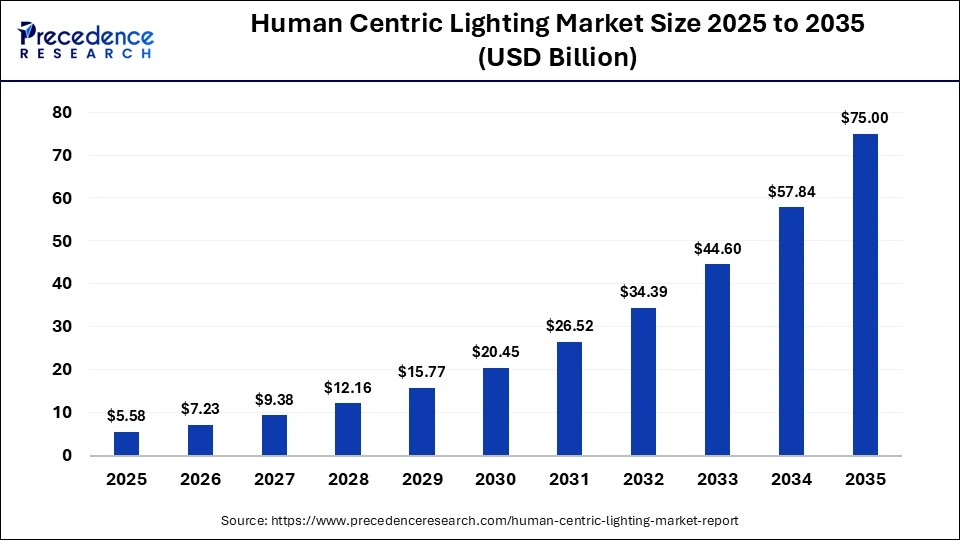
The growing integration of AI-powered automation, IoT-enabled lighting infrastructure, smart building technologies, and advanced LED systems is accelerating market expansion globally.
Understanding Human Centric Lighting
Human centric lighting refers to intelligent lighting systems designed to improve human health, productivity, comfort, and emotional well-being by replicating natural daylight patterns. Unlike conventional lighting systems that focus only on illumination, HCL systems dynamically adjust color temperature, brightness, and intensity throughout the day to support biological and psychological needs.
Modern human centric lighting systems incorporate:
- Tunable white LEDs
- Smart sensors
- AI-powered automation
- IoT connectivity
- Cloud-based lighting controls
- Circadian rhythm optimization
- Adaptive environmental sensing
These systems are increasingly used across commercial offices, hospitals, schools, industrial facilities, retail spaces, hospitality environments, and residential buildings to improve mood, focus, sleep quality, and operational efficiency.
Key Market Highlights
- The human centric lighting market was valued at USD 5.58 billion in 2025.
- The market is projected to reach USD 75 billion by 2035.
- The market is expected to grow at a CAGR of 29.68%.
- Europe accounted for 39% of global market share in 2025.
- Commercial applications dominated the market with 60% share.
- Fixtures emerged as the leading product segment globally.
- Asia-Pacific is expected to witness the fastest growth during the forecast period.
Growing Focus on Employee Wellness Driving Market Growth
One of the strongest growth drivers for the human centric lighting market is the increasing emphasis on employee well-being and workplace productivity.
Organizations worldwide are recognizing the relationship between lighting quality and human performance. Human centric lighting systems help regulate circadian rhythms, reduce fatigue, improve concentration, and create healthier work environments.
Benefits of HCL systems include:
- Improved cognitive performance
- Better concentration and alertness
- Reduced eye strain
- Enhanced mood and comfort
- Improved sleep quality
- Lower absenteeism
- Increased workplace productivity
Modern commercial environments increasingly deploy dynamic lighting systems that simulate natural daylight cycles to optimize employee performance and wellness.
AI and Smart Automation Revolutionizing Lighting Infrastructure
Artificial intelligence is rapidly transforming the human centric lighting industry.
AI-powered HCL systems can automatically analyze environmental conditions, occupancy behavior, daylight availability, and user preferences to optimize lighting in real time.
According to Precedence Research, AI integration significantly improves the efficiency and functionality of human centric lighting systems by automatically adjusting color temperature and intensity to align with circadian rhythms.
AI-enabled lighting systems provide capabilities such as:
- Adaptive brightness adjustment
- Dynamic color temperature tuning
- Occupancy-based automation
- Energy optimization
- Predictive maintenance
- Personalized lighting profiles
- Smart scheduling
Researchers are also exploring advanced asset management and predictive maintenance strategies for intelligent lighting systems to improve operational efficiency and user comfort.
Smart Buildings and Sustainable Infrastructure Fueling Demand
The rapid expansion of smart buildings and sustainable infrastructure projects is significantly accelerating market growth.
Governments and enterprises worldwide are heavily investing in:
- Smart offices
- Green buildings
- Sustainable infrastructure
- Smart city initiatives
- Intelligent healthcare facilities
- Connected residential environments
Human centric lighting is increasingly becoming a core component of modern building automation systems due to its ability to improve occupant wellness while supporting sustainability goals.
The integration of smart lighting with building management systems enables:
- Real-time monitoring
- Automated energy optimization
- Remote lighting control
- Environmental analytics
- Occupancy management
The increasing deployment of connected lighting infrastructure is expected to remain a major long-term growth driver for the market.
Advanced LED Technology Accelerating Innovation
Advanced LED systems form the technological foundation of modern human centric lighting solutions.
Sophisticated tunable LED technologies allow smooth adjustments in correlated color temperature (CCT) and brightness, enabling lighting systems to mimic natural daylight conditions more accurately.
Advantages of LED-based HCL systems include:
- Lower energy consumption
- Longer operational lifespan
- Flexible lighting customization
- Improved color rendering
- Reduced maintenance costs
- Enhanced environmental sustainability
- Smart automation compatibility
The growing adoption of energy-efficient LED infrastructure across residential and commercial sectors is creating significant growth opportunities for lighting manufacturers globally.
Segmental Analysis
By Product
Fixtures Segment Dominates the Market
The fixtures segment accounted for the largest market share in 2025 due to its central role in delivering biologically optimized illumination.
Modern HCL fixtures increasingly integrate:
- Tunable white LEDs
- Smart sensors
- Wireless connectivity
- AI-powered controls
- Motion detection systems
Their ability to directly influence occupant comfort and productivity continues driving strong global demand.
Services Segment Witnessing Rapid Growth
The services segment is expected to witness the fastest growth during the forecast period due to increasing demand for:
- Lighting audits
- Design consulting
- Smart system integration
- Maintenance services
- Software upgrades
- Energy optimization
As HCL systems become more technologically advanced, organizations increasingly require specialized implementation and support services.
By Installation Type
New Installation Segment Leads the Market
The new installation segment accounted for 68% of total market share in 2025.
New construction projects increasingly integrate human centric lighting systems during initial infrastructure development to maximize:
- Energy efficiency
- Smart building compatibility
- Wellness optimization
- Long-term operational performance
Commercial offices, hospitals, educational institutions, and smart residential developments continue driving strong demand for new HCL installations.
Retrofit Segment Growing Rapidly
The retrofit segment is expected to witness the fastest CAGR during the forecast period as organizations upgrade legacy lighting systems with intelligent and energy-efficient HCL technologies.
Retrofit solutions provide:
- Lower implementation costs
- Faster deployment
- Reduced infrastructure disruption
- Improved energy efficiency
- Enhanced occupant comfort
By Application
Commercial Segment Holds Largest Market Share
The commercial segment dominated the market with 60% share in 2025.
Corporate offices, retail environments, hospitality facilities, and industrial workplaces increasingly deploy HCL systems to improve employee productivity and customer experience.
Commercial adoption is also driven by:
- ESG initiatives
- Employee wellness programs
- Smart office transformation
- Sustainability goals
- Energy efficiency regulations
Residential Segment Expanding Rapidly
The residential segment is expected to witness substantial growth as consumers increasingly adopt smart home technologies and wellness-oriented lighting systems.
Homeowners increasingly seek lighting systems capable of:
- Improving sleep quality
- Enhancing mood
- Supporting circadian health
- Delivering personalized lighting experiences
Regional Insights
Europe
Europe dominated the global human centric lighting market in 2025 with approximately 39% revenue share.
The region benefits from:
- Strong sustainability regulations
- Advanced smart building infrastructure
- High wellness awareness
- Significant R&D investments
- Strict energy efficiency standards
Countries such as Germany, the UK, and France continue leading adoption of intelligent lighting infrastructure.
North America
North America is witnessing strong market growth driven by increasing investments in:
- Smart buildings
- Healthcare modernization
- AI-powered automation
- Workplace wellness solutions
- Connected infrastructure
The United States remains a major innovation hub for intelligent lighting technologies.
Asia-Pacific
Asia-Pacific is expected to witness the fastest growth during the forecast period due to:
- Rapid urbanization
- Expanding smart city projects
- Rising smart home adoption
- Growing commercial construction
- Increasing awareness regarding wellness technologies
China, Japan, South Korea, and India are emerging as major growth hubs for advanced lighting technologies.
Competitive Landscape
The human centric lighting market is highly competitive and innovation-driven. Major companies are focusing on AI integration, IoT connectivity, advanced LED systems, and sustainability-focused infrastructure solutions.
Leading industry participants include:
- Signify
- Samsung Electronics
- Legrand
- Acuity Brands
- Zumtobel Group
- Lutron Electronics
These companies are increasingly investing in:
- AI-powered lighting controls
- Smart building integration
- Circadian rhythm optimization
- IoT-enabled infrastructure
- Tunable LED systems
- Sustainability-focused lighting technologies
Conclusion
The human centric lighting market is entering a transformative growth phase fueled by AI-powered automation, smart infrastructure expansion, advanced LED technologies, and increasing awareness regarding wellness-centered lighting solutions.
From corporate offices and hospitals to smart homes and educational institutions, organizations worldwide are increasingly adopting intelligent lighting systems to improve health, productivity, sustainability, and energy efficiency.
With the market projected to surpass USD 75 billion by 2035, the industry presents significant opportunities for lighting manufacturers, AI technology providers, smart building developers, and infrastructure companies seeking to capitalize on the future of intelligent and human-focused lighting ecosystems.
Get a Sample Copy: https://www.precedenceresearch.com/sample/8227
For inquiries regarding discounts, bulk purchases, or customization requests, please contact us at [email protected]
