
 by
by The global biosafety and biosecurity market is witnessing steady and strategic expansion as governments, healthcare institutions, and research organizations intensify efforts to mitigate biological risks. The market size was valued at USD 16.50 billion in 2025 and is projected to grow from USD 18.12 billion in 2026 to approximately USD 42.02 billion by 2035, expanding at a CAGR of 9.80% during the forecast period.
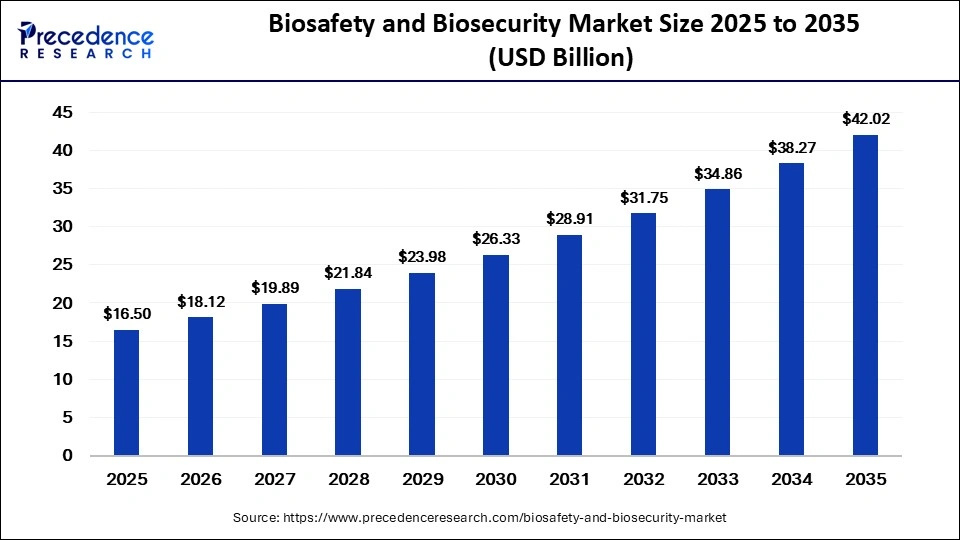
The increasing frequency of infectious disease outbreaks, rising concerns over bio-terrorism, and growing investments in biotechnology research are key factors driving demand for advanced biosafety solutions. As global awareness around biological risk management continues to grow, biosafety systems are becoming essential across healthcare, research, agriculture, and defense sectors.
Read Also: AI Ethics and Governance Solutions Market
Quick Insights
The biosafety and biosecurity market generated USD 16.50 billion in 2025 and is expected to reach USD 42.02 billion by 2035, growing at a CAGR of 9.80%. North America dominated the market in 2025 due to strong healthcare infrastructure and regulatory frameworks, while Asia Pacific is expected to grow at the fastest rate. Biocides and disinfectants led the product segment with a 28% share, followed by personal protective equipment at 22%. Government and regulatory bodies accounted for the largest end-user share at 26%, reflecting strong institutional demand.
How is Artificial Intelligence Transforming Biosafety and Biosecurity?
Artificial intelligence is playing a transformative role in biosafety by enabling real-time monitoring and predictive analytics. AI-powered systems can detect anomalies in laboratory environments, monitor containment systems, and provide early warnings for potential biological hazards, significantly improving response efficiency.
Moreover, AI integration with biosurveillance platforms and cloud-based systems allows continuous monitoring, predictive maintenance, and rapid pathogen detection. These advancements are shifting biosafety from static containment systems to dynamic, intelligent ecosystems capable of adapting to emerging threats.
What are the Key Growth Drivers of the Biosafety and Biosecurity Market?
The market is primarily driven by the increasing incidence of infectious diseases and global health emergencies, which are pushing governments and organizations to invest in advanced biosafety infrastructure and surveillance systems.
Additionally, the expansion of biotechnology, pharmaceutical research, and synthetic biology is creating sustained demand for containment systems, monitoring tools, and safety protocols. Strict regulatory frameworks and rising awareness of biosafety standards are further accelerating adoption globally.
What Opportunities and Trends are Shaping the Market?
Is the Rise of Modular Laboratories Driving Market Expansion?
Yes, the growing adoption of modular BSL-2 and BSL-3 laboratories is enabling rapid deployment of biosafety infrastructure, particularly during health emergencies.
Are Environmental Surveillance Systems Emerging as a Key Trend?
Absolutely. The integration of wastewater and air monitoring systems with clinical diagnostics is enhancing early detection capabilities and strengthening public health responses.
Is Cyberbiosecurity Becoming a Critical Focus Area?
Yes, with increasing digitization of biological data, cyberbiosecurity is gaining importance to protect sensitive genetic information and prevent misuse.
Expert Insight
A Principal Consultant at Precedence Research states:
“Biosafety and biosecurity are evolving into intelligent, interconnected systems. The integration of AI, real-time surveillance, and digital platforms will redefine global preparedness against biological threats.”
Regional Analysis
North America dominated the global biosafety and biosecurity market in 2025, supported by advanced healthcare infrastructure, strong R&D capabilities, and significant government funding.
Asia Pacific is expected to witness the fastest growth, driven by expanding healthcare infrastructure, increasing investments in life sciences research, and rising awareness of infectious disease preparedness in countries such as China and India.
Europe also remains a key market due to stringent regulatory standards and a strong focus on public health safety.
Segmental Analysis
By Product Type
| Product Type | 2025 Share | 2035 Forecast |
|---|---|---|
| Biocides & Disinfectants | 28% | 24% |
| Personal Protective Equipment (PPE) | 22% | 18% |
| Detection & Monitoring Equipment | 20% | 26% |
| Decontamination Systems | 18% | 20% |
| Others | 12% | 12% |
Biocides and disinfectants dominated the market due to widespread use in infection control, while detection and monitoring equipment is expected to grow rapidly due to technological advancements.
By End-User
| End User | 2025 Share |
|---|---|
| Government & Regulatory Bodies | 26% |
| Healthcare Institutions | 24% |
| Agriculture Sector | 18% |
| Research & Academia | 16% |
| Private & Commercial Sector | 16% |
Government agencies dominate due to strict regulations and national biosecurity initiatives.
Competitive Landscape and Key Companies
Key players operating in the biosafety and biosecurity market include:
- Thermo Fisher Scientific
- Danaher Corporation
- Merck KGaA
- Sartorius AG
- Eppendorf AG
- 3M Company
- Bio-Rad Laboratories
- Honeywell International Inc.
- Abbott Laboratories
- Steris plc
- Getinge AB
- Labconco Corporation
These companies are focusing on innovation, smart monitoring systems, and advanced containment technologies to strengthen their market position.
What Challenges are Impacting Market Growth?
Are High Costs Limiting Market Adoption?
Yes, the high cost of establishing containment laboratories and advanced monitoring systems remains a significant barrier, especially in developing regions.
Do Regulatory Complexities Slow Market Expansion?
Strict regulatory requirements, while essential for safety, can increase compliance burdens and delay implementation.
Case Study: Strengthening Biosafety Infrastructure
Countries across Asia Pacific have significantly increased investments in biosafety laboratories and surveillance systems following recent global health crises. These initiatives have improved outbreak response capabilities and strengthened public health resilience, highlighting the importance of proactive biosafety investments.
Conclusion
The biosafety and biosecurity market is becoming a cornerstone of global health security. With rising biological threats, technological advancements, and increasing regulatory focus, the market is poised for sustained growth through 2035.
Get Sample Link: https://www.precedenceresearch.com/sample/8343
For inquiries regarding discounts, bulk purchases, or customization requests, please contact us at [email protected]
