
 by
by The global High Performance Computing for AI market is undergoing unprecedented expansion as organizations accelerate investments in advanced computing infrastructure to support next-generation artificial intelligence workloads. The market was valued at USD 17.30 billion in 2025 and is projected to grow from USD 22.21 billion in 2026 to USD 210.72 billion by 2035, expanding at a remarkable CAGR of 28.40% during the forecast period.
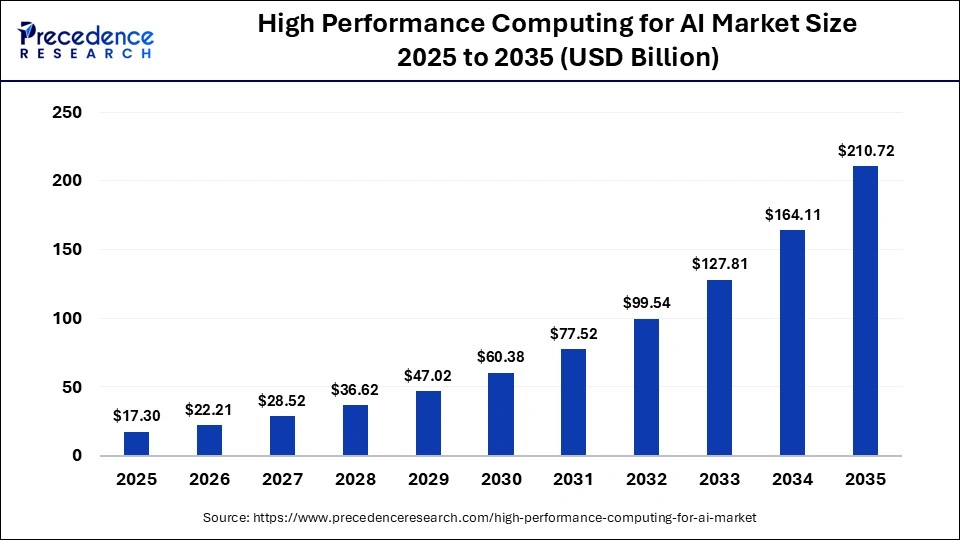
This rapid growth is fueled by the surge in generative AI, deep learning models, and data-intensive applications requiring massive computational power. From hyperscale data centers to AI-driven enterprises, high-performance computing (HPC) is becoming the backbone of modern digital transformation.
Get Sample Link: https://www.precedenceresearch.com/sample/8346
Quick Insights
The high performance computing for AI market generated USD 17.30 billion in 2025 and is expected to reach USD 210.72 billion by 2035, growing at a CAGR of 28.40%. North America dominated the market with a 40% share in 2025, while Asia Pacific is expected to grow at the fastest rate. GPUs led the HPC technology segment with 40% share, followed by CPUs at 25%. Cloud-based HPC solutions accounted for 45% of the market, and IT & telecommunications emerged as the leading end-use industry with a 25% share.
How is Artificial Intelligence Transforming High Performance Computing?
Artificial intelligence is not only a driver of HPC demand but also a key enabler of its evolution. AI-powered systems are optimizing workload distribution, improving scheduling efficiency, and enhancing system performance through predictive analytics. This allows organizations to maximize computing resources while reducing operational inefficiencies.
Additionally, AI is enabling intelligent automation within HPC environments, including anomaly detection, system optimization, and energy efficiency improvements. This convergence of AI and HPC is accelerating innovation across industries, from healthcare research to autonomous systems and financial modeling.
What are the Key Growth Drivers of the High Performance Computing for AI Market?
The primary driver is the rapid adoption of AI applications across industries that require large-scale computing capabilities. Training complex models such as large language models (LLMs), running real-time analytics, and enabling generative AI applications are pushing organizations to invest heavily in HPC infrastructure.
Another key factor is the increasing demand for data analytics and real-time processing. As enterprises generate vast volumes of structured and unstructured data, HPC systems are essential for extracting insights quickly and efficiently.
What Opportunities and Trends are Shaping the Market?
Is Cloud-Based HPC Driving Market Expansion?
Yes, cloud-based HPC solutions are dominating due to their scalability, flexibility, and cost efficiency. Organizations can access powerful computing resources without heavy upfront investments, making cloud HPC ideal for dynamic AI workloads.
Are AI Accelerators Creating New Growth Opportunities?
Absolutely. GPUs, TPUs, and FPGAs are revolutionizing AI computing by enabling faster processing and improved efficiency. These specialized processors are becoming essential for handling complex AI workloads and large-scale model training.
Is Hybrid HPC Architecture Emerging as a Key Trend?
Yes, hybrid HPC solutions are gaining traction as they allow organizations to balance on-premise control with cloud scalability, optimizing performance and cost efficiency.
Expert Insight
A Principal Consultant at Precedence Research states:
“High-performance computing is no longer confined to scientific research—it has become the engine powering the AI economy. Organizations that invest in scalable, AI-ready infrastructure will define the next decade of innovation.”
Regional Analysis
North America dominated the global HPC for AI market in 2025, supported by advanced technological infrastructure, strong presence of leading tech companies, and significant investments in AI research and data centers.
Asia Pacific is expected to grow at the fastest rate due to rapid digital transformation, increasing AI adoption, and rising investments in cloud and high-performance computing infrastructure in countries such as China and India.
Europe also represents a significant market, driven by advancements in AI research, industrial automation, and government initiatives supporting digital innovation.
Segmental Analysis
By HPC Technology
| HPC Technology | 2025 Share | Growth Outlook |
|---|---|---|
| GPUs | 40% | Dominant |
| CPUs | 25% | Stable Growth |
| TPUs | 15% | Fastest Growing |
| FPGAs | 10% | Niche Applications |
| Quantum Computing | 10% | Emerging |
GPUs dominate due to their parallel processing capabilities, while TPUs are expected to witness the fastest growth due to their efficiency in deep learning applications.
By Deployment Mode
| Deployment Mode | 2025 Share | 2035 Outlook |
|---|---|---|
| Cloud-Based | 45% | 50% |
| On-Premise | 40% | 35% |
| Hybrid | 15% | 15% |
Cloud-based HPC leads the market, while hybrid solutions are gaining traction for flexibility and performance optimization.
By Application
| Application | 2025 Share | Growth Trend |
|---|---|---|
| AI & Machine Learning | 40% | Dominant |
| Deep Learning & Neural Networks | 30% | Fastest Growing |
| Data Analytics | 15% | Steady |
| Scientific Simulation | 5% | Moderate |
| Autonomous Systems | 5% | Emerging |
| HPC as a Service | 5% | Growing |
AI and machine learning dominate the application segment, while deep learning is expected to grow rapidly due to increasing complexity of neural networks.
By End-Use Industry
| End-Use Industry | 2025 Share |
|---|---|
| IT & Telecommunications | 25% |
| Healthcare & Life Sciences | 20% |
| Automotive & Mobility | 15% |
| BFSI | 10% |
| Retail & E-commerce | 10% |
| Government & Defense | 10% |
| Others | 10% |
IT & telecommunications lead the market due to strong demand for AI infrastructure and network optimization solutions.
Competitive Landscape and Key Companies
The market is highly competitive, with leading players focusing on AI accelerators, cloud HPC platforms, and advanced computing infrastructure. Key companies include:
- NVIDIA Corporation
- Intel Corporation
- IBM Corporation
- Hewlett Packard Enterprise
- Microsoft Corporation
- Amazon Web Services (AWS)
- Google LLC
- Dell Technologies
- Cisco Systems
Recent developments include innovations in AI memory systems and next-generation computing architectures aimed at improving efficiency and scalability for AI workloads.
What Challenges are Impacting Market Growth?
Are High Energy Consumption and Costs a Major Barrier?
Yes, HPC systems require significant energy and infrastructure investment, which can increase operational costs and limit adoption for smaller organizations.
Is Infrastructure Complexity Slowing Adoption?
Deploying and managing HPC systems requires specialized expertise, making integration and scalability challenging for enterprises transitioning to AI-driven environments.
Case Study: HPC Powering Generative AI Breakthroughs
Leading technology companies are leveraging HPC infrastructure to train large language models and generative AI systems. These systems require thousands of GPUs and massive computing clusters, demonstrating the critical role of HPC in enabling cutting-edge AI innovation.
Conclusion
The High Performance Computing for AI market is set to redefine the future of computing. As AI adoption accelerates across industries, HPC will remain the foundation of innovation, enabling faster insights, scalable infrastructure, and transformative digital capabilities.
Get Sample Link: https://www.precedenceresearch.com/sample/8346
For inquiries regarding discounts, bulk purchases, or customization requests, please contact us at [email protected]
