
 by
by Sovereign AI Infrastructure Market: The Global Race for AI Independence
Introduction: From Cloud Dependency to Digital Sovereignty
Artificial intelligence is rapidly evolving into a strategic national capability, reshaping economies, defense systems, and governance models. In this new era, control over AI infrastructure—data centers, computing power, and algorithms—is becoming as critical as control over natural resources.
This shift has led to the rise of sovereign AI infrastructure, where nations aim to build and operate AI ecosystems within their own borders, ensuring security, compliance, and independence from foreign technology providers.
Market Overview: A High-Growth Strategic Landscape
The global sovereign AI infrastructure market was valued at USD 15.00 billion in 2025 and is projected to grow from USD 19.20 billion in 2026 to USD 177.09 billion by 2035, registering a remarkable CAGR of 28.00%.
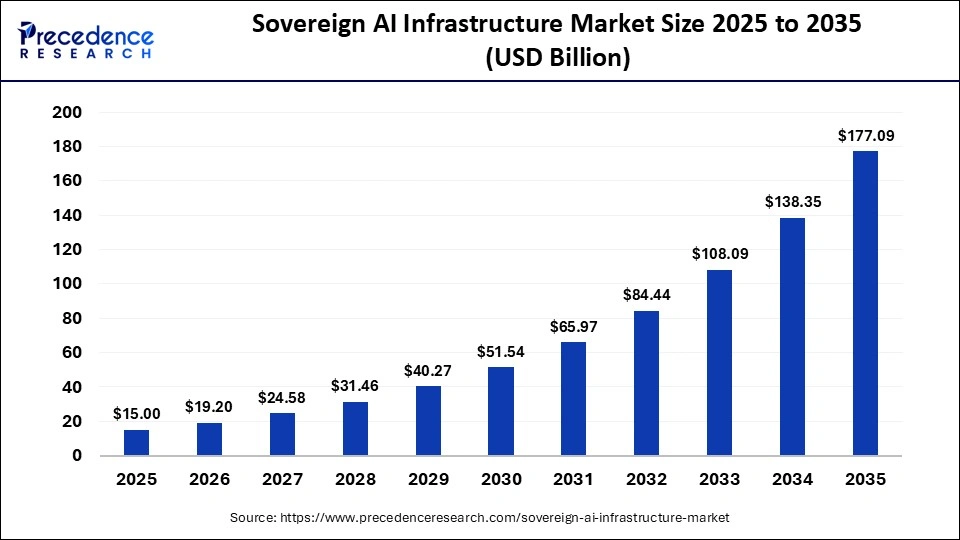
This explosive growth reflects increasing global urgency around:
- National data security
- AI competitiveness
- Geopolitical risks
- Regulatory compliance
Governments and enterprises are rapidly investing in localized AI ecosystems to reduce reliance on foreign cloud and AI service providers.
Read Also: AI Data Center Power Consumption Market
What is Sovereign AI Infrastructure?
Sovereign AI infrastructure refers to a nation’s capability to:
- Build and operate AI data centers domestically
- Maintain control over data, models, and compute resources
- Ensure compliance with local laws and regulations
- Minimize dependency on foreign technology providers
It represents a holistic ecosystem, including:
- AI compute hardware (GPUs, accelerators)
- Networking and interconnect systems
- AI software stacks and orchestration tools
- Security and compliance frameworks
Key Market Trends
1. Government-Led AI Infrastructure Investments
Governments worldwide are heavily investing in:
- National AI data centers
- Dedicated GPU clusters
- AI supercomputers
These initiatives aim to process sensitive data locally and build independent AI capabilities.
2. Emergence of Sovereign Cloud Platforms
Sovereign cloud solutions are gaining traction as they provide:
- Data localization
- Regulatory compliance
- Enhanced control over workloads
Global cloud providers are increasingly collaborating with governments to deliver localized cloud environments that meet sovereignty requirements.
3. Rise of Hybrid Sovereign Architectures
Organizations are adopting hybrid models that combine:
- On-premises infrastructure for sensitive data
- Sovereign cloud for scalable computing
This approach balances cost efficiency, performance, and regulatory compliance.
4. Development of “Neoclouds”
A new category of localized cloud providers—often called neoclouds—is emerging as alternatives to global hyperscalers. These providers focus on delivering region-specific AI infrastructure solutions.
5. Focus on GPU Independence and Supply Chains
Countries are increasingly investing in:
- Domestic GPU clusters
- Semiconductor supply chains
- AI hardware manufacturing
This trend reflects the need to reduce dependency on foreign hardware providers.
Market Dynamics
Key Drivers
1. National Security and Data Protection
Rising cyber threats and geopolitical tensions are pushing governments to secure sensitive data within national borders.
2. Data Localization Regulations
Strict policies require data to be stored and processed locally, driving demand for sovereign infrastructure.
3. AI as a Strategic Asset
AI is now seen as a critical driver of economic growth and global competitiveness.
4. Expansion of High-Performance Computing
The increasing demand for advanced computing capabilities is accelerating infrastructure investments.
Challenges
1. High Capital Investment
Building sovereign AI infrastructure requires massive spending on:
- Data centers
- GPUs and hardware
- Networking systems
2. Operational Complexity
Managing large-scale AI systems involves:
- Complex integration
- High maintenance costs
- Skilled workforce requirements
3. Hardware Supply Constraints
Dependence on global semiconductor supply chains remains a major challenge.
Opportunities
1. Government-Funded AI Data Centers
Public-sector investments are creating significant opportunities for infrastructure providers.
2. Growth of Local AI Ecosystems
Encouraging domestic startups and enterprises strengthens national AI capabilities.
3. Strategic Public-Private Partnerships
Collaborations between governments and tech companies are accelerating development.
Segment Analysis
By Infrastructure Type
- National Data Centers (38.4% Share) – Largest segment, forming the backbone of sovereign AI systems
- Government AI Cloud Platforms – Rapidly growing segment
- AI-Dedicated GPU Clusters (22.1%) – Essential for training large AI models
- AI Supercomputers (12.2%) – Used for advanced research and defense
By Component
- Hardware (46.8%) – Dominant Segment
- Software Stack – Fastest Growing
- Networking & Interconnects (22.4%)
- Security & Compliance Services (12.2%)
By Deployment
- On-Premises – Leading Segment (maximum control and security)
- Sovereign Cloud – Fast-growing
- Hybrid Deployment – Cost-efficient and flexible
By End-User
- Government & Defense – Dominant Segment
- Healthcare & Life Sciences – Fastest Growing
- Financial Services (BFSI)
- Critical Infrastructure (Energy & Telecom)
Regional Insights
Europe (Leading Region – 34.2% Share)
- Strong regulatory frameworks
- Focus on digital sovereignty
- Investments in localized AI infrastructure
Middle East (Fastest Growing Region)
- Government-led AI initiatives
- Rapid digital transformation
North America & Asia Pacific
- High AI adoption
- Strong presence of technology companies
- Expanding cloud and data center infrastructure
Future Outlook: The Strategic Future of AI
The sovereign AI infrastructure market is expected to reshape the global AI landscape in the coming decade.
Key Future Trends:
- Decentralization of AI infrastructure
- Increased government control over digital assets
- Development of energy-efficient AI systems
- Integration of AI with national security frameworks
Research also suggests that true AI sovereignty depends not only on data and models but also on control over infrastructure, energy systems, and networks, highlighting the importance of a fully integrated ecosystem.
Conclusion
The rise of sovereign AI infrastructure marks a fundamental shift in global technology strategy. Nations are no longer just competing in AI innovation—they are competing for control, independence, and security.
With the market projected to reach USD 177.09 billion by 2035, sovereign AI infrastructure will become a cornerstone of:
- National security
- Economic growth
- Technological leadership
The future of AI will not just be defined by intelligence—but by who owns and controls the infrastructure behind it.
Get a Sample Copy: https://www.precedenceresearch.com/sample/8319
For inquiries regarding discounts, bulk purchases, or customization requests, please contact us at [email protected]
