
 by
by The global fiber optic cable market size was valued at USD 18.50 billion in 2025 and is projected to increase from USD 20.42 billion in 2026 to approximately USD 49.76 billion by 2035, expanding at a CAGR of 10.40% during the forecast period. The market is witnessing strong momentum as telecom providers, governments, and enterprises invest heavily in high-speed broadband, 5G deployment, hyperscale data centers, and smart city infrastructure. Fiber optic cables are becoming increasingly essential for reliable, low-latency, and high-bandwidth communication networks.
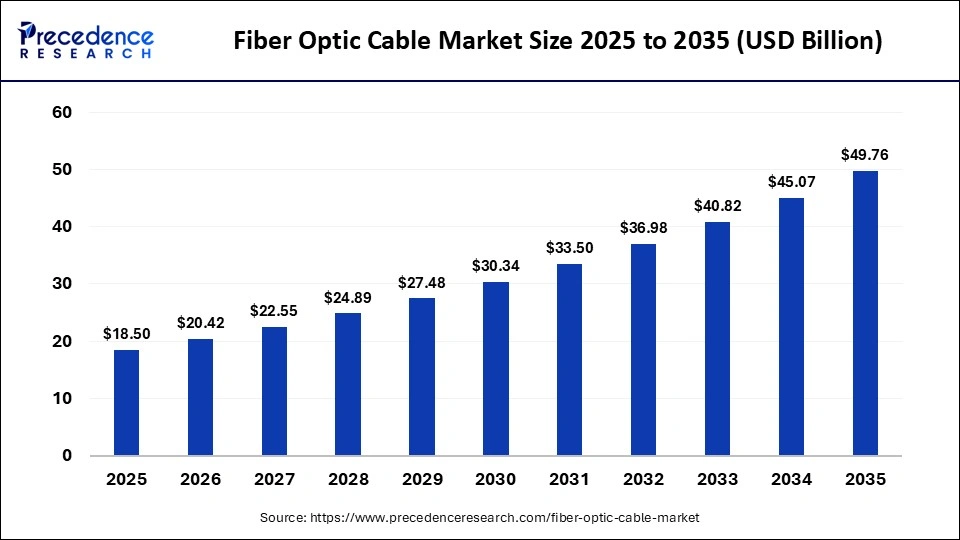
Fiber optic cables are replacing conventional copper-based communication systems in many industries due to their superior speed, bandwidth, durability, and transmission efficiency. The rising need for digital transformation, remote connectivity, cloud computing, and IoT-enabled systems is creating long-term opportunities for fiber optic cable manufacturers across developed and emerging economies.
Read Also: Industrial Vacuum Cleaner Market
Quick Insights
- The global fiber optic cable market was valued at USD 18.50 billion in 2025 and is forecast to reach USD 49.76 billion by 2035.
- The market is expected to grow at a CAGR of 10.40% between 2026 and 2035.
- North America accounted for the largest share of 38% in 2025.
- Asia Pacific is expected to witness the fastest growth, with a CAGR of 11% during the forecast period.
- Single-mode fiber optic cable held the largest product share of 60% in 2025.
- Telecommunications represented the leading application segment with a 40% market share in 2025.
- Underground installation accounted for the largest share of 50% in 2025.
- Major companies operating in the market include Corning Incorporated, Prysmian Group, CommScope, Sumitomo Electric Industries, and Nexans.
Fiber Optic Cable Market Revenue Snapshot
| Metric | Value |
|---|---|
| Market Size in 2025 | USD 18.50 Billion |
| Market Size in 2026 | USD 20.42 Billion |
| Forecast Market Size in 2035 | USD 49.76 Billion |
| CAGR (2026-2035) | 10.40% |
| Largest Regional Market | North America |
| Fastest Growing Region | Asia Pacific |
How Is Artificial Intelligence Influencing the Fiber Optic Cable Market?
Artificial intelligence is significantly influencing the fiber optic cable market by increasing the need for ultra-fast, low-latency communication infrastructure. AI workloads such as machine learning, predictive analytics, generative AI, and real-time processing require enormous data transfer capacity, pushing demand for high-performance fiber optic networks. The rapid growth of AI-enabled data centers is creating new demand for advanced fiber optic cable systems capable of handling massive data volumes efficiently.
AI is also helping telecom operators and infrastructure providers improve the management of fiber networks. Companies are integrating AI into network monitoring systems for predictive maintenance, fault detection, automated traffic routing, and network optimization. These technologies help reduce outages, improve bandwidth allocation, and enhance overall network reliability.
What Are the Major Growth Drivers of the Fiber Optic Cable Market?
The growing demand for high-speed internet connectivity is one of the strongest drivers of the market. Consumers and enterprises increasingly require faster broadband, uninterrupted video streaming, remote work capabilities, cloud computing, and digital services. Fiber optic technology offers much higher speeds and bandwidth than traditional copper cables, making it essential for modern communication infrastructure.
Another major growth factor is the rapid rollout of 5G networks worldwide. Fiber optic cables are critical for connecting cellular towers, base stations, and core telecom infrastructure. As telecom providers invest in 5G deployment, demand for fiber infrastructure is expected to rise significantly across both urban and rural markets.
The expansion of data centers is also fueling strong market demand. Fiber optic cables are widely used in hyperscale data centers because they support faster data transfer, lower latency, and more efficient connectivity compared to copper cabling systems. The increasing use of cloud services, AI applications, and edge computing is expected to accelerate this trend further.
Why Is Single-Mode Fiber Optic Cable Dominating the Market?
Single-mode fiber optic cable dominated the market with a 60% share in 2025 because of its superior performance in long-distance communication. Its single-core design allows only one light mode to pass through, reducing signal loss and enabling higher bandwidth transmission over long distances. These advantages make single-mode cables ideal for telecom backbones, long-haul internet infrastructure, and intercity communication networks.
Multi-mode fiber optic cable represented the second-largest segment with a 40% share in 2025. Multi-mode cables are widely used in short-distance applications such as campuses, office buildings, and data centers because they are more affordable and easier to install. Their demand is expected to remain strong as enterprise networks continue to expand.
How Will 5G and Smart Cities Create New Opportunities?
The rapid expansion of 5G communication networks is expected to create one of the biggest opportunities for the fiber optic cable market. 5G requires dense fiber backhaul networks to support high-speed data transmission, low latency, and reliable connectivity. Telecom operators worldwide are investing in fiber infrastructure to support growing mobile traffic and next-generation digital services.
Smart city development is another major opportunity area. Fiber optic networks play a critical role in enabling intelligent traffic systems, connected surveillance, smart grids, public Wi-Fi, and IoT-enabled urban infrastructure. Countries such as India, China, the United States, and Japan are increasingly investing in smart city programs that require large-scale fiber deployment.
Which Segments Are Leading the Fiber Optic Cable Market?
The telecommunications segment led the market with a 40% share in 2025 because of the increasing demand for high-speed broadband, mobile data services, and 5G connectivity. Telecom providers are investing heavily in fiber deployment to improve network coverage, increase capacity, and support growing consumer demand for faster internet services.
The data center segment held the second-largest share of 25% in 2025 and is expected to grow at a CAGR of 10.5% during the forecast period. This growth is driven by the rising adoption of cloud computing, edge computing, AI, and enterprise digital transformation initiatives. Fiber optic cables are essential for ensuring fast, reliable, and scalable connectivity within modern data center environments.
Why Is Underground Installation Leading the Market?
Underground installation held the largest market share of 50% in 2025 because it offers greater protection from weather, accidents, vandalism, and environmental damage. Underground fiber networks are widely used in urban areas and mission-critical sectors such as healthcare, transportation, finance, and government where uninterrupted connectivity is essential.
The aerial installation segment accounted for 25% of the market in 2025 and is expected to grow steadily because it offers faster deployment and lower installation costs, especially in rural and semi-urban areas. Meanwhile, submarine fiber optic cables are expected to witness strong growth because of the increasing need for international data transmission and global connectivity.
Why Is North America Leading the Global Fiber Optic Cable Market?
North America accounted for 38% of the global fiber optic cable market in 2025 due to its advanced telecommunications infrastructure, widespread 5G rollout, strong cloud computing ecosystem, and rapid expansion of hyperscale data centers. The region is also benefiting from government initiatives focused on broadband expansion and rural internet connectivity.
The United States remains the dominant market in North America because of large-scale investments in fiber broadband networks, AI-ready data centers, and smart city projects. Companies such as Corning and CommScope continue to strengthen the country’s leadership in fiber optic innovation and manufacturing. Europe remains an important market due to ongoing digital transformation programs, while Asia Pacific is expected to witness the fastest growth due to rapid urbanization, telecom expansion, and strong government support for digital infrastructure in countries such as China, India, and Japan.
What Are the Latest Breakthroughs and Developments in the Market?
Fiber optic cable manufacturers are increasingly focusing on high-capacity cables, bend-insensitive fiber technology, eco-friendly production methods, and advanced cable management systems. There is also growing interest in submarine fiber networks, ribbon fiber technology, and AI-enabled network monitoring systems.
Leading companies are expanding production capacity, entering partnerships, and launching new products to strengthen their market presence. Corning Incorporated, Prysmian Group, CommScope, OFS Fitel, Sumitomo Electric Industries, Furukawa Electric, LS Cable & System, Nexans, and Broadcom are among the major companies driving innovation in the market. Several leading players are also focusing on mergers, acquisitions, and strategic collaborations to strengthen their position in global broadband and telecom infrastructure projects.
What Challenges Could Restrict Market Growth?
Despite its strong outlook, the fiber optic cable market faces several challenges. High installation costs remain a major barrier, particularly for underground and submarine fiber deployment projects. Building fiber infrastructure often requires significant capital investment, skilled labor, and regulatory approvals, which can slow deployment in some regions.
Supply chain disruptions, raw material price volatility, and shortages of skilled technicians can also affect market growth. In many developing regions, limited funding and outdated infrastructure continue to restrict the expansion of high-speed fiber networks.
Case Study: Hyperscale Data Centers Accelerate Fiber Deployment
The rapid growth of hyperscale data centers is creating substantial demand for fiber optic cable systems worldwide. Cloud providers, AI companies, and digital service platforms are investing heavily in fiber infrastructure to support fast data transfer, large-scale storage, and low-latency connectivity. In the United States, several large cloud providers have significantly expanded fiber-based networking infrastructure to support AI workloads and cloud computing services. This trend is expected to continue as demand for digital services rises globally.
Get Sample Link: https://www.precedenceresearch.com/sample/8315
For inquiries regarding discounts, bulk purchases, or customization requests, please contact us at [email protected]
