
 by
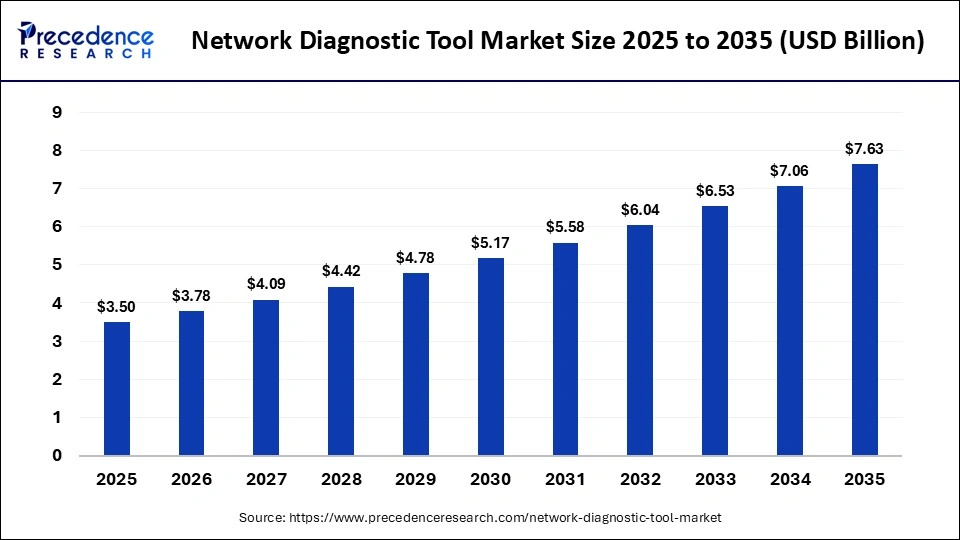
by The global network diagnostic tool market size was valued at USD 3.50 billion in 2025 and is projected to grow from USD 3.78 billion in 2026 to approximately USD 7.63 billion by 2035, expanding at a CAGR of 8.10% during the forecast period. Growing network complexity, higher internet traffic volumes, and rising reliance on hybrid IT architectures are increasing the need for advanced diagnostic tools that can deliver real-time visibility, faster fault detection, and proactive network performance management.
Enterprises across telecom, banking, healthcare, government, and retail are increasingly deploying network diagnostic tools to monitor latency, packet loss, jitter, service quality, and abnormal network activity. As cloud adoption, software-defined networking, and distributed computing environments continue to grow, organizations are looking for scalable monitoring platforms capable of managing increasingly fragmented infrastructures.
Read Also: AI Search Engine Market
Quick Insights
- The global network diagnostic tool market was valued at USD 3.50 billion in 2025 and is expected to reach USD 7.63 billion by 2035.
- The market is projected to grow at a CAGR of 8.10% from 2026 to 2035.
- North America accounted for the largest revenue share of 40% in 2025.
- Asia Pacific is expected to register the fastest growth, with a CAGR of 10% during the forecast period.
- Cloud-based deployment held the largest share of 55% in 2025 because of growing demand for scalable and remote network monitoring platforms.
- IT and telecommunication represented the largest end-use segment with a 40% market share in 2025.
- Network performance monitoring tools dominated the product category with a 35% share in 2025.
- Major companies in the market include Cisco Systems, NETSCOUT Systems, SolarWinds, LogicMonitor, ManageEngine, Paessler AG, and Wireshark.
Network Diagnostic Tool Market Revenue Snapshot
| Metric | Value |
|---|---|
| Market Size in 2025 | USD 3.50 Billion |
| Market Size in 2026 | USD 3.78 Billion |
| Forecast Market Size in 2035 | USD 7.63 Billion |
| CAGR (2026-2035) | 8.10% |
| Leading Region | North America |
| Fastest Growing Region | Asia Pacific |
How Is Artificial Intelligence Reshaping the Network Diagnostic Tool Market?
Artificial intelligence is becoming a major force in the evolution of network diagnostics. Modern diagnostic platforms are increasingly using AI and machine learning to analyze telemetry data from cloud, edge, and 5G environments. These tools can detect anomalies, latency issues, bottlenecks, and service disruptions faster than conventional monitoring systems, helping organizations improve uptime and reduce operational risks.
AI-enabled diagnostic tools are also helping businesses automate incident response and predictive maintenance. Vendors are integrating capabilities such as automated fault detection, intelligent alert prioritization, root-cause analysis, and predictive analytics into their platforms. As organizations deploy SD-WAN, SASE, hybrid cloud, and multi-cloud environments, the role of AI in simplifying complex network operations is becoming more important.
What Are the Major Growth Drivers of the Network Diagnostic Tool Market?
One of the biggest growth drivers is the rapid adoption of cloud and hybrid IT architectures. Businesses are increasingly moving mission-critical workloads across public cloud, private cloud, and on-premise environments, creating more complex and distributed networks. Diagnostic tools help organizations maintain visibility into latency, service availability, packet flow, and traffic patterns across these environments.
Another major growth factor is the global expansion of 5G and edge computing. As telecom operators deploy network slicing, virtualized network functions, and low-latency services, the need for advanced monitoring and fault management capabilities continues to rise. According to industry data, global 5G connections surpassed 2 billion in 2025, increasing demand for diagnostic tools that can ensure network reliability and performance.
The growing convergence between cybersecurity and network observability is also driving market demand. Enterprises increasingly want tools that can not only monitor network health but also detect suspicious traffic, intrusion attempts, and unusual user behavior in real time.
Why Are Cloud-Based Network Diagnostic Tools Becoming More Popular?
Cloud-based deployment dominated the market with a 55% share in 2025 and is projected to grow at a CAGR of 10% through 2035. Enterprises are increasingly adopting cloud-based monitoring tools because they offer scalability, flexibility, centralized visibility, and easier integration across remote locations and hybrid environments. These solutions are especially attractive for organizations managing geographically distributed infrastructure.
The increasing use of remote work models, serverless applications, and edge-cloud integration is further boosting demand for cloud-based diagnostic ecosystems. Businesses are leveraging these tools to manage performance across multiple sites while reducing infrastructure and maintenance costs.
How Will 5G and Edge Computing Create Future Opportunities?
The rapid deployment of 5G networks and edge infrastructure is expected to create major growth opportunities for the network diagnostic tool market. 5G networks involve higher data throughput, more connected devices, lower latency requirements, and greater operational complexity. This is increasing the need for sophisticated network diagnostic solutions that can monitor performance across dynamic telecom environments.
Edge computing is also creating new opportunities because it moves processing closer to users and connected devices. As businesses adopt smart manufacturing, industrial IoT, autonomous systems, and connected healthcare technologies, there is a growing requirement for localized, low-latency monitoring capabilities that can maintain service continuity and detect issues in real time.
Expert Perspective
According to a fictional principal consultant at Precedence Research:
“Organizations can no longer rely on reactive network troubleshooting. The future of network diagnostics lies in predictive intelligence, automated fault resolution, and real-time observability. Companies investing early in AI-driven monitoring platforms will gain a major advantage in reliability, security, and service continuity.”
Which Product Segments Are Leading the Market?
Network performance monitoring tools led the market with a 35% share in 2025 due to strong demand for real-time visibility into bandwidth, latency, speed, and network efficiency. These tools are widely used across telecom networks, enterprise infrastructure, and cloud environments to ensure service quality and operational continuity.
Network traffic analyzer tools represented the second-largest segment with a 30% share in 2025 and are expected to grow at a CAGR of 8.5% during the forecast period. The rising need for encrypted traffic visibility, bottleneck detection, and security-driven analytics is contributing to segment growth.
| Product Type | 2025 Share | Forecast CAGR |
|---|---|---|
| Network Performance Monitoring Tools | 35% | 7.0% |
| Network Traffic Analyzer Tools | 30% | 8.5% |
| Network Configuration and Change Management Tools | 15% | 9.0% |
| Network Troubleshooting Tools | 12% | 8.8% |
| Other Diagnostic Tools | 8% | 11.0% |
Why Does IT and Telecommunication Dominate the Market?
The IT and telecommunication segment held the largest share of 40% in 2025 because telecom providers and network operators require continuous visibility into voice, video, and data traffic across high-speed digital networks. The expansion of fiber broadband, 5G networks, and software-defined networking is creating strong demand for advanced diagnostic and monitoring solutions.
The BFSI segment accounted for 25% of the market in 2025 and continues to grow because financial institutions depend on stable and secure networks for online banking, digital payments, and fraud detection systems. Healthcare, government, and retail sectors are also investing more in network observability as they expand digital services and connected infrastructure.
Why Is North America Leading the Global Market?
North America accounted for 40% of the global network diagnostic tool market in 2025 due to its high concentration of hyperscale data centers, major telecom providers, and advanced digital infrastructure. The region recorded more than 314 million 5G connections in 2025, highlighting the increasing need for real-time network diagnostics and performance monitoring tools.
The United States remains the largest country-level market because enterprises are investing heavily in cloud-native architectures, hybrid IT ecosystems, AI-based monitoring platforms, and advanced cybersecurity infrastructure. Europe remains the second-largest market, supported by strong digital transformation initiatives and stricter data protection requirements, while Asia Pacific is projected to witness the fastest growth due to rapid internet adoption, expanding telecom infrastructure, and rising investments in smart cities and industrial IoT.
What Are the Latest Breakthroughs from Leading Companies?
Technology vendors are increasingly launching advanced network testing, observability, and cloud-based monitoring solutions to address the rising complexity of modern digital infrastructure.
- In April 2026, NetAlly launched the LinkRunner AT 1500 tester to support faster troubleshooting and automated cloud-based reporting.
- In March 2026, Credo Technology Group Holding introduced 800G ZeroFlap transceivers designed to improve AI network stability and fault detection in high-performance environments.
- In March 2026, GlobalConnect launched a network access control service aimed at strengthening enterprise cybersecurity and access management.
- Cisco introduced secure network infrastructure solutions designed to support AI-enabled workspaces and centralized observability.
Key companies operating in the network diagnostic tool market include Cisco Systems, NETSCOUT Systems, SolarWinds, Splunk, LogicMonitor, Paessler AG, Wireshark, ManageEngine, Zabbix, Nokia, Keysight Technologies, and ConnectWise.
What Challenges Could Limit Market Expansion?
Despite its strong growth outlook, the market faces several challenges. High implementation costs remain a major barrier, particularly for small and mid-sized businesses with limited IT budgets. Integrating diagnostic tools with legacy infrastructure, fragmented IT environments, and older networking systems can also be complex and expensive.
Another major challenge is the shortage of skilled IT professionals capable of managing advanced monitoring, observability, and AI-powered diagnostic systems. As networks become more complex, organizations may struggle to maintain the technical expertise needed to maximize the value of these tools.
Case Study: Telecom Operators Reduce Resolution Times with Automated Fault Management
Large telecom operators are increasingly adopting automated fault management platforms to improve service quality and minimize downtime. According to industry findings, automated fault management systems reduced incident resolution times by more than 40% across large telecom networks in 2025. This demonstrates how advanced network diagnostic tools are helping operators manage increasingly complex digital infrastructures more efficiently.
Get Sample Copy: https://www.precedenceresearch.com/sample/8313
For inquiries regarding discounts, bulk purchases, or customization requests, please contact us at [email protected]
