
 by
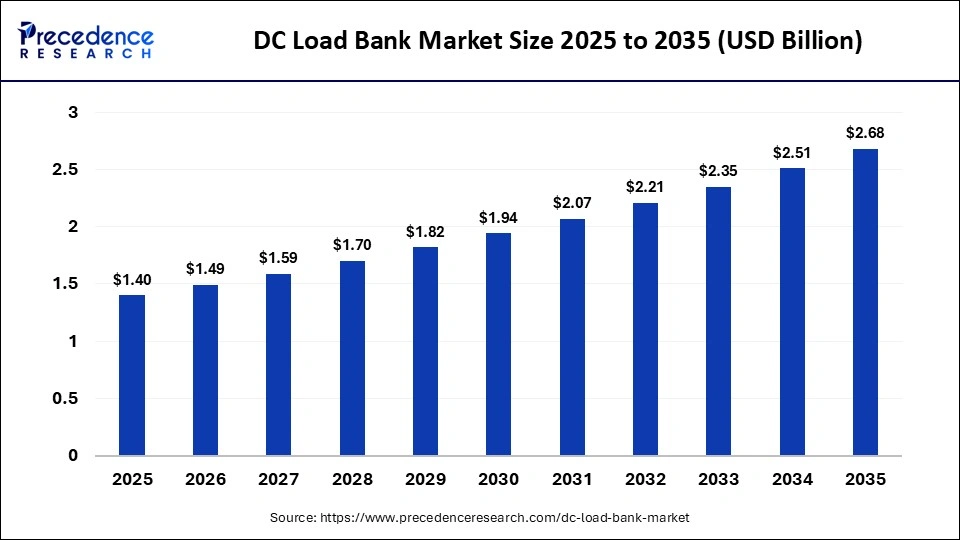
by The global DC load bank market is entering a strong growth phase as industries place greater emphasis on power reliability, backup validation, and electrical infrastructure testing. The market size was valued at USD 1.40 billion in 2025 and is projected to increase from USD 1.49 billion in 2026 to nearly USD 2.68 billion by 2035, growing at a CAGR of 6.71% between 2026 and 2035.
The growing expansion of hyperscale data centers, renewable energy projects, battery energy storage systems, telecom infrastructure, and EV charging networks is creating significant demand for DC load banks. These systems play a crucial role in simulating electrical loads to test batteries, generators, UPS systems, and power distribution units under real-world operating conditions.
Read Also: AI in Meeting Assistants Market
Quick Insights
North America remained the leading region in the DC load bank market in 2025, accounting for 35% of global revenue due to its strong digital infrastructure and large-scale data center deployments. Asia Pacific is expected to register the fastest growth rate of 8.5% through 2035, driven by industrialization, energy infrastructure expansion, and rapid digital transformation.
Portable DC load banks emerged as the leading product category in 2025, capturing 55% of the market because of their flexibility, mobility, and suitability for field testing. Stationary DC load banks are expected to witness the fastest growth due to rising demand from hyperscale data centers and industrial facilities.
Battery testing represented the largest application area, contributing 40% of total market revenue in 2025. The increasing adoption of energy storage systems, EV batteries, and backup power solutions is strengthening demand for high-precision testing equipment.
The data centers segment held the largest end-use share of 30% in 2025 as operators increasingly rely on DC load banks to validate UPS systems, PDUs, and backup power infrastructure.
Revenue Snapshot of the DC Load Bank Market
| Category | Value |
|---|---|
| Market Size in 2025 | USD 1.40 Billion |
| Market Size in 2026 | USD 1.49 Billion |
| Forecast Market Size by 2035 | USD 2.68 Billion |
| CAGR (2026-2035) | 6.71% |
| Leading Region | North America |
| Fastest Growing Region | Asia Pacific |
How is AI Transforming the DC Load Bank Market?
Artificial intelligence is increasingly becoming a valuable component in the DC load bank ecosystem. AI-driven control systems are enabling real-time performance monitoring, predictive diagnostics, and automated load adjustments during testing processes.
By analyzing electrical behavior patterns, AI-enabled systems can identify component wear, resistive element degradation, overheating, and power imbalance issues before failures occur. This reduces downtime and improves maintenance efficiency across critical power infrastructure.
AI also supports adaptive testing environments by automatically modifying load profiles based on operating conditions, helping operators improve testing accuracy and reduce manual intervention. These capabilities are becoming particularly important in large-scale data centers, renewable energy facilities, and EV charging infrastructure.
What Are the Key Growth Factors Driving the DC Load Bank Market?
Why is the Rise of Hyperscale Data Centers Supporting Market Expansion?
The rapid deployment of hyperscale and colocation data centers is significantly increasing demand for DC load banks. Operators rely on these systems to test UPS units, batteries, generators, and backup infrastructure to ensure uninterrupted power availability.
With global AI workloads, cloud computing, and edge computing infrastructure expanding rapidly, data centers are under pressure to maintain high uptime standards. Goldman Sachs Research estimates that global data center power demand could rise by 50% by 2027 and by as much as 165% by the end of the decade compared with 2023 levels. This trend is creating a strong need for advanced power validation systems.
How Are Grid Modernization Projects Creating New Opportunities?
Governments worldwide are heavily investing in smart grids, renewable integration, and battery energy storage systems. These projects require reliable testing equipment to simulate electrical loads, validate grid stability, and ensure system readiness.
In March 2026, the Indian Ministry of Power introduced new viability gap funding programs to support approximately 43 GWh of battery energy storage system capacity for grid modernization. Similarly, the U.S. continues to invest heavily in smart grid infrastructure, with J.P. Morgan estimating nearly USD 1 trillion in grid investments over the next decade.
Why is EV Charging Infrastructure Becoming a Major Opportunity Area?
The expansion of electric vehicle charging networks is creating a new demand stream for DC load banks. Charging stations, battery storage systems, and high-voltage EV infrastructure require load testing to ensure grid compatibility, performance, and safety compliance.
As public and private investments in EV charging continue to grow globally, DC load banks are increasingly being used to test battery performance, simulate electrical loads, and verify charging system reliability before deployment.
Which Product Segments Are Leading the Market?
Portable DC load banks dominated the market in 2025 with a 55% share because they can be rapidly deployed across different testing locations. These solutions are widely used in battery testing, UPS validation, and field-based commissioning projects.
Stationary DC load banks are projected to grow at the fastest pace over the forecast period because of their suitability for large-scale applications in power plants, substations, and data centers where continuous, high-capacity testing is essential.
Which Applications Are Driving the Highest Demand?
Battery testing accounted for the largest market share of 40% in 2025. The rise of energy storage systems, EV batteries, telecom backup systems, and industrial power storage is increasing the need for accurate battery performance evaluation. DC load banks help determine state-of-charge, state-of-health, and internal resistance under simulated operating conditions.
UPS testing represented the second-largest application area, contributing 30% of market revenue. Increasing reliance on uninterrupted power across hospitals, data centers, office buildings, and IT infrastructure is driving demand for advanced UPS validation solutions.
Generator load testing is also witnessing strong momentum due to rising demand for backup power reliability across critical infrastructure, manufacturing facilities, and energy projects.
Why Does North America Continue to Dominate the Market?
North America held the largest market share of 35% in 2025 due to its advanced power infrastructure, dense concentration of data centers, and widespread use of backup power systems. The region also benefits from significant investments in renewable energy integration, nuclear hybrid systems, and smart grid modernization.
The U.S. remains the largest contributor in the region because of its strong AI infrastructure ecosystem, dense hyperscale data center network, and increasing reliance on sophisticated electrical testing systems to manage growing compute workloads.
Why is Asia Pacific Emerging as the Fastest-Growing Region?
Asia Pacific is expected to record the highest CAGR of 8.5% during the forecast period due to rising industrialization, increasing investments in power generation, and rapid growth in manufacturing and telecom infrastructure.
Countries such as China and India are making large-scale investments in energy infrastructure, industrial facilities, and battery storage systems, creating strong demand for advanced electrical testing solutions.
What Challenges Could Limit Market Growth?
Despite strong growth prospects, the DC load bank market faces several challenges. The high upfront cost of load bank systems remains a key concern, particularly for small and medium-sized enterprises. Integration with digital monitoring platforms and smart grids also requires significant technical expertise.
Additionally, the need for regular maintenance, calibration, and software upgrades can increase total ownership costs over time, limiting adoption among budget-constrained users.
Key companies operating in the DC load bank market include:
- Crestchic Loadbanks
- Loadbanks.com
- Shenzhen SROH Technology
- Chroma ATE
- Avtron Power Solutions
- Simplex
- Mosebach Manufacturing Company
Case Study: Why Data Centers Depend on DC Load Banks
A large hyperscale data center operator preparing a new facility for launch typically uses portable and stationary DC load banks to validate backup batteries, UPS systems, PDUs, and generator performance before commissioning.
These tests help ensure uninterrupted operation during outages, reduce system failures, and maintain uptime requirements for Tier III and Tier IV facilities. As AI workloads continue to increase server density and power demand, data center operators are expected to invest more heavily in advanced load testing solutions.
Get Sample Copy: https://www.precedenceresearch.com/sample/8306
For inquiries regarding discounts, bulk purchases, or customization requests, please contact us at [email protected]
