
 by
by The global applied AI in autonomous vehicles market is entering a period of explosive growth as automakers, technology firms, and mobility providers accelerate the deployment of AI-powered driving systems. The market size was valued at USD 13.20 billion in 2025 and is expected to rise from USD 17.34 billion in 2026 to nearly USD 202.55 billion by 2035, expanding at a CAGR of 31.40% during the forecast period.
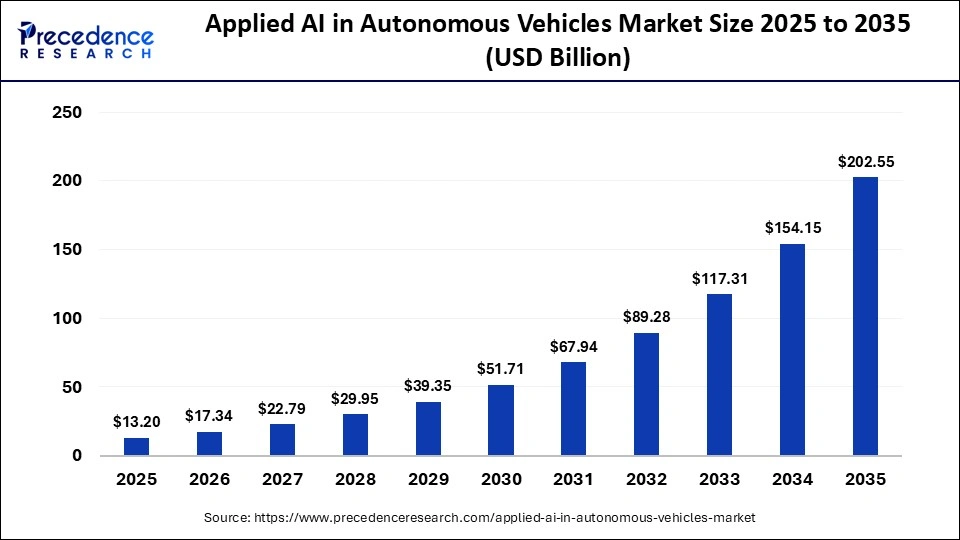
The growing need to reduce traffic accidents, improve road safety, lower transportation costs, and enable real-time driving intelligence is driving adoption of artificial intelligence across autonomous vehicles. AI technologies such as machine learning, computer vision, deep learning, and sensor fusion are enabling vehicles to perceive surroundings, predict movement, and make split-second decisions with minimal human intervention.
Read Also: AI in Meeting Assistants Market
Quick Insights
North America dominated the global market in 2025 with a 40% share due to strong investments in autonomous mobility, advanced semiconductor infrastructure, and the presence of leading automotive technology companies. Asia Pacific is expected to register the fastest growth through 2035 as countries such as China, Japan, South Korea, and India continue investing in smart transportation and autonomous vehicle testing ecosystems.
The machine learning segment led the market with a 35% share in 2025 because it forms the foundation of real-time decision-making, sensor interpretation, and predictive driving capabilities. Computer vision was the second-largest technology segment and is expected to witness the fastest growth due to rising demand for road sign recognition, lane tracking, and object detection.
By autonomous vehicle type, Level 3 vehicles accounted for the largest share of 30% in 2025 because they offer the most commercially viable balance between driver control and automated operation. Passenger vehicles represented the leading end-use category, contributing 55% of market revenue in 2025.
Revenue Snapshot of the Applied AI in Autonomous Vehicles Market
| Category | Value |
|---|---|
| Market Size in 2025 | USD 13.20 Billion |
| Market Size in 2026 | USD 17.34 Billion |
| Forecast Market Size by 2035 | USD 202.55 Billion |
| CAGR (2026-2035) | 31.40% |
| Largest Region | North America |
| Fastest Growing Region | Asia Pacific |
How is AI Reshaping Autonomous Vehicles?
Artificial intelligence is at the core of the autonomous driving revolution. AI models process massive volumes of data collected from cameras, radar, LiDAR, GPS, and ultrasonic sensors to create a real-time understanding of the driving environment.
Machine learning helps vehicles recognize traffic patterns, identify pedestrians, predict road hazards, and adapt to changing traffic conditions. Deep learning models further enhance decision-making by enabling autonomous systems to interpret complex driving scenarios with greater accuracy than traditional rule-based software. Sensor fusion technologies combine data from multiple sensors to provide a complete 360-degree view around the vehicle, helping reduce blind spots and improve response times.
Increasing adoption of edge-based AI processing is also transforming the market. Instead of relying only on cloud infrastructure, autonomous vehicles are now able to process huge amounts of data directly inside the vehicle for faster, safer, and more reliable decisions.
What Are the Major Growth Factors Driving the Market?
Why is Autonomous Vehicle Production Expanding Rapidly?
The rising production of autonomous and semi-autonomous vehicles is one of the biggest growth drivers for the market. Automakers are integrating advanced driver assistance systems, intelligent cruise control, automatic emergency braking, lane-keeping technologies, and driver monitoring systems into passenger and commercial vehicles.
AI-powered vehicles are helping reduce human driving errors, which remain one of the leading causes of accidents globally. Technologies such as LiDAR, cameras, and radar can improve decision-making accuracy by nearly 15% while reducing reaction times by around 20%, making AI essential for future mobility solutions.
How is the Rise of Robotaxis Creating New Opportunities?
The rapid commercialization of robotaxi fleets is creating one of the most significant opportunities in the applied AI in autonomous vehicles market. Companies are increasingly using AI to power driverless taxi services, autonomous shuttles, and last-mile delivery solutions.
Community discussions and industry research suggest that China’s robotaxi market alone could expand from approximately USD 54 million in 2025 to nearly USD 47 billion by 2035, supported by rapid fleet expansion, declining hardware costs, and government support for autonomous mobility.
Commercial applications are also expanding rapidly in logistics, freight transport, and delivery fleets, where companies are seeking to reduce labor costs, improve efficiency, and minimize fuel consumption.
Why Are Generative AI and Simulation Technologies Becoming Important?
Generative AI is creating a new opportunity for autonomous vehicle development by enabling simulation of rare and dangerous driving scenarios that are difficult to capture in real-world environments.
AI developers can now use synthetic datasets to train autonomous systems for rare edge cases, unusual pedestrian behavior, extreme weather conditions, and unexpected road hazards. This reduces the need for costly physical testing and accelerates deployment timelines for higher levels of vehicle autonomy.
Which Technology Segments Are Leading the Market?
Machine learning dominated the market in 2025 with a 35% share because it supports predictive analytics, perception, route planning, and real-time driving decisions. AI-driven ADAS systems are heavily dependent on machine learning for safety, navigation, and driver behavior analysis.
Computer vision represented 30% of the market in 2025 and is expected to grow at the fastest pace over the next decade. It enables autonomous vehicles to recognize traffic signs, lane markings, pedestrians, road obstacles, and traffic lights with high precision.
Deep learning is also emerging as one of the fastest-growing technologies because of its ability to manage the complexity and unpredictability of real-world driving conditions. Sensor fusion and data analytics are becoming increasingly important as autonomous systems require integrated data from cameras, radar, LiDAR, and other sensors.
Which Vehicle Types and Applications Are Creating the Most Demand?
Level 3 autonomous vehicles held the largest share of 30% in 2025 because they allow drivers to disengage under specific conditions while maintaining a balance between automation and human oversight. Level 2 vehicles also continue to see strong adoption due to their affordability and widespread use in mass-market passenger vehicles.
Level 4 and Level 5 vehicles are expected to witness the fastest growth during the forecast period as technology matures and regulations evolve. Level 5 full automation is projected to grow at a CAGR of 40% through 2035.
Navigation and mapping represented the largest application segment with a 30% market share in 2025 because autonomous systems rely on real-time maps, environmental understanding, and route optimization to operate safely. Object and pedestrian detection accounted for 25% of market revenue and continues to grow rapidly due to increasing emphasis on road safety and collision avoidance.
Why Does North America Continue to Dominate the Market?
North America accounted for 40% of global market revenue in 2025 due to the presence of leading AI, semiconductor, and automotive companies. The region benefits from strong investments in autonomous mobility, robust R&D ecosystems, and a supportive regulatory environment for testing self-driving technologies.
The U.S. remains the largest contributor in the region because of its advanced technology infrastructure, strong presence of autonomous driving companies, and growing investments in AI-driven mobility. Major players are increasingly testing and deploying autonomous systems in commercial fleets, delivery vehicles, and urban transport systems.
Why is Asia Pacific Becoming the Fastest-Growing Region?
Asia Pacific is expected to witness the fastest CAGR during the forecast period because of rising investments in smart cities, connected infrastructure, autonomous public transportation, and EV ecosystems.
China is emerging as one of the most important markets because of strong government support, rapid deployment of robotaxis, and leadership in LiDAR and sensor technology. Recent developments such as new color-detecting LiDAR systems are improving vehicle perception capabilities and accelerating commercialization of higher autonomy levels.
South Korea is also becoming a major growth hub through its investments in smart city projects, 5G-enabled transportation networks, and connected vehicle ecosystems. Japan continues to strengthen its position through advanced automotive manufacturing and robotics expertise.
What Challenges Could Slow Market Growth?
Despite rapid expansion, the applied AI in autonomous vehicles market still faces several major barriers. High development costs, cybersecurity threats, regulatory uncertainty, and consumer trust issues continue to limit adoption.
One of the biggest technical challenges remains the “long-tail problem,” where autonomous systems struggle to respond to rare or highly unpredictable events such as unusual pedestrian behavior, severe weather, or unexpected traffic scenarios. Public concerns over AI reliability, data privacy, and hacking risks also remain important issues that manufacturers must address.
Case Study: Robotaxi Fleets Are Becoming a Real Commercial Opportunity
Autonomous mobility is moving beyond pilot programs. Industry analysts expect robotaxi services to become a large-scale commercial business over the next decade, especially in urban markets such as Beijing, Shanghai, Shenzhen, and Guangzhou.
Research shared within the self-driving community suggests that robotaxi fleets could eventually grow to nearly 1.9 million vehicles in China by 2035, supported by lower hardware costs, improved remote fleet management, and stronger public acceptance. Companies such as Waymo, Pony AI, Baidu Apollo, and WeRide are expected to compete aggressively for leadership in this space.
Get Sample Copy: https://www.precedenceresearch.com/sample/8307
For inquiries regarding discounts, bulk purchases, or customization requests, please contact us at [email protected]
