
 by
by The global hybrid packaging market is witnessing steady growth due to rising demand for sustainable packaging solutions, increasing regulatory pressure on plastic waste, and rapid adoption of multi-material packaging formats that improve durability, functionality, and shelf life.
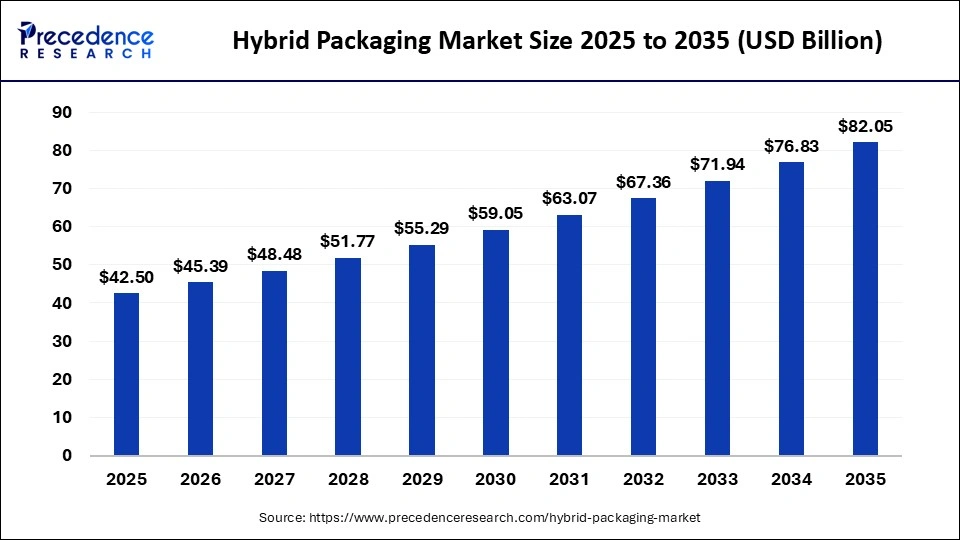
The global hybrid packaging market size accounted for USD 42.50 billion in 2025 and is predicted to increase from USD 45.39 billion in 2026 to approximately USD 82.05 billion by 2035, expanding at a CAGR of 6.80% from 2026 to 2035. The market is benefiting from growing use of lightweight, recyclable, and cost-efficient packaging solutions across food, pharmaceuticals, personal care, and industrial applications.
Read Also: Air Cargo Security Screening Systems Market
Market Overview
Hybrid packaging refers to packaging solutions that combine two or more materials such as plastic, paper, paperboard, glass, or metal to improve product protection, convenience, aesthetics, and sustainability. These packaging formats are increasingly being adopted because they provide better barrier properties, longer shelf life, enhanced durability, and lower transportation costs.
Hybrid packaging is widely used in food and beverage products, pharmaceutical goods, cosmetics, consumer goods, and industrial products. Manufacturers are increasingly investing in innovative material combinations to reduce environmental impact while maintaining packaging performance.
Key Takeaways
- North America dominated the hybrid packaging market with a 30% share in 2025.
- Asia Pacific is expected to grow at the fastest CAGR of 7.8% between 2026 and 2035.
- By material type, plastic accounted for the largest market share of 40% in 2025.
- Paper and paperboard held a 30% share in 2025 and are expected to grow at the fastest CAGR of 7.8%.
- By packaging type, rigid hybrid packaging dominated the market with a 55% share in 2025.
- Flexible hybrid packaging held a 45% share in 2025 and is expected to grow at a CAGR of 7.5%.
- By application, food and beverages accounted for the largest market share of 40% in 2025.
- Pharmaceuticals held a 20% share and are expected to grow at a strong CAGR of 6.8%.
- By end-use, consumer goods accounted for 50% of the market in 2025.
- Healthcare held a 25% share and is expected to grow significantly during the forecast period.
Market Drivers
Rising Demand for Sustainable Packaging
One of the key drivers of the hybrid packaging market is the increasing emphasis on sustainability. Governments, consumers, and companies are placing greater focus on reducing plastic waste, increasing recyclability, and lowering carbon emissions.
Hybrid packaging solutions that combine recyclable paper with lightweight plastic or metal layers are becoming increasingly popular because they reduce raw material usage while maintaining product safety and durability. Many companies are also adopting bio-based materials and recyclable laminates to comply with environmental regulations.
Growth in Food and Beverage Packaging
The food and beverage industry is one of the largest users of hybrid packaging because products require packaging that can extend shelf life, maintain freshness, and protect against contamination.
Flexible pouches, multi-layer cartons, rigid containers, and resealable hybrid packaging formats are becoming more common in packaged food, beverages, snacks, dairy products, and ready-to-eat meals. Rising demand for convenience foods and e-commerce grocery delivery is further accelerating adoption.
Increasing Demand from Pharmaceutical and Healthcare Industries
Pharmaceutical and healthcare companies require packaging solutions that provide strong barrier protection, sterility, and tamper resistance. Hybrid packaging solutions are increasingly used for medicines, medical devices, personal care products, and sterile packaging applications.
The healthcare segment is expected to experience strong growth because hybrid packaging can combine the durability of plastic with the barrier properties of foil, paper, or glass to ensure product integrity and patient safety.
Impact of Artificial Intelligence on the Hybrid Packaging Market
Artificial intelligence is transforming the hybrid packaging market by improving packaging design, supply chain efficiency, and production processes. AI tools are increasingly being used to optimize material selection, reduce waste, forecast demand, and improve packaging performance.
Manufacturers are also using AI to automate quality inspection, identify defects, and enhance predictive maintenance in packaging machinery. These technologies help reduce costs, improve sustainability, and speed up product development.
Segment Insights
By Material Type
The plastic segment dominated the market with a 40% share in 2025 because plastic remains lightweight, cost-effective, and easy to combine with other materials. Plastic is widely used in hybrid packaging for food, personal care, and industrial products.
The paper and paperboard segment held a 30% share in 2025 and is expected to grow at the fastest rate through 2035. This growth is driven by increasing demand for eco-friendly and recyclable packaging materials.
Metal and glass are also important components in hybrid packaging because they provide superior protection and premium product presentation, particularly for beverages, pharmaceuticals, and cosmetics.
By Packaging Type
Rigid hybrid packaging held the largest market share of 55% in 2025 because it offers strong protection for products that require durability and impact resistance. Rigid packaging formats include bottles, jars, containers, cartons, and trays.
Flexible hybrid packaging held a 45% share in 2025 and is expected to grow at a CAGR of 7.5% during the forecast period. Flexible packaging formats are increasingly used because they are lightweight, reduce shipping costs, and require less material than rigid packaging.
Industry discussions also suggest that flexible packaging formats such as pouches, laminates, and films are seeing strong growth due to rising demand from food, pharmaceutical, and retail industries. High-barrier recyclable laminates and mono-material flexible packaging solutions are becoming particularly important in emerging markets such as India.
Application Insights
The food and beverage segment dominated the market with a 40% share in 2025 because hybrid packaging helps preserve freshness, improve convenience, and extend shelf life.
The pharmaceutical segment held a 20% share in 2025 and is expected to grow strongly due to increasing demand for sterile, tamper-resistant, and high-barrier packaging formats.
Personal care and cosmetics companies are also increasing adoption of hybrid packaging to improve product appearance, reduce environmental impact, and enhance user convenience. Industrial applications continue to expand because hybrid packaging improves product protection during storage and transportation.
Regional Insights
North America
North America led the hybrid packaging market with a 30% share in 2025. The region benefits from strong demand for sustainable packaging, advanced manufacturing infrastructure, and high adoption of innovative packaging technologies.
Food, healthcare, and consumer goods companies in the region are increasingly using hybrid packaging to improve sustainability and comply with environmental regulations.
Asia Pacific
Asia Pacific is expected to grow at the fastest CAGR of 7.8% between 2026 and 2035. Growth is being driven by rapid industrialization, rising urbanization, growing e-commerce activity, and increasing demand for packaged food and healthcare products.
India and China are emerging as major growth markets because of expanding manufacturing sectors and increasing focus on sustainable packaging. Industry discussions also highlight that India’s flexible packaging sector is benefiting from lower production costs, strong domestic demand, and increasing investment in recyclable packaging solutions.
Europe
Europe is also witnessing steady growth in the hybrid packaging market due to strict environmental regulations and strong consumer preference for recyclable packaging materials. Many companies in the region are investing in paper-based packaging, compostable materials, and closed-loop recycling systems to reduce waste and meet sustainability targets.
Competitive Landscape
Leading companies operating in the hybrid packaging market are focusing on sustainable material innovation, recyclable designs, lightweight packaging formats, and smart packaging technologies.
Major players are investing in partnerships, acquisitions, and new product launches to expand their packaging portfolios and strengthen their presence in food, healthcare, and industrial sectors. Companies are also increasingly adopting AI-driven packaging design tools and automation technologies to improve operational efficiency.
Future Outlook
The hybrid packaging market is expected to witness long-term growth due to rising demand for sustainable packaging, increasing use of flexible packaging formats, and stronger regulations on single-use plastics.
The shift toward recyclable paper-plastic combinations, mono-material packaging, and AI-enabled packaging production is expected to create significant opportunities for manufacturers over the next decade. Food, healthcare, and consumer goods industries are likely to remain the major drivers of market demand.
Get Sample Link: https://www.precedenceresearch.com/sample/8294
For inquiries regarding discounts, bulk purchases, or customization requests, please contact us at [email protected]
