
 by
by The global wearable AI market is entering a period of rapid transformation as artificial intelligence becomes increasingly embedded into everyday wearable devices. From smartwatches and fitness bands to smart glasses and medical wearables, AI-powered technologies are reshaping how consumers monitor their health, improve productivity, and engage with connected ecosystems.
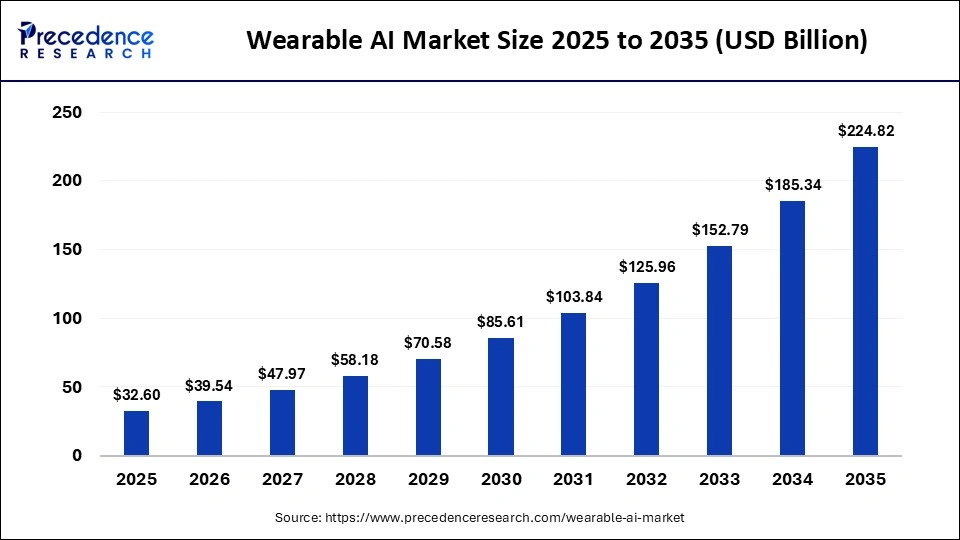
The global wearable AI market size was valued at USD 32.60 billion in 2025 and is expected to rise from USD 39.54 billion in 2026 to nearly USD 224.82 billion by 2035, expanding at a CAGR of 21.30% between 2026 and 2035. The market is being driven by the growing need for real-time health monitoring, increasing adoption of smart consumer devices, and rapid advances in artificial intelligence, sensors, and connectivity technologies.
Read Also: 5G Customer Premises Equipment Market
Quick Insights: What is Powering the Wearable AI Market?
North America emerged as the leading regional market in 2025, accounting for approximately 40% of global revenue due to the strong presence of leading technology companies, higher consumer spending on smart devices, and rapid adoption of AI-powered healthcare wearables.
Asia Pacific is projected to witness the fastest growth during the forecast period, supported by rising smartphone penetration, increasing disposable incomes, rapid urbanization, and growing investments in digital health ecosystems across countries such as China, India, Japan, and South Korea.
Smartwatches remained the largest product segment in 2025, contributing nearly 50% of total market revenue due to their broad usage in health tracking, communication, fitness monitoring, and lifestyle management.
Healthcare represented the largest application area in 2025 with a 35% market share, reflecting the growing use of wearable AI devices for remote patient monitoring, chronic disease management, sleep tracking, and cardiovascular monitoring.
The hardware segment accounted for nearly 50% of the market in 2025, driven by strong demand for advanced sensors, processors, batteries, and AI-enabled wearable components.
How is Artificial Intelligence Transforming the Wearable AI Market?
Artificial intelligence is fundamentally changing the wearable technology landscape by making devices more predictive, responsive, and personalized. Traditional wearable devices were mainly designed to collect data, such as steps taken, heart rate, and sleep duration. However, modern AI-powered wearables can interpret this data, identify behavioral patterns, and provide personalized recommendations in real time.
AI algorithms are increasingly being used to detect irregular heart rhythms, predict health anomalies, monitor stress levels, optimize sleep quality, and improve physical performance. Advanced machine learning models also allow wearables to continuously learn from user habits and provide more accurate health insights over time. This transformation is making wearable AI devices essential tools in preventive healthcare, sports performance, workplace productivity, and digital wellness.
Another major trend is the shift toward on-device AI. Instead of relying entirely on cloud computing, wearable devices are increasingly processing data directly on the device using neural processing units, digital signal processors, and AI chipsets. This reduces latency, improves privacy, and allows users to receive real-time feedback without requiring continuous internet connectivity.
What are the Key Growth Factors Driving the Wearable AI Market?
Why is Demand for Real-Time Health Monitoring Rising?
Consumers are becoming increasingly health-conscious and are seeking devices that can provide continuous monitoring of vital signs such as heart rate, blood oxygen levels, blood pressure, glucose levels, sleep quality, and physical activity. AI-powered wearables provide actionable insights that help users proactively manage their health and wellness.
Why are Smartwatches Leading the Market?
Smartwatches remain the most widely adopted wearable AI product because they combine health tracking, fitness management, communication, entertainment, and payment functionalities into a single device. Their growing integration with smartphones, health apps, and smart home ecosystems is further strengthening demand.
How is Healthcare Creating New Opportunities?
Healthcare providers are increasingly using wearable AI devices for remote patient monitoring, chronic disease management, rehabilitation, and elderly care. Wearables help reduce hospital visits, improve early disease detection, and enhance patient engagement.
Why are Sports and Fitness Applications Expanding?
Athletes, fitness enthusiasts, and sports organizations are increasingly adopting AI wearables to monitor performance metrics, prevent injuries, track recovery, and improve training efficiency. Smart wearables can provide real-time coaching, motion analysis, and fatigue monitoring, creating strong growth potential in sports applications.
Expert Perspective: What Does the Future Hold for Wearable AI?
“Wearable AI is moving beyond fitness tracking into a much broader ecosystem of predictive healthcare, enterprise productivity, and immersive consumer experiences. The next wave of growth will come from smart glasses, medical-grade wearables, and AI-powered devices that can operate independently with on-device intelligence,” said Aditi Sharma.
Which Segments are Driving the Strongest Growth?
Component Analysis
The hardware segment dominated the wearable AI market in 2025 because wearables require high-performance sensors, microprocessors, displays, batteries, and connectivity chips to function effectively. Hardware innovation remains critical to enabling smaller, more energy-efficient, and more accurate wearable devices.
Meanwhile, the software segment is expected to grow at the fastest pace over the coming years. AI-driven applications for health monitoring, sleep analysis, fitness coaching, and predictive analytics are increasing the importance of wearable software platforms. Consumers increasingly prefer wearable devices that can deliver actionable insights rather than simple data collection.
Product Type Analysis
Smartwatches continued to dominate the market in 2025, while smart glasses are anticipated to witness the fastest growth. The growing popularity of augmented reality, virtual reality, translation tools, navigation features, and immersive digital experiences is creating significant opportunities for AI-powered smart glasses.
Application Analysis
Healthcare remained the largest application segment in 2025 due to the rapid adoption of remote monitoring devices and AI-enabled medical wearables. However, sports applications are expected to expand at the fastest rate as athletes and organizations increasingly rely on data-driven training tools.
Why is North America Leading While Asia Pacific Expands Faster?
North America continues to dominate the wearable AI market due to its advanced digital infrastructure, strong consumer awareness, and the presence of major companies such as Apple Inc., Google LLC, Samsung Electronics Co. Ltd., and Garmin Ltd.. The region also benefits from higher spending on premium consumer electronics and stronger healthcare digitization.
Asia Pacific is projected to record the fastest growth due to the rapid expansion of e-commerce, increased smartphone adoption, lower manufacturing costs, and strong government support for digital innovation. Countries such as China, India, and South Korea are emerging as important hubs for wearable AI development and adoption.
What Challenges Could Slow Market Growth?
Despite its strong growth potential, the wearable AI market faces several challenges. One major issue is data privacy and cybersecurity. Since wearable devices collect highly sensitive personal information, companies must ensure strong encryption, secure cloud storage, and compliance with evolving data protection regulations.
Battery life and device miniaturization also remain significant concerns. Consumers want devices that are lightweight, stylish, and long-lasting, but adding advanced AI features often increases energy consumption. Additionally, premium wearable devices remain expensive, limiting adoption in price-sensitive markets. Interoperability across devices and platforms also remains a challenge for manufacturers and software developers.
Case Study: How Medical Wearables are Transforming Patient Care
The medical-grade wearables segment is witnessing significant growth as healthcare providers increasingly rely on AI-powered devices for continuous patient monitoring. Devices such as ECG patches, glucose monitors, smart rehabilitation trackers, and blood pressure wearables are helping physicians monitor patients remotely and identify potential health risks before they become critical.
One example is the partnership between Best Buy Health and Biobeat, which integrated AI-powered remote patient monitoring wearables into broader healthcare systems. These devices use AI-based early warning systems to alert clinicians when patient conditions deteriorate, enabling faster interventions and improved outcomes.
Which Companies are Leading the Wearable AI Market?
Key companies operating in the wearable AI market include:
- Samsung Electronics Co. Ltd.
- Meta Platforms Inc.
- Fitbit Inc.
- Garmin Ltd.
- Google LLC
- Huawei Technologies Co. Ltd.
- Xiaomi Corporation
- Motorola Solutions Inc.
- Apple Inc.
- Sony Corporation
- Oura Health Oy
- Ultrahuman Healthcare Pvt Ltd.
Get Sample Link: https://www.precedenceresearch.com/sample/8298
For inquiries regarding discounts, bulk purchases, or customization requests, please contact us at [email protected]
