
 by
by Inorganic Scintillators Market: Enabling Precision in Radiation Detection and Medical Imaging
Introduction: The Invisible Technology Powering Critical Industries
Inorganic scintillators are essential yet often overlooked components in modern technology. From medical imaging systems to nuclear safety and homeland security, these materials play a crucial role in detecting and measuring radiation with high precision.
As global demand rises for accurate diagnostics, advanced research tools, and enhanced security systems, inorganic scintillators are becoming increasingly indispensable across industries.
Market Overview: Stable Growth with Expanding Applications
The global inorganic scintillators market was valued at USD 780 million in 2025 and is projected to grow from USD 833.82 million in 2026 to USD 1,520.10 million by 2035, expanding at a CAGR of 6.90%.
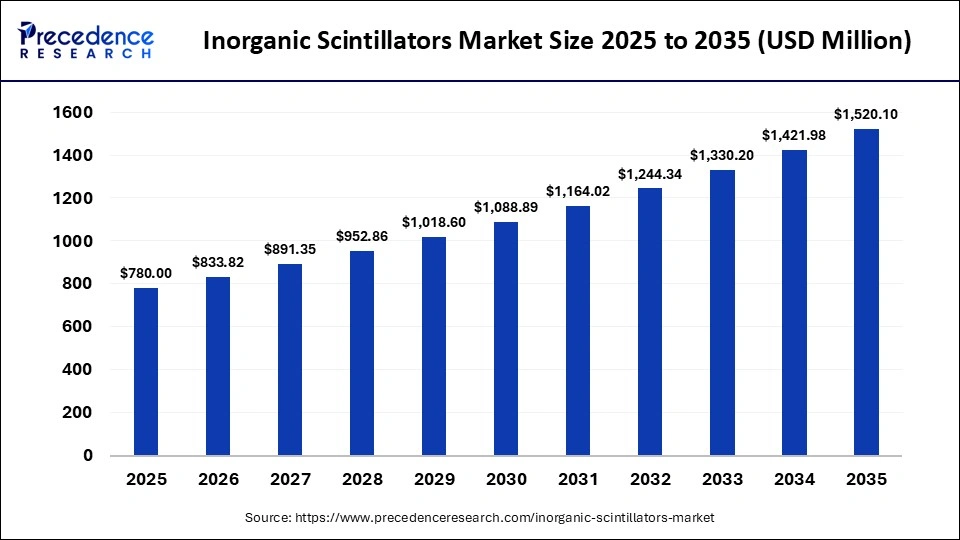
This growth is driven by:
- Increasing demand for advanced medical imaging technologies
- Rising need for radiation detection and nuclear safety systems
- Growing investments in scientific research and defense applications
- Continuous advancements in high-performance scintillator materials
Read Also: Sovereign AI Infrastructure Market
What Are Inorganic Scintillators?
Inorganic scintillators are crystalline materials that emit visible light when exposed to ionizing radiation. They are widely used in:
- PET (Positron Emission Tomography)
- SPECT imaging systems
- CT scanners
- Radiation monitoring devices
These materials are typically grown in high-temperature environments and include compounds such as sodium iodide, cesium iodide, and lutetium-based crystals.
Key Market Trends
1. Rising Demand in Medical Imaging
Medical imaging dominates the market, accounting for approximately 40% of total share in 2025.
The increasing prevalence of chronic diseases and the need for early diagnosis are driving demand for:
- PET scans
- CT imaging
- Nuclear medicine systems
Scintillators enable accurate radiation detection, improving diagnostic precision.
2. Growing Importance in Radiation Detection and Security
Governments and defense agencies are expanding investments in radiation detection technologies for:
- Border security
- Nuclear threat monitoring
- Environmental radiation tracking
These applications are significantly boosting market demand.
3. Advancements in Scintillator Materials
Ongoing R&D is leading to the development of:
- High-density scintillators
- Faster response-time materials
- Improved light output crystals
Lutetium-based scintillators (LSO/LYSO) are emerging as a high-growth segment, offering superior performance in medical imaging.
4. Integration of Artificial Intelligence
AI is playing a transformative role by:
- Accelerating material discovery
- Enhancing detector performance
- Improving predictive modeling
Machine learning techniques are helping optimize scintillator design and efficiency.
Market Dynamics
Key Drivers
1. Expansion of Healthcare Infrastructure
The global rise in hospitals and diagnostic centers is increasing demand for imaging technologies powered by scintillators.
2. Growth in Nuclear Energy Projects
As countries expand nuclear power capabilities, the need for reliable radiation monitoring systems is growing.
3. Increased Scientific Research
High-energy physics and advanced research rely heavily on scintillator-based detection systems.
Challenges
1. High Production Costs
Manufacturing scintillator crystals involves complex processes, increasing overall costs.
2. Material Limitations
Certain scintillators are sensitive to environmental factors such as moisture and temperature.
3. Performance Constraints
Issues like afterglow effects and scalability limitations can impact efficiency.
Opportunities
1. Advanced Material Innovation
New crystal technologies are improving detection accuracy and efficiency.
2. Emerging Market Growth
Asia Pacific is witnessing strong growth due to expanding healthcare and industrial sectors.
3. Integration with Next-Gen Technologies
Combining scintillators with AI and digital imaging systems offers significant potential.
Segment Analysis
By Material Type
- Sodium Iodide (NaI) – 35% Market Share (Dominant)
- Cesium Iodide (CsI) – 20%
- Bismuth Germanate (BGO) – 15%
- Lutetium-based Scintillators (LSO/LYSO) – Fastest Growing
- Other Advanced Materials
NaI dominates due to its high light yield and cost-effectiveness, making it widely used in medical imaging and radiation detection.
By Application
- Medical Imaging – 40% (Largest Segment)
- Nuclear Power & Radiation Detection – 25%
- Homeland Security & Defense – 15%
- High-Energy Physics Research – 10%
- Oil & Gas Exploration – 10%
By End-Use Industry
- Healthcare & Diagnostics – 45% (Leading Segment)
- Energy & Nuclear Industry – 20%
- Defense & Security Agencies – 15%
- Research Institutes – 10%
- Industrial Applications – 10%
By Detection Technology
- Photomultiplier Tube (PMT) Systems – 55% (Dominant)
- Silicon Photomultiplier (SiPM) Systems – Fastest Growing
- Hybrid Detection Systems
SiPM technology is gaining popularity due to its compact size and higher efficiency.
Regional Insights
North America (38% Market Share)
- Strong healthcare infrastructure
- Advanced research facilities
- High adoption of imaging technologies
Asia Pacific (Fastest Growing Region)
- Rapid healthcare expansion
- Growth in nuclear energy projects
- Increasing industrial applications
Europe
- Strong focus on research and innovation
- Adoption of advanced diagnostic technologies
Future Outlook: Innovation Driving Stability
The inorganic scintillators market is expected to evolve steadily with advancements in materials and applications.
Key Future Trends:
- Development of high-speed, high-resolution scintillators
- Increased adoption of SiPM-based detection systems
- Integration with AI-driven imaging technologies
- Expansion of portable radiation detection devices
Conclusion
The inorganic scintillators market is a stable yet strategically critical industry, supporting essential technologies in healthcare, security, and scientific research.
With a projected market size of USD 1,520.10 million by 2035, the sector will continue to grow through innovation, expanding applications, and increasing global demand for precision detection systems.
Get a Sample Copy: https://www.precedenceresearch.com/sample/8322
For inquiries regarding discounts, bulk purchases, or customization requests, please contact us at [email protected]
