
 by
by The global marketing automation software market is experiencing significant growth as businesses increasingly adopt data-driven strategies to enhance customer engagement and streamline marketing operations. The market is projected to grow from USD 11.19 billion in 2026 to approximately USD 36.97 billion by 2035, expanding at a CAGR of 14.2%.
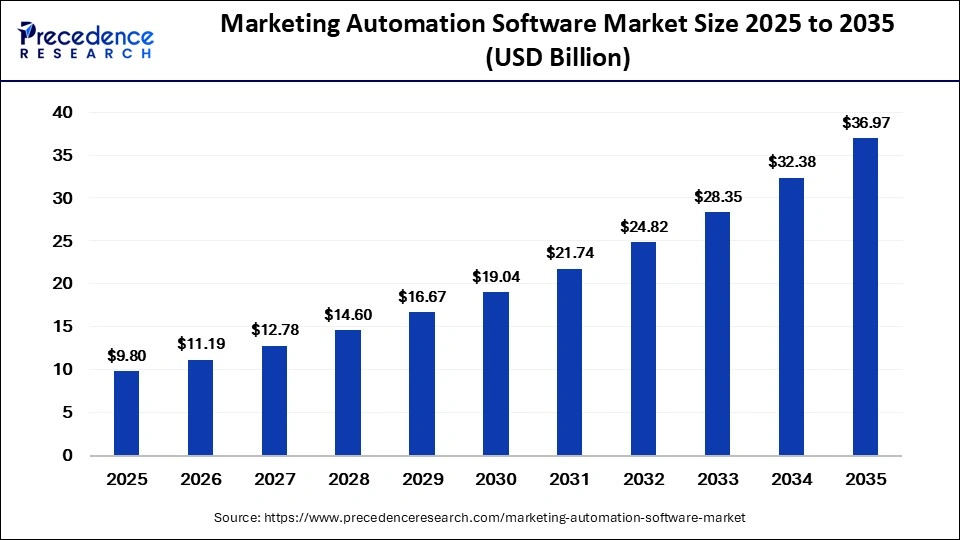
This rapid expansion reflects the growing importance of automation platforms in managing complex marketing ecosystems and delivering personalized experiences at scale.
Read Also: Data Center Chillers Market
What is Marketing Automation Software?
Marketing automation software refers to platforms that automate, streamline, and measure marketing tasks across channels such as email, social media, websites, and mobile apps. These tools help businesses manage campaigns, nurture leads, and analyze customer behavior in real time.
Modern solutions integrate artificial intelligence (AI) and machine learning (ML) to enable predictive analytics, behavioral targeting, and personalized communication strategies.
Key Market Drivers
1. Rising Demand for Personalized Customer Experiences
Businesses are increasingly focusing on delivering tailored experiences to customers. Automation platforms enable hyper-personalization by leveraging behavioral data, purchase history, and real-time intent signals.
2. Growth of Omnichannel Marketing
The shift toward omnichannel engagement is driving demand for tools that can manage interactions across multiple platforms while ensuring consistency and relevance.
3. Increasing Digital Marketing Investments
Organizations are investing heavily in digital marketing technologies to improve efficiency, scalability, and return on investment (ROI).
Latest Market Trends
AI and Generative AI Integration
AI is transforming marketing automation by enabling predictive customer insights, automated decision-making, and real-time campaign optimization. Generative AI is also being used for content creation and strategy planning.
Cloud-Based Solutions Dominate
Cloud deployment leads the market, accounting for around 75% share in 2025, due to its scalability, flexibility, and cost-effectiveness.
Customer Journey Orchestration Growth
Customer journey orchestration is one of the fastest-growing segments, driven by the need for seamless, personalized experiences across touchpoints.
Rising Adoption Among SMEs
Small and medium enterprises (SMEs) are rapidly adopting SaaS-based marketing tools to scale operations without heavy upfront investments.
Market Segmentation Insights
By Component
- Software platforms dominate with around 72% market share, driven by automation capabilities and analytics features.
- Services such as consulting and integration are also growing steadily.
By Deployment Mode
- Cloud-based solutions hold the largest share due to subscription-based pricing and scalability.
- On-premise solutions remain relevant for organizations prioritizing data security.
By Organization Size
- Large enterprises dominate the market with 60% share.
- SMEs are the fastest-growing segment, with a CAGR of 17%.
By Application
- Lead management and nurturing lead with approximately 25% share.
- Customer journey orchestration is the fastest-growing application segment.
By End-Use Industry
- Retail and e-commerce dominate with around 30% share, driven by high customer interaction and personalization needs.
Regional Analysis
North America Leads the Market
North America holds the largest market share (38%) due to advanced digital infrastructure and early adoption of marketing technologies.
Asia Pacific Shows Fastest Growth
Asia Pacific is expected to grow at the fastest CAGR of 17.5%, driven by rapid digital transformation, increasing internet penetration, and expanding e-commerce ecosystems in countries such as India and China.
Challenges in the Market
Despite strong growth, the market faces several challenges:
- High implementation and licensing costs
- Integration issues with legacy systems
- Data silos and complexity in managing large datasets
These factors can limit adoption, especially among smaller organizations.
Opportunities and Future Outlook
The future of marketing automation lies in AI-driven innovation and real-time engagement. Emerging technologies are enabling:
- Predictive customer behavior analysis
- Automated decision-making systems
- Integration with messaging platforms and chatbots
- Enhanced customer lifetime value (CLV) optimization
As businesses continue to prioritize digital transformation, marketing automation platforms are evolving into comprehensive customer engagement ecosystems.
Conclusion
The marketing automation software market is no longer just about automating campaigns—it is about enabling intelligent, data-driven marketing strategies.
With strong growth projections, increasing AI integration, and rising demand for personalized experiences, the market is set to play a crucial role in shaping the future of digital marketing. Businesses that invest in advanced automation tools today will be better positioned to compete in an increasingly dynamic and customer-centric landscape.
