
 by
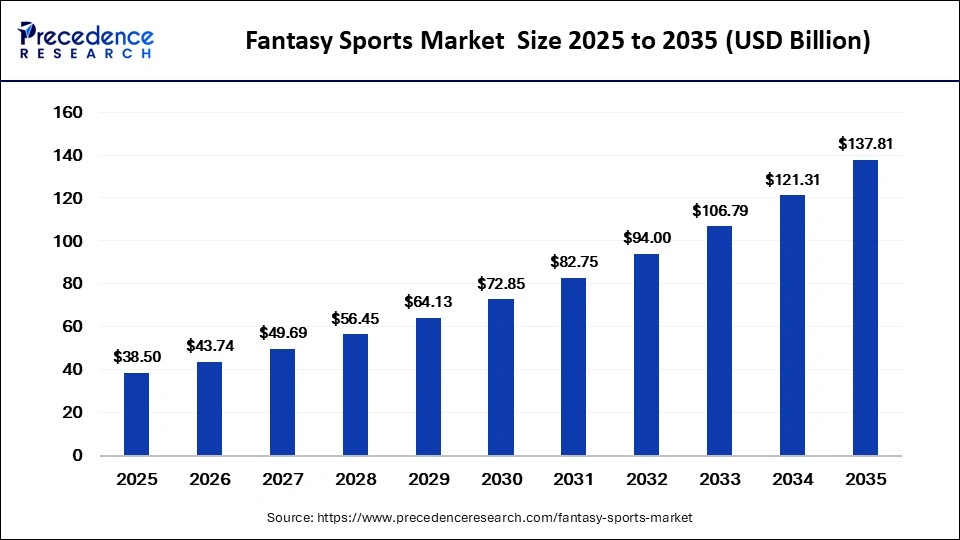
by The global fantasy sports market is projected to grow from USD 43.74 billion in 2026 to USD 137.81 billion by 2035 at a CAGR of 13.60%. Explore market trends, AI integration, regional insights, segment analysis, and key companies driving the fantasy sports industry.
Fantasy Sports Market Size, Share, Trends and Forecast 2026 to 2035
The global fantasy sports market is witnessing substantial growth as sports entertainment rapidly shifts toward digital and interactive experiences. Fantasy sports platforms have transformed the way fans engage with live sports by enabling users to create virtual teams and compete based on the real-world performance of athletes.
According to industry analysis, the global fantasy sports market size accounted for USD 38.50 billion in 2025 and is expected to increase from USD 43.74 billion in 2026 to approximately USD 137.81 billion by 2035, expanding at a CAGR of 13.60% from 2026 to 2035. The market growth is primarily driven by rising smartphone penetration, mobile-first engagement, real-time sports analytics integration, and increasing monetization opportunities through fantasy gaming platforms.
The rapid expansion of esports, AI-driven predictive analytics, digital payment infrastructure, and sports streaming services is significantly reshaping the fantasy sports ecosystem worldwide.
Read Also: Generative AI in Coding Market
Market Overview
Fantasy sports are online games where participants create virtual teams consisting of real-life athletes. Points are earned based on the statistical performance of those athletes in actual sporting events.
Fantasy sports platforms generate revenue through:
- Entry fees
- Advertising
- Premium subscriptions
- Sponsorships and partnerships
- In-app purchases
The industry has evolved into a highly competitive digital entertainment ecosystem supported by artificial intelligence, live data integration, cloud infrastructure, and mobile gaming technologies.
Major sports categories covered in fantasy sports platforms include:
- Football
- Cricket
- Basketball
- Baseball
- Hockey
- Kabaddi
- Esports
North America dominated the fantasy sports market with 43% market share in 2025, while Europe and Asia-Pacific continue witnessing rapid expansion.
How Artificial Intelligence is Transforming the Fantasy Sports Market
Artificial intelligence is becoming one of the most influential technologies shaping the future of fantasy sports.
AI-powered fantasy platforms help users:
- Analyze player performance
- Predict match outcomes
- Optimize team selection
- Monitor injuries and player trends
- Improve real-time decision-making
Machine learning algorithms are increasingly integrated into fantasy sports applications to process massive sports datasets and provide predictive insights.
Modern fantasy sports platforms now utilize AI for:
- Automated drafting tools
- Personalized recommendations
- Dynamic player projections
- Fraud detection
- User behavior analysis
- Real-time analytics
Reddit sports analytics communities increasingly discuss the growing role of machine learning models in fantasy baseball, football, and basketball analytics.
AI-powered analytics are expected to remain a major competitive differentiator among fantasy sports operators during the forecast period.
Key Market Drivers
Mobile-First Adoption Accelerating Market Expansion
The increasing global adoption of smartphones is one of the primary factors fueling fantasy sports market growth.
Mobile applications accounted for 78% of market share in 2025 due to rising consumer preference for mobile gaming and real-time sports interaction.
Fantasy sports mobile applications provide:
- Live score tracking
- Instant notifications
- Real-time team management
- Seamless digital payments
- Interactive gaming experiences
Countries such as India, the United States, and the United Kingdom are witnessing strong mobile-first fantasy sports participation.
Rising Popularity of Cricket Fantasy Sports
Cricket fantasy sports are experiencing explosive growth, particularly in India and South Asia.
The cricket segment accounted for 28% of market share in 2025 and is projected to grow at a CAGR of 18% between 2026 and 2035.
According to the Internet and Mobile Association of India (IAMAI), more than 225 million users actively participate in fantasy cricket platforms.
Popular platforms such as Dream11, MPL, and My11Circle continue driving market expansion through mobile-first engagement strategies and real-time gameplay experiences.
Growth of Esports Fantasy Gaming
The esports segment held 6% market share in 2025 and is expected to witness the fastest CAGR of 22% during the forecast period.
Increasing global participation in online gaming, live streaming, and multiplayer esports tournaments is fueling demand for fantasy esports platforms.
Fantasy esports platforms are increasingly attracting younger audiences through:
- Real-time competitions
- Interactive streaming integration
- AI-based player analytics
- Social gaming experiences
Emerging Market Trends
Integration of Real-Time Analytics
Fantasy sports operators are increasingly integrating real-time analytics tools into their platforms to improve user engagement and gameplay accuracy.
These analytics solutions allow users to:
- Monitor player statistics instantly
- Evaluate matchups
- Analyze performance trends
- Make live strategic decisions
The growing demand for data-driven gameplay is significantly increasing investments in sports analytics technologies.
Expansion of Daily Fantasy Sports (DFS)
Daily fantasy sports (DFS) continue dominating the market due to shorter contest cycles and higher engagement frequency.
The DFS segment contributed 64% market share in 2025.
DFS platforms attract users through:
- Instant rewards
- Flexible participation
- Real-time competition
- High-frequency gameplay
The convergence between fantasy sports and regulated sports betting ecosystems is also boosting DFS growth globally.
Rise of AI-Powered Fantasy Sports Platforms
Fantasy sports application developers are increasingly focusing on AI-powered features such as predictive analytics, automated lineup recommendations, and user personalization.
These technologies help improve:
- User retention
- Engagement rates
- Personalized gaming experiences
- Platform monetization
Market Restraints
Regulatory Uncertainty
One of the major challenges facing the fantasy sports market is regulatory fragmentation across countries and regions.
Fantasy sports platforms often face varying regulations regarding:
- Gambling classifications
- Taxation
- Licensing requirements
- Payment processing
These regulatory inconsistencies may limit global scalability and market expansion.
Intense Market Competition
The fantasy sports industry is becoming increasingly competitive due to the rising number of operators globally.
Growing competition may result in:
- Higher customer acquisition costs
- Reduced profit margins
- Increased marketing expenses
- User fragmentation
Cybersecurity and Fraud Risks
Fantasy sports platforms manage large volumes of sensitive user data and digital transactions.
Cybersecurity threats include:
- Data breaches
- Account fraud
- Payment fraud
- Bot activity
Platform operators are increasingly investing in secure payment systems and fraud prevention technologies.
Segment Analysis
Sports Type Insights
Football Segment Dominated the Market
The football segment accounted for the highest market share of 32% in 2025 due to the strong popularity of NFL and European football leagues.
Fantasy football benefits from:
- Large fan engagement
- Structured statistical ecosystems
- AI-driven analytics
- Sports betting integration
Cricket Segment Witnessing Rapid Growth
The cricket segment is projected to grow significantly during the forecast period due to India’s rapidly expanding fantasy gaming ecosystem.
Fantasy cricket platforms continue benefiting from:
- IPL tournaments
- Massive mobile adoption
- Digital payment integration
- Real-time score tracking
Esports Segment Growing Fastest
The esports fantasy segment is expected to witness the fastest CAGR due to increasing digital gaming participation globally.
Platform Insights
Mobile Applications Dominated the Market
Mobile applications accounted for 78% market share in 2025 due to increasing smartphone penetration and mobile gaming adoption.
Web-Based Platforms Continue Expanding
The web-based platform segment held 22% share in 2025 and continues attracting users seeking detailed analytics and desktop-based gameplay experiences.
Game Type Insights
Daily Fantasy Sports (DFS) Led the Market
Daily fantasy sports dominated the market with 64% share in 2025 because of their high-frequency gameplay model.
Season-Long Fantasy Sports Maintaining Popularity
Season-long fantasy sports continue attracting highly engaged sports enthusiasts seeking long-term league participation.
User Type Insights
Casual Players Dominated the Market
Casual players accounted for 72% market share in 2025 due to simplified mobile gaming experiences and increasing accessibility.
Professional Players Segment Expanding Rapidly
The professional players segment is expected to grow at the fastest CAGR of 17% during the forecast period.
Regional Analysis
North America Dominated the Global Market
North America held 43% market share in 2025 due to strong sports ecosystems and high fantasy sports participation.
The North America fantasy sports market was valued at USD 17.71 billion in 2025 and is projected to reach approximately USD 54.03 billion by 2035.
U.S. Market Trends
The United States remains the largest fantasy sports market globally due to widespread participation across NFL, NBA, MLB, and NHL fantasy leagues.
According to the Fantasy Sports & Gaming Association (FSGA), more than 60 million fantasy sports users were active in the United States in 2025.
Europe Experiencing Significant Growth
Europe accounted for 20% market share in 2025 and is expected to grow steadily due to football-centric fantasy engagement.
United Kingdom Leading Regional Expansion
The UK remains Europe’s largest fantasy sports hub due to the popularity of Fantasy Premier League and UEFA competitions.
Asia-Pacific Emerging as High-Growth Region
Asia-Pacific is expected to witness strong growth due to mobile-first adoption, cricket popularity, and expanding digital payment infrastructure.
India Driving Regional Growth
India is emerging as one of the world’s largest fantasy sports markets due to:
- Massive cricket fan base
- UPI payment infrastructure
- Affordable mobile internet
- Growing esports ecosystem
Competitive Landscape
The fantasy sports market is highly competitive, with companies focusing on AI integration, real-time analytics, cloud scalability, and user engagement optimization.
Key Companies Operating in the Market
- DraftKings Inc.
- FanDuel Group
- Dream11
- Yahoo Fantasy Sports
- ESPN Fantasy Sports
- CBS Sports Fantasy
- Sleeper
- Underdog Fantasy
- MPL (Mobile Premier League)
- PrizePicks
- Fantrax
- My11Circle
These companies are investing heavily in:
- AI-powered analytics
- Real-time sports APIs
- Cloud-based infrastructure
- User personalization
- Secure payment integration
Recent Developments
- Fantasy sports operators are increasingly integrating AI-powered predictive analytics to improve user engagement and lineup optimization.
- Fantasy sports app development companies are focusing on scalable cloud infrastructure and real-time sports data integration.
- The esports fantasy gaming segment is witnessing rapid growth due to increasing global digital gaming participation.
Future Outlook
The future of the fantasy sports market appears highly promising due to rapid technological innovation, AI integration, esports expansion, and growing mobile engagement worldwide.
Emerging technologies expected to shape the industry include:
- Artificial intelligence
- Predictive analytics
- Blockchain-based rewards
- AR/VR gaming integration
- Real-time sports streaming
- Personalized gaming ecosystems
Asia-Pacific, especially India, is expected to remain one of the strongest long-term growth engines for the global fantasy sports market.
Conclusion
The global fantasy sports market is witnessing robust growth driven by mobile-first engagement, AI-powered analytics, esports expansion, and increasing sports digitization.
Daily fantasy sports, cricket fantasy gaming, and AI-driven personalization are significantly transforming the user experience across fantasy sports platforms.
With North America leading the market and Asia-Pacific emerging as a major high-growth region, the fantasy sports industry is expected to witness continued innovation and substantial expansion through 2035.
Get a Sample Copy: https://www.precedenceresearch.com/sample/8425
For inquiries regarding discounts, bulk purchases, or customization requests, please contact us at [email protected]
