
 by
by The global visitor management system market is undergoing significant transformation as organizations worldwide prioritize workplace security, operational efficiency, compliance automation, and smart building integration. Increasing concerns regarding unauthorized access, data protection, visitor tracking, and employee safety are pushing enterprises toward the adoption of intelligent visitor management solutions across corporate offices, healthcare facilities, educational institutions, government buildings, and industrial sites.
According to industry analysis, the global visitor management system market size accounted for USD 2.35 billion in 2025 and is projected to increase from USD 2.70 billion in 2026 to approximately USD 9.90 billion by 2035, expanding at a CAGR of 14.20% during the forecast period from 2026 to 2035.
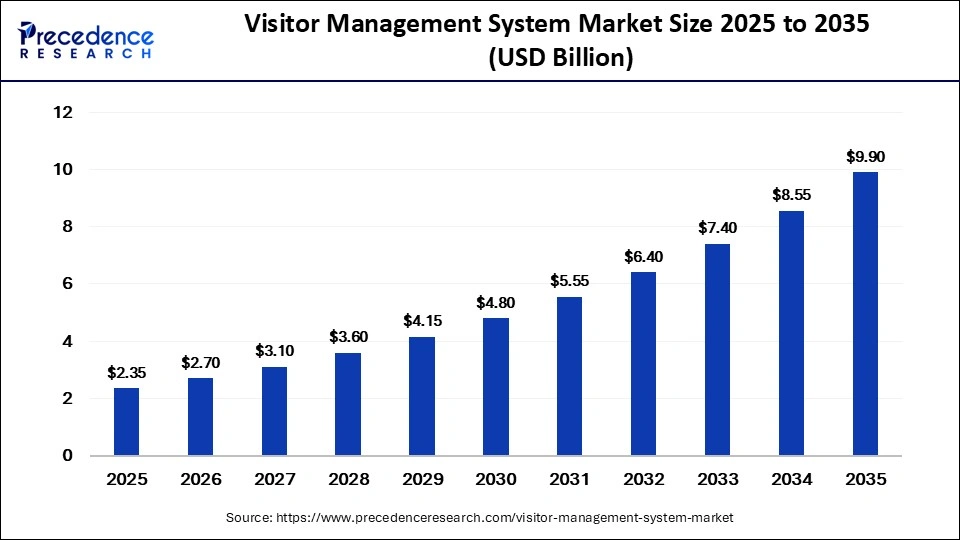
The market is being strongly fueled by rapid digital transformation initiatives, rising implementation of cloud-based visitor tracking platforms, increasing adoption of contactless check-in technologies, and growing integration of artificial intelligence into physical security systems. Organizations are increasingly replacing traditional paper-based visitor logs with automated and centralized visitor management infrastructure capable of delivering real-time monitoring, identity verification, advanced analytics, and compliance-ready reporting.
As enterprises continue modernizing facility operations and embracing hybrid work environments, visitor management systems are rapidly becoming a core component of intelligent workplace ecosystems.
Read Also: AI in Regulatory Technology Market
Quick Insights: What Is Accelerating Growth in the Visitor Management System Market?
North America dominated the global visitor management system market in 2025 with a 40% market share due to strong workplace digitization and early adoption of advanced security infrastructure.
Asia Pacific is expected to grow at the fastest CAGR of 18.5% during the forecast period as organizations across China, India, Japan, and Southeast Asia accelerate investments in smart offices and digital access management systems.
The software segment emerged as the leading component segment with a 78% market share in 2025 because organizations increasingly require automated visitor registration, compliance monitoring, analytics dashboards, and identity verification capabilities.
Cloud-based deployment dominated the market with a 72% share in 2025 owing to increasing demand for scalable, remotely accessible, and subscription-based security solutions.
Large enterprises accounted for 65% market share in 2025 as multinational organizations continue investing heavily in integrated security and compliance infrastructure.
The IT & telecom sector led the market with a 28% share in 2025 due to rising adoption of smart workplace technologies and increasing enterprise automation initiatives.
Security & compliance features captured 25% market share in 2025 as organizations increasingly prioritize access control, regulatory compliance, and data security.
Visitor Management System Market Snapshot
| Market Category | Details |
|---|---|
| Market Size in 2025 | USD 2.35 Billion |
| Market Size in 2026 | USD 2.70 Billion |
| Forecast Market Size by 2035 | USD 9.90 Billion |
| CAGR (2026–2035) | 14.20% |
| Dominant Region | North America |
| Fastest Growing Region | Asia Pacific |
Why Are Visitor Management Systems Becoming Essential Across Modern Enterprises?
Organizations worldwide are increasingly prioritizing digital visitor management systems as security threats, compliance requirements, and operational complexities continue rising across industries. Traditional visitor logs and manual reception processes are no longer capable of meeting the security, transparency, and efficiency demands of modern enterprise environments.
Visitor management systems automate several critical functions, including:
- Visitor registration
- ID verification
- Badge printing
- Access authorization
- Visitor tracking
- Compliance documentation
- Emergency response management
- Host notifications
These systems not only improve operational efficiency but also strengthen security frameworks by enabling organizations to maintain centralized and audit-ready visitor records.
The rapid expansion of hybrid workplaces and flexible office models is further accelerating demand for intelligent visitor management platforms capable of managing dynamic workplace access patterns across multiple locations.
How Is Artificial Intelligence Transforming the Visitor Management System Market?
Artificial intelligence is significantly enhancing visitor management systems by improving security intelligence, automation capabilities, operational efficiency, and personalization. AI-powered visitor management platforms can now automate visitor invitations, optimize check-in workflows, and maintain centralized global visitor logs with minimal manual intervention.
Advanced AI capabilities such as facial recognition, behavioral analysis, and predictive monitoring are enabling organizations to detect suspicious activities more effectively while strengthening facility security. AI algorithms can analyze visitor traffic patterns, monitor access behaviors, and identify anomalies in real time, improving emergency preparedness and threat detection.
AI also improves multilingual adaptability and personalized visitor engagement. Intelligent systems can automatically customize visitor greetings, streamline onboarding experiences, and optimize visitor flow management based on historical data and occupancy trends. As smart building ecosystems continue expanding globally, AI-driven visitor intelligence is expected to become increasingly critical for enterprise infrastructure management.
What Are the Key Growth Drivers Fueling the Visitor Management System Market?
Growing Demand for Workplace Security
Rising concerns regarding unauthorized access, workplace safety, and data protection are encouraging organizations to deploy intelligent visitor management infrastructure capable of providing real-time monitoring and centralized access control.
Increasing Regulatory Compliance Requirements
Organizations across healthcare, BFSI, manufacturing, government, and IT sectors are under increasing pressure to maintain accurate visitor records and comply with security, audit, and privacy regulations such as GDPR and HIPAA.
Expansion of Smart Offices and Intelligent Buildings
The rapid deployment of smart workplace infrastructure is significantly increasing demand for integrated visitor management systems capable of supporting automation, analytics, and connected security ecosystems.
Rising Adoption of Cloud-Based Platforms
Cloud-native visitor management systems offer flexibility, scalability, lower deployment costs, and centralized management capabilities, making them increasingly attractive to enterprises operating across multiple locations.
Contactless Visitor Experiences Becoming Standard
Organizations are increasingly implementing QR-code authentication, mobile check-ins, facial recognition systems, and self-service kiosks to improve visitor convenience while minimizing physical contact.
Could Personalized Visitor Experiences Become a Major Competitive Advantage?
Yes, personalization is emerging as one of the strongest opportunities within the visitor management system market. Modern digital visitor management systems now enable organizations to customize visitor badges, greetings, workflows, and onboarding processes to deliver highly personalized visitor experiences.
Businesses are increasingly recognizing that visitor interactions directly influence brand perception, workplace experiences, and operational efficiency. Intelligent visitor management systems help organizations create seamless, professional, and secure visitor journeys while improving front-desk productivity and customer satisfaction.
The growing focus on personalization is expected to drive innovation in AI-powered visitor engagement tools, multilingual interfaces, predictive scheduling systems, and smart workplace automation.
Why Is Cloud-Based Deployment Dominating the Market?
The cloud-based deployment segment dominated the visitor management system market with a 72% share in 2025 and is expected to grow at the fastest CAGR of 18.5% during the forecast period.
Cloud deployment offers several strategic advantages:
- Lower upfront infrastructure costs
- Remote access capabilities
- Real-time monitoring
- Simplified software upgrades
- Centralized visitor data management
- Scalability across multiple sites
Cloud-based visitor management systems also provide organizations with enhanced visibility into visitor activities, enabling consistent policy enforcement and standardized compliance management across global operations.
What Challenges Are Limiting Market Expansion?
Dependence on Internet Connectivity
Cloud-based visitor management platforms rely heavily on uninterrupted internet access to synchronize operations, maintain records, and support real-time functionality. Connectivity disruptions can affect operational continuity.
Rising Cybersecurity Risks
As visitor management systems process sensitive personal information and access data, organizations face increasing cybersecurity threats and data privacy concerns.
Integration Complexity with Legacy Infrastructure
Many organizations continue operating outdated security systems that can be difficult to integrate with modern visitor management platforms, creating implementation challenges and increasing deployment costs.
Which Segment Dominated the Visitor Management System Market in 2025?
Software Segment Maintained Leadership
The software segment led the visitor management system market with a 78% share in 2025 and is expected to continue dominating throughout the forecast period.
Modern software platforms provide:
- Automated visitor registration
- ID scanning
- Compliance management
- Watchlist screening
- Analytics dashboards
- Electronic signatures
- Badge printing
- Real-time monitoring
The growing need for advanced analytics, security automation, and workflow customization continues driving strong demand for visitor management software solutions.
Why Are Large Enterprises Investing Heavily in Visitor Management Infrastructure?
Large enterprises accounted for 65% market share in 2025 due to increasing investments in integrated security systems and enterprise-wide compliance management frameworks.
Large organizations require sophisticated visitor management platforms capable of:
- Managing multi-site operations
- Standardizing global workflows
- Integrating with access control systems
- Supporting audit readiness
- Delivering centralized visibility
Meanwhile, SMEs are projected to grow at the fastest CAGR of 17.5% as smaller businesses increasingly prioritize affordable cloud-based visitor management solutions.
How Is the IT & Telecom Sector Driving Market Growth?
The IT & telecom segment dominated the market with a 28% share in 2025 and is expected to maintain strong growth momentum throughout the forecast period.
Technology companies are rapidly deploying visitor management systems to:
- Improve workplace automation
- Strengthen facility security
- Enhance employee and guest experiences
- Generate operational insights through analytics
The integration of visitor management systems within smart office environments is significantly improving workplace efficiency and data-driven decision-making capabilities across the IT sector.
Competitive Landscape: Which Companies Are Shaping the Visitor Management System Industry?
The visitor management system market is becoming increasingly competitive as technology companies focus on AI-driven security, cloud-native infrastructure, and smart workplace integration.
Major Companies Operating in the Market
- Envoy
- Proxyclick
- iLobby
- Traction Guest
- Honeywell
- HID Global
- Sine
- MRI Software
- Pitney Bowes
- ALICE Receptionist
- KeepnTrack
- Greetly
- The Receptionist
- Veristream
- SwipedOn
These companies are increasingly focusing on:
- Contactless access systems
- AI-powered analytics
- Facial recognition integration
- Compliance automation
- Smart building connectivity
- Predictive security intelligence
What Recent Developments Are Transforming the Market?
Odisha Introduced India’s First Fully Automated Visitor Management System
In February 2026, Odisha Governor Hari Babu Kambhampati launched the e-Lok Bhavan Odisha App, a secure web-based visitor management and appointment automation platform for the Governor’s Secretariat. Odisha became the first Indian state to implement a fully automated visitor management system at the Governor’s House.
Kadence Launched AI-Driven Visitor Management Platform
In January 2026, Kadence introduced its newly rebuilt AI-driven visitor management system designed to automate visitor operations, reduce front-desk friction, and provide organizations with real-time visibility into on-site activities across multiple locations.
Case Study: Smart Workplace Transformation Through AI-Integrated Visitor Management
A multinational IT company operating across North America and Asia Pacific implemented a cloud-based AI-driven visitor management system integrated with facial recognition and smart access control technologies across its corporate campuses.
The deployment resulted in:
- 60% reduction in visitor processing time
- Improved emergency response visibility
- Enhanced compliance reporting
- Reduced manual administrative workloads
- Better visitor experience and workplace security
The company also achieved improved operational efficiency through centralized monitoring and predictive analytics capabilities.
Conclusion: Visitor Management Systems Are Becoming the Foundation of Smart Enterprise Security
The visitor management system market is entering a new era driven by digital transformation, AI-powered automation, cloud infrastructure expansion, and rising workplace security requirements. As enterprises continue modernizing physical infrastructure and implementing intelligent workplace strategies, visitor management platforms are becoming mission-critical operational systems.
With the market projected to reach USD 9.90 billion by 2035, industry participants are expected to focus heavily on:
- AI-powered visitor intelligence
- Contactless authentication
- Smart building integration
- Cloud-native infrastructure
- Predictive analytics
- Personalized visitor engagement
The future of visitor management will increasingly center around intelligent automation, data-driven security, and seamless workplace experiences.
Get a Sample Copy: https://www.precedenceresearch.com/sample/8393
For inquiries regarding discounts, bulk purchases, or customization requests, please contact us at [email protected]
