
 by
by The global low code AI platform market is expected to reach USD 56.82 billion by 2035, driven by generative AI integration, enterprise automation, cloud adoption, and rising demand for citizen development platforms.
Low Code AI Platform Market Overview
The global low code AI platform market is experiencing remarkable growth as enterprises increasingly adopt intelligent automation technologies to accelerate digital transformation and simplify application development. According to Precedence Research, the market size was valued at USD 6.30 billion in 2025 and is projected to grow from USD 7.85 billion in 2026 to approximately USD 56.82 billion by 2035, expanding at a CAGR of 24.60% during the forecast period.
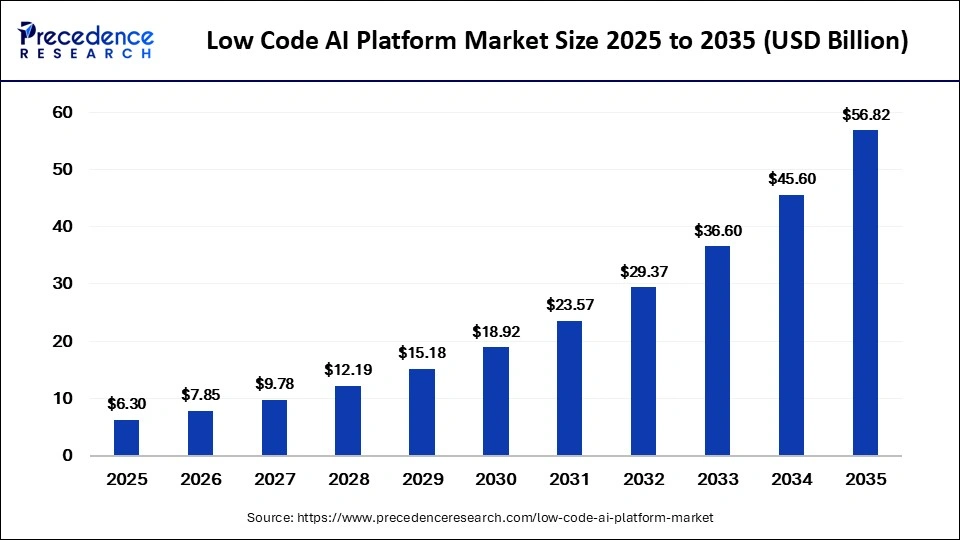
Low-code AI platforms are transforming enterprise software development by enabling users to build AI-powered applications with minimal coding knowledge. These platforms use visual interfaces, drag-and-drop tools, AI copilots, workflow automation systems, and pre-built templates to accelerate application deployment.
The increasing shortage of skilled software developers, combined with rising enterprise demand for AI-driven automation, is fueling rapid adoption of low-code AI solutions across industries such as BFSI, healthcare, retail, manufacturing, telecommunications, and government.
The growing integration of generative AI, machine learning, natural language processing (NLP), robotic process automation (RPA), and predictive analytics within low-code ecosystems is further strengthening market expansion globally.
Read Also: Collaborative Whiteboard Software Market
Understanding Low-Code AI Platforms
Low-code AI platforms are software development environments that allow organizations to build, deploy, and manage intelligent applications using simplified visual tools instead of extensive manual coding.
These platforms generally include:
- Drag-and-drop development interfaces
- AI-assisted coding tools
- Machine learning integration
- Conversational AI frameworks
- Workflow automation systems
- Predictive analytics engines
- Intelligent process automation
- Pre-built AI templates and APIs
Low-code AI platforms significantly reduce development complexity and improve operational agility, enabling businesses to innovate faster while lowering development costs.
Key Market Drivers
Rising Demand for AI Democratization
One of the major drivers of the low-code AI platform market is the increasing push toward AI democratization.
Organizations want business teams, operations staff, and non-technical employees to participate directly in application development and workflow automation initiatives without relying entirely on professional developers.
Low-code AI platforms empower “citizen developers” to create intelligent applications through user-friendly interfaces and AI-driven automation tools.
According to the report, businesses can reduce application development timelines by nearly 80% using low-code AI platforms compared to traditional software development methods.
The growing global shortage of skilled AI engineers and software developers is also encouraging enterprises to adopt simplified AI development environments.
Rapid Integration of Generative AI
Generative AI is reshaping the low-code ecosystem by enabling users to create workflows, applications, and automation systems using natural language prompts.
The generative AI integration segment accounted for approximately 17% of the market share in 2025 and is expected to grow at the fastest CAGR of 32.5% through 2035.
Modern low-code platforms increasingly include AI copilots capable of:
- Generating code automatically
- Designing workflows
- Building chatbots
- Automating documentation
- Creating user interfaces
- Optimizing processes
Developer discussions across online communities indicate growing enterprise interest in agentic AI workflows capable of autonomous decision-making and orchestration. These advancements are expected to significantly reshape enterprise automation strategies over the coming decade.
Growing Demand for Process Automation
The process automation segment held the largest market share of 28% in 2025 due to increasing enterprise demand for operational efficiency and cost optimization.
Organizations increasingly use low-code AI platforms to automate:
- Customer onboarding
- Employee workflows
- IT service management
- Claims processing
- Fraud detection
- Supply chain operations
- Customer support services
- Inventory management
The ability to automate complex workflows without deep technical expertise is significantly accelerating market adoption.
Expanding Cloud Adoption
Cloud deployment continues dominating the low-code AI platform market due to scalability, lower infrastructure costs, and operational flexibility.
The cloud-based segment accounted for nearly 80% of the market share in 2025.
Cloud-native low-code AI platforms allow enterprises to rapidly deploy applications while minimizing infrastructure investments. Subscription-based pricing models further improve accessibility for startups and small-to-medium enterprises.
The rise of hybrid work environments and distributed operations is also increasing demand for cloud-based AI development ecosystems.
Market Restraints
Governance and Security Concerns
Despite strong growth opportunities, governance and security challenges remain major barriers for enterprise-scale adoption.
Many organizations remain concerned about:
- Data privacy risks
- AI governance gaps
- Compliance issues
- Workflow auditability
- Explainability limitations
- Access management challenges
Industry discussions highlight that governance frameworks for autonomous AI workflows and multi-agent orchestration systems are still evolving.
Highly regulated industries such as healthcare, banking, and government require robust compliance and monitoring systems before scaling AI-driven automation initiatives.
Integration Complexity with Legacy Systems
Many enterprises operate highly fragmented legacy IT environments, creating integration challenges for low-code AI deployments.
Complex backend integrations, outdated infrastructure, and compatibility limitations may increase deployment costs and implementation timelines for large organizations.
Vendor Lock-In Risks
Vendor lock-in remains another significant concern in the market.
Organizations worry about long-term dependency on specific low-code platforms because migrating workflows, applications, and AI models between vendors can be costly and technically challenging.
Emerging Opportunities
Rise of Agentic AI and Autonomous Workflows
One of the most promising opportunities in the market is the rise of agentic AI systems capable of autonomous decision-making and workflow orchestration.
Industry experts increasingly discuss the evolution of low-code platforms into “automation fabrics” where AI agents, workflow systems, and orchestration engines work together seamlessly.
Platforms capable of integrating:
- Multi-agent orchestration
- Autonomous AI workflows
- Governance frameworks
- Real-time analytics
- Explainability tools
are expected to gain strong competitive advantages.
Growing Healthcare Adoption
Healthcare is emerging as one of the fastest-growing end-use industries for low-code AI platforms.
The healthcare segment is projected to grow at a CAGR of 26% during the forecast period due to increasing demand for:
- Administrative automation
- Patient engagement solutions
- AI-assisted diagnostics
- Workflow optimization
- Remote patient monitoring
- Intelligent scheduling systems
Low-code AI solutions help healthcare organizations accelerate digital transformation while reducing operational inefficiencies.
Expansion Across Retail and E-Commerce
Retail and e-commerce are expected to witness the fastest growth among end-use industries, registering a CAGR of 28.5% through 2035.
Retailers increasingly leverage low-code AI platforms to:
- Personalize customer experiences
- Optimize inventory forecasting
- Automate marketing campaigns
- Improve recommendation systems
- Streamline logistics operations
The rapid growth of digital commerce worldwide is expected to create substantial long-term opportunities for market players.
Segment Analysis
Cloud-Based Deployment Dominates
By deployment model, cloud-based platforms dominated the market with an 80% share in 2025 due to scalability and lower operational costs.
Cloud deployment enables enterprises to rapidly launch AI-driven applications while supporting remote collaboration and faster innovation cycles.
Meanwhile, on-premises deployment continues growing steadily among enterprises prioritizing stricter data governance and compliance management.
Machine Learning Segment Leads Technology Category
The machine learning segment accounted for approximately 30% of the market share in 2025.
Organizations increasingly rely on machine learning tools for predictive analytics, forecasting, intelligent automation, and recommendation systems.
The NLP segment represented around 20% of the market and is projected to grow rapidly because of rising adoption of conversational AI, virtual assistants, and chatbot technologies.
IT & Telecom Sector Holds Largest Share
The IT and telecom sector dominated the market with a 28% share in 2025 due to accelerating digital transformation initiatives and rising automation investments.
Telecom companies increasingly deploy low-code AI solutions to automate customer support, improve operational efficiency, and enhance digital service delivery.
The BFSI segment also maintains significant market presence because of increasing adoption of intelligent automation and fraud detection systems.
Regional Analysis
North America Leads the Global Market
North America accounted for approximately 46% of the global market share in 2025 due to strong AI investments, advanced digital infrastructure, and early adoption of low-code technologies.
The United States remains the dominant regional market, supported by the presence of major enterprise software providers and hyperscalers.
The U.S. low-code AI platform market is projected to reach nearly USD 19.95 billion by 2035.
Asia-Pacific Emerges as Fastest-Growing Region
Asia-Pacific is projected to grow at the fastest CAGR of 30.5% during the forecast period.
Rapid digitalization, government-backed AI initiatives, expanding startup ecosystems, and increasing enterprise automation demand are driving regional growth.
Countries such as India, China, Singapore, and Japan are rapidly becoming major hubs for AI-powered software innovation.
Europe Maintains Strong Growth Momentum
Europe continues maintaining a strong market position due to increasing enterprise automation investments and rising adoption of AI governance frameworks.
The region is witnessing growing demand for low-code AI solutions across banking, healthcare, manufacturing, and government sectors.
Competitive Landscape
The low-code AI platform market is highly competitive, with global technology providers and enterprise software companies investing heavily in intelligent automation capabilities and AI integration.
Key Companies Operating in the Market
Major market players include:
- Microsoft
- Google Cloud
- Amazon Web Services
- IBM
- Salesforce
- SAP
- Oracle
- Appian
- OutSystems
- UiPath
- ServiceNow
Get a Sample Copy: https://www.precedenceresearch.com/sample/8403
For inquiries regarding discounts, bulk purchases, or customization requests, please contact us at [email protected]
