
 by
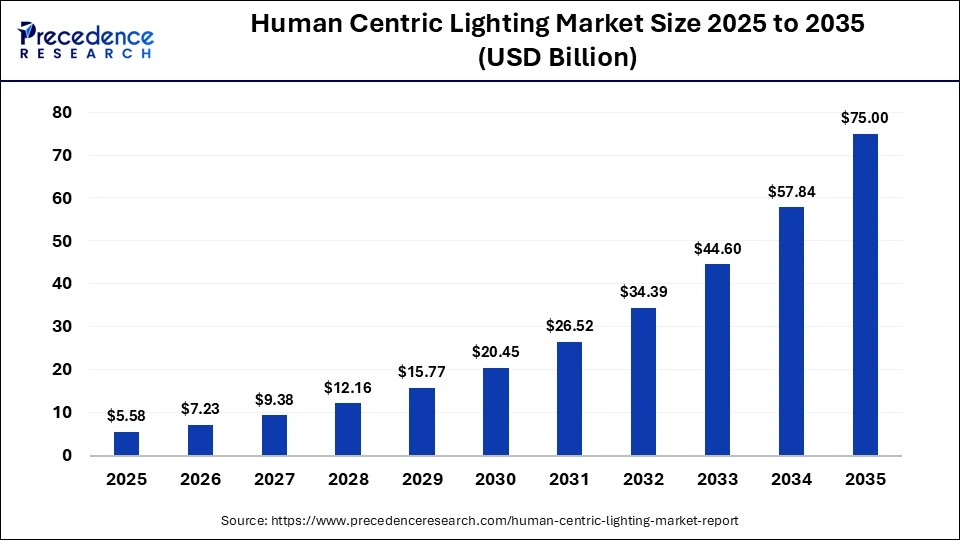
by The global human centric lighting market is projected to grow from USD 7.23 billion in 2026 to USD 75.00 billion by 2035, driven by smart lighting technologies, AI integration, energy efficiency, and increasing focus on health and workplace wellness.
Read Also: Tau Protein Targeting Therapeutics Market
Human Centric Lighting Market Overview
The global human centric lighting market is experiencing remarkable growth as industries increasingly prioritize employee well-being, productivity, and energy-efficient smart infrastructure. The market size was valued at USD 5.58 billion in 2025 and is projected to increase from USD 7.23 billion in 2026 to approximately USD 75.00 billion by 2035, expanding at an impressive CAGR of 29.68% during the forecast period.
Human centric lighting (HCL) is transforming traditional illumination systems into intelligent environments that align with human circadian rhythms. Unlike conventional lighting solutions that focus solely on brightness, HCL systems dynamically adjust color temperature and intensity to mimic natural daylight patterns, improving mood, concentration, sleep quality, and overall wellness.
The increasing adoption of smart buildings, sustainable infrastructure, and AI-powered lighting systems is significantly accelerating market expansion globally.
What is Human Centric Lighting?
Human centric lighting refers to advanced lighting systems specifically designed to support human biological and emotional needs by simulating natural daylight cycles.
These systems automatically adapt lighting conditions throughout the day to:
- Enhance alertness during daytime
- Improve concentration and productivity
- Reduce fatigue and stress
- Support healthy sleep cycles
- Improve emotional well-being
- Increase energy efficiency
Human centric lighting is increasingly being implemented across:
- Corporate offices
- Healthcare facilities
- Educational institutions
- Residential buildings
- Hospitality environments
- Industrial facilities
The technology combines LED lighting, sensors, IoT connectivity, automation systems, and AI algorithms to create intelligent lighting ecosystems.
Key Market Highlights
- The global human centric lighting market is expected to reach USD 75.00 billion by 2035.
- Europe dominated the market with a 39% share in 2025.
- Asia-Pacific is expected to witness the fastest growth during the forecast period.
- Fixtures accounted for the largest product segment with 36% market share in 2025.
- Services are projected to grow at the fastest rate through 2035.
- New installation projects represented 68% of market share in 2025.
- Commercial applications dominated with 60% market share in 2025.
- Residential adoption is expected to accelerate rapidly in the coming years.
How AI is Transforming the Human Centric Lighting Market
Artificial intelligence is emerging as a game-changing technology within the human centric lighting market by enabling highly adaptive and automated lighting systems.
AI-powered lighting systems can:
- Analyze environmental conditions
- Detect human presence and movement
- Automatically adjust brightness levels
- Optimize color temperature in real time
- Reduce energy consumption
- Improve circadian rhythm synchronization
In office environments, AI-enabled lighting systems improve employee focus during work hours and support relaxation later in the day. In healthcare facilities, intelligent lighting assists patient recovery and improves sleep quality.
AI integration also enables predictive maintenance, occupancy-based energy optimization, and smart building management, making lighting systems more sustainable and cost-efficient.
Major Trends Driving the Human Centric Lighting Market
Increasing Adoption Across Commercial Spaces
Commercial buildings remain one of the largest adopters of human centric lighting solutions.
Organizations increasingly recognize that optimized lighting environments can:
- Improve employee productivity
- Reduce workplace fatigue
- Enhance cognitive performance
- Lower absenteeism
- Improve employee satisfaction
Corporate offices, retail stores, hotels, and coworking spaces are investing heavily in smart lighting infrastructure to improve occupant experiences and operational efficiency.
Rising Demand for Smart and Sustainable Buildings
The rapid development of intelligent infrastructure and green buildings is strongly supporting market growth.
Human centric lighting systems contribute significantly to:
- Energy efficiency goals
- Smart building automation
- ESG initiatives
- Sustainable architecture
- Reduced carbon emissions
Governments and regulatory bodies worldwide are encouraging adoption of energy-efficient building technologies, further accelerating demand for HCL systems.
Growing Popularity of Tunable LED Technology
Advanced tunable LED technology is becoming the foundation of modern human centric lighting systems.
Tunable LEDs allow dynamic adjustment of:
- Color temperature
- Brightness intensity
- Daylight simulation
- Circadian rhythm synchronization
This technology is increasingly being adopted in healthcare, education, residential, and industrial environments.
Expanding Smart Home Integration
The growing adoption of smart homes and connected living environments is fueling residential demand for human centric lighting systems.
Consumers increasingly seek lighting solutions that:
- Improve sleep quality
- Enhance comfort
- Support wellness routines
- Integrate with voice assistants
- Offer mobile app controls
Smart lighting ecosystems are becoming central components of modern home automation platforms.
Market Dynamics
Driver: Growing Focus on Employee Wellness and Productivity
One of the primary growth drivers of the human centric lighting market is the increasing focus on workplace wellness.
Businesses are adopting HCL systems to create healthier work environments that support employee performance and mental well-being.
Studies increasingly demonstrate that lighting aligned with natural circadian rhythms can improve:
- Productivity
- Cognitive function
- Mood
- Sleep quality
- Workplace engagement
This is particularly important in corporate offices, educational institutions, and healthcare environments.
Restraint: High Initial Installation Costs
Despite strong market potential, the high upfront costs associated with human centric lighting systems remain a significant challenge.
Costs related to:
- Advanced LED fixtures
- Sensors
- Smart controls
- IoT connectivity
- System integration
can limit adoption, particularly among small businesses and budget-constrained organizations.
Complex integration into existing infrastructure also increases deployment costs and implementation timelines.
Opportunity: Expansion of Advanced LED Lighting Technologies
The growing adoption of advanced LED technologies presents substantial growth opportunities for market participants.
Modern LED systems support:
- Intelligent automation
- Spectral tuning
- Wireless connectivity
- Energy optimization
- Real-time monitoring
As LED prices continue declining and smart building technologies become more accessible, the adoption of human centric lighting is expected to accelerate globally.
Segmental Insights
Fixtures Segment Dominated the Market
The fixtures segment accounted for the largest market share in 2025 due to the critical role lighting fixtures play in delivering biologically optimized illumination.
Modern HCL fixtures integrate:
- Tunable white LEDs
- Occupancy sensors
- Smart control systems
- Wireless communication technologies
Their ability to directly influence occupant comfort and productivity has significantly driven market demand.
Services Segment Expected to Grow Rapidly
The services segment is projected to expand at the fastest rate during the forecast period.
Growing demand for:
- Lighting design consultation
- Installation support
- System integration
- Maintenance services
- Software upgrades
is driving growth across the services category.
As HCL systems become more sophisticated, organizations increasingly rely on specialized technical expertise for implementation and management.
Commercial Applications Lead Market Adoption
Commercial applications dominated the market with a 60% share in 2025.
Corporate offices, retail environments, and hospitality spaces are increasingly deploying HCL systems to improve occupant experiences and operational performance.
Large-scale commercial projects also benefit from:
- Higher energy savings
- Smart building integration
- Enhanced ESG compliance
- Improved workforce productivity
Residential Segment Witnessing Strong Growth
Residential adoption of human centric lighting is expected to increase rapidly in the coming years.
Homeowners increasingly seek lighting systems that support:
- Better sleep quality
- Relaxation
- Mood enhancement
- Personalized living environments
The growth of smart home ecosystems is further accelerating residential market expansion.
Regional Insights
Europe Dominated the Global Market
Europe led the human centric lighting market with a 39% share in 2025.
The region benefits from:
- Strong sustainability regulations
- High adoption of smart buildings
- Advanced lighting research
- Strong awareness regarding workplace wellness
Countries such as Germany are major contributors due to extensive investments in intelligent infrastructure and energy-efficient building systems.
Asia-Pacific Emerging as the Fastest Growing Region
Asia-Pacific is expected to witness the fastest growth during the forecast period due to:
- Rapid urbanization
- Expanding commercial infrastructure
- Smart city initiatives
- Rising healthcare investments
- Increasing adoption of smart homes
China, Japan, and India are becoming major growth centers for advanced lighting technologies.
North America Maintaining Strong Market Presence
North America continues witnessing significant adoption of human centric lighting systems across corporate offices, healthcare facilities, educational institutions, and residential applications.
Strong technology adoption and increasing investment in smart building infrastructure support regional market expansion.
Competitive Landscape
Leading companies operating in the human centric lighting market include:
- Signify Holding
- Acuity Brands
- Zumtobel Group
- Schneider Electric
- Legrand SA
- Eaton Corporation
- Hubbell Lighting
- Wipro Lighting
- LEDVANCE GmbH
- Trilux Group
- Helvar
- Lutron Electronics
These companies are focusing heavily on AI integration, smart lighting innovation, IoT connectivity, and sustainable lighting solutions to strengthen their market positions.
Recent Industry Developments
Hyundai Mobis Introduced AI-Powered Automotive HCL System
In January 2024, Hyundai Mobis introduced an advanced automotive human centric lighting system capable of adjusting car interior lighting based on the driver’s mood and physical condition.
The system automatically modifies brightness, color, and display settings to improve safety and personalized driving experiences.
Get a Sample Copy: https://www.precedenceresearch.com/sample/8227
For inquiries regarding discounts, bulk purchases, or customization requests, please contact us at [email protected]
