
 by
by The global green AI infrastructure market is entering a high-growth phase as organizations increasingly prioritize sustainability alongside computational performance. The market was valued at USD 6.50 billion in 2025 and is projected to grow from USD 8.14 billion in 2026 to USD 61.51 billion by 2035, expanding at a CAGR of 25.20% during the forecast period.
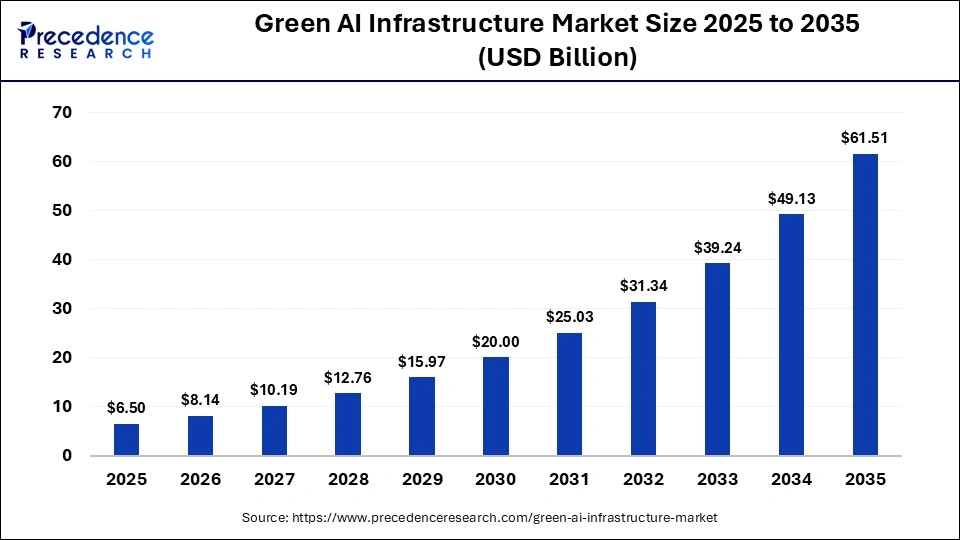
The rapid expansion of AI workloads, combined with rising concerns over energy consumption and carbon emissions, is pushing enterprises to adopt low-carbon, energy-efficient infrastructure. From green data centers to AI-optimized energy management systems, the market is becoming a critical pillar of sustainable digital transformation.
Read Also: High Performance Computing for AI Market
Quick Insights
The green AI infrastructure market generated USD 6.50 billion in 2025 and is expected to reach USD 61.51 billion by 2035, growing at a CAGR of 25.20%. North America dominated with a 35% share in 2025, while Asia Pacific is projected to grow at the fastest CAGR of 27%. Data centers led the infrastructure segment with 50% share, hardware accounted for 45% of components, machine learning & deep learning dominated AI technologies with 45%, and IT & telecommunications led end-use industries with 30% share.
How is Artificial Intelligence Driving Sustainable Infrastructure?
Artificial intelligence is playing a dual role in this market—both as a driver of demand and as a solution for sustainability. AI systems are being used to optimize energy consumption in data centers by dynamically adjusting workloads, improving power usage efficiency (PUE), and reducing energy waste through predictive analytics.
Moreover, AI-powered energy management systems are enabling organizations to integrate renewable energy sources such as solar and wind into their infrastructure. These intelligent systems forecast energy demand, optimize resource utilization, and reduce carbon emissions, making AI infrastructure more sustainable and cost-efficient.
What are the Key Growth Drivers of the Green AI Infrastructure Market?
The primary growth driver is the rising demand for energy-efficient and low-carbon computing systems as AI workloads become more complex and resource-intensive. Organizations are increasingly aligning their technology investments with environmental, social, and governance (ESG) goals.
Additionally, the exponential growth of data generation and AI adoption across industries is increasing the need for high-performance yet sustainable infrastructure. The integration of renewable energy and advancements in cooling technologies are further accelerating market expansion.
What Opportunities and Trends are Shaping the Market?
Is AI-Driven Energy Optimization Creating New Opportunities?
Yes, AI is being used to dynamically manage energy consumption in data centers, improving efficiency and reducing operational costs while minimizing environmental impact.
Are Green Data Centers Becoming the Industry Standard?
Absolutely. Organizations are increasingly investing in sustainable data centers equipped with advanced cooling systems, renewable energy integration, and optimized power usage to meet both performance and sustainability goals.
Is Edge Computing Driving Sustainable AI Adoption?
Yes, edge computing is gaining traction as it reduces latency and energy consumption by processing data closer to the source, minimizing reliance on centralized infrastructure.
Expert Insight
A Principal Consultant at Precedence Research comments:
“Green AI infrastructure represents the convergence of performance and sustainability. Organizations that adopt energy-efficient AI systems today will gain both cost advantages and regulatory alignment in the future digital economy.”
Regional Analysis
North America dominated the global green AI infrastructure market in 2025, accounting for 35% share, driven by advanced digital infrastructure, strong AI adoption, and significant investments in sustainable technologies.
Asia Pacific is expected to grow at the fastest rate, supported by rapid digital transformation, increasing investments in AI infrastructure, and rising adoption of sustainable technologies in countries such as China and India.
Europe also remains a key market due to strict environmental regulations and strong focus on reducing carbon emissions across industries.
Segmental Analysis
By Infrastructure Type
| Infrastructure Type | 2025 Share | 2035 Share | CAGR |
|---|---|---|---|
| Data Centers | 50% | 48% | 24.0% |
| Edge Computing Infrastructure | 20% | 25% | 28.5% |
| Cloud Computing Infrastructure | 25% | 22% | 21.0% |
| Hybrid AI Infrastructure | 5% | 5% | 20.0% |
Data centers dominate due to the high computational demands of AI workloads, while edge computing is expected to grow fastest due to real-time processing needs.
By Component
| Component | 2025 Share | 2035 Share | CAGR |
|---|---|---|---|
| Hardware (GPUs, CPUs, TPUs, Servers) | 45% | 42% | 23.5% |
| Software (AI Models & Data Management) | 25% | 28% | 26.0% |
| Networking Equipment | 15% | 14% | 19.0% |
| Energy Management Solutions | 15% | 16% | 30.0% |
Hardware leads due to demand for high-performance AI processing, while energy management solutions are the fastest-growing segment due to sustainability requirements.
By AI Technology
| AI Technology | 2025 Share | 2035 Share | CAGR |
|---|---|---|---|
| Machine Learning & Deep Learning | 45% | 50% | 26.0% |
| NLP | 15% | 13.5% | 22.0% |
| Computer Vision | 20% | 18.5% | 24.5% |
| Reinforcement Learning | 10% | 9.5% | 23.0% |
| Generative AI | 10% | 9.0% | 28.0% |
Machine learning dominates due to its central role in AI applications, while generative AI is expected to grow rapidly due to compute-intensive workloads.
By End-Use Industry
| End-Use Industry | 2025 Share | Growth Outlook |
|---|---|---|
| IT & Telecommunications | 30% | Dominant |
| Healthcare | 25% | Fast Growth |
| Automotive & Mobility | 15% | Rapid Growth |
| BFSI | 10% | Steady |
| Retail & E-commerce | 10% | Moderate |
| Government & Defense | 5% | Growing |
| Others | 5% | Stable |
IT & telecom dominates due to high demand for AI-driven infrastructure, while healthcare and automotive sectors are emerging as high-growth areas.
Competitive Landscape and Key Companies
The market is highly competitive, with leading players focusing on sustainable computing, AI optimization, and renewable energy integration. Key companies include:
- NVIDIA Corporation
- Intel Corporation
- Microsoft Corporation
- Google LLC
- Amazon Web Services (AWS)
- IBM Corporation
- Hewlett Packard Enterprise
- Cisco Systems
These companies are investing in green data centers, AI-driven energy management solutions, and advanced hardware to reduce the carbon footprint of AI operations.
What Challenges are Impacting Market Growth?
Are High Initial Costs Limiting Adoption?
Yes, the high capital investment required for deploying green AI infrastructure, including renewable energy integration and advanced cooling systems, remains a major challenge.
Is Balancing Performance and Sustainability Difficult?
Achieving high computational performance while minimizing energy consumption requires advanced technologies and optimized system design, which can be complex and resource-intensive.
Case Study: AI-Driven Green Data Centers
Leading hyperscale data centers are integrating AI-powered cooling and energy optimization systems to reduce energy consumption and carbon emissions. These facilities use real-time data analytics to optimize workloads, improve efficiency, and support large-scale AI operations sustainably—demonstrating the real-world impact of green AI infrastructure.
Conclusion
The green AI infrastructure market is poised for transformative growth as sustainability becomes a core priority in the AI ecosystem. With advancements in energy-efficient technologies, renewable integration, and AI-driven optimization, the market is set to redefine how organizations build and operate digital infrastructure in the coming decade.
Get Sample Link: https://www.precedenceresearch.com/sample/8347
For inquiries regarding discounts, bulk purchases, or customization requests, please contact us at [email protected]
