
 by
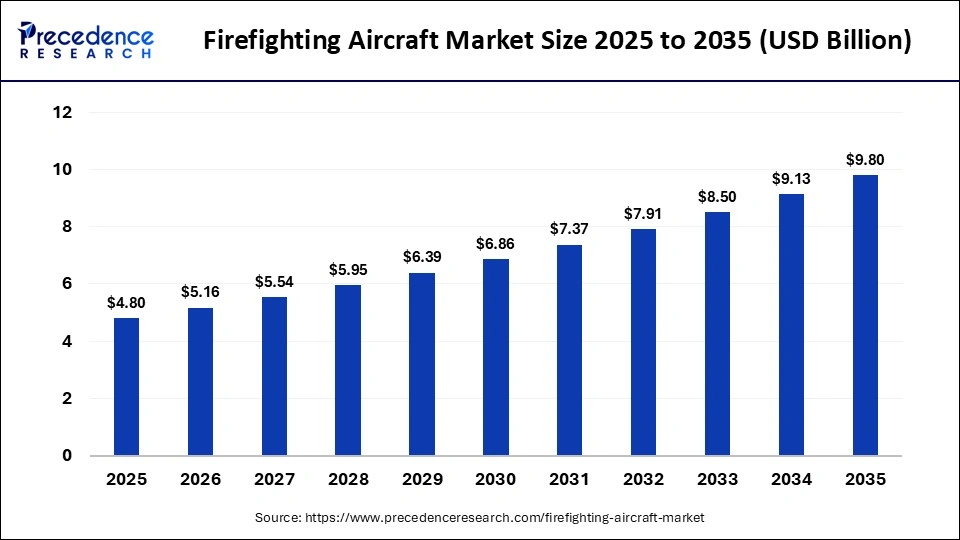
by The global firefighting aircraft market is experiencing steady growth due to the increasing frequency of wildfires and rising investments in aerial firefighting infrastructure. The market was valued at USD 4.80 billion in 2025 and is projected to grow from USD 5.16 billion in 2026 to approximately USD 9.80 billion by 2035, expanding at a CAGR of 7.40% during the forecast period.
Firefighting aircraft are specialized planes and helicopters designed to combat fires by delivering water, foam, or fire retardants. These aircraft are crucial in reaching remote or inaccessible areas where ground-based firefighting methods are ineffective. With climate change intensifying wildfire incidents globally, governments and private agencies are increasingly investing in advanced aerial firefighting fleets.
Read Also: Household Induction Cooktops Market
Key Market Highlights
- Market size projected to reach USD 5.16 billion in 2026
- Expected to hit USD 9.80 billion by 2035
- Growing at a CAGR of 7.40% (2026–2035)
- North America dominated with 42% market share in 2025
- Fixed-wing aircraft led with 60% share by type
- Forest firefighting accounted for 50% share by application
- Government agencies dominated with 65% share by end-user
Market Trends
Increasing Use of AI and Predictive Analytics
Artificial intelligence and satellite-based monitoring systems are being widely adopted to detect wildfires early, optimize flight routes, and improve firefighting efficiency.
Expansion of Aerial Firefighting Fleets
Governments and private operators are investing in modern air tankers, helicopters, and multi-mission aircraft to enhance disaster response capabilities.
Integration of Drones for Fire Monitoring
Drones equipped with thermal imaging and sensors are increasingly used alongside aircraft for real-time fire assessment and coordination.
Advanced Water Dispersal Technologies
Next-generation aircraft are incorporating precision drop systems and improved retardant dispersal technologies to maximize effectiveness and reduce resource wastage.
Impact of Artificial Intelligence on the Market
Artificial intelligence is transforming wildfire management by enabling real-time data analysis and predictive modeling. AI systems process satellite imagery, environmental conditions, and fire behavior patterns to support early detection and efficient resource allocation.
Additionally, AI enhances operational efficiency by optimizing flight paths, monitoring wind patterns, and improving safety for firefighting crews. These advancements are significantly improving the effectiveness of aerial firefighting operations.
Market Dynamics
Driver: Rising Frequency of Wildfires
The increasing occurrence and severity of wildfires worldwide are the primary drivers of market growth. Climate change, prolonged droughts, and rising temperatures are contributing to larger and more frequent fire outbreaks, necessitating rapid-response aerial firefighting solutions.
Restraint: Shortage of Skilled Workforce
A shortage of trained pilots and technical personnel poses a challenge to market expansion. Additionally, high operational and maintenance costs can limit adoption in developing regions.
Opportunity: Technological Advancements and UAV Integration
The integration of unmanned aerial vehicles (UAVs), AI-driven analytics, and advanced firefighting systems presents significant growth opportunities. These technologies enhance operational efficiency, reduce response times, and improve fire containment strategies.
Segment Insights
By Aircraft Type
The fixed-wing aircraft segment dominated the market with a 60% share in 2025, due to its ability to cover large areas quickly and carry significant volumes of water or retardant. These aircraft are ideal for large-scale wildfire suppression operations.
Rotary-wing aircraft (helicopters) held a 40% share and are preferred for precision operations in difficult terrains such as mountains and urban areas. Their maneuverability makes them essential for targeted firefighting and rescue missions.
By Water Tanking Capacity
The large-capacity segment (above 10,000 liters) led the market with a 42% share, driven by its efficiency in combating large wildfires with fewer trips.
Medium-capacity aircraft are also widely used due to their flexibility and cost-effectiveness, particularly in regions with limited infrastructure.
By Application
Forest firefighting dominated the market with a 50% share in 2025, driven by the increasing frequency of wildfires in remote areas.
Structural firefighting is gaining importance due to rising urbanization and industrialization, requiring aerial support for fire suppression in densely populated areas.
Agricultural firefighting is also growing steadily, as protecting farmland and rural areas becomes a priority for governments and private stakeholders.
By End User
Government agencies accounted for the largest share of 65% in 2025, as they are primarily responsible for disaster management and wildfire control.
Private companies are emerging as a fast-growing segment, offering specialized firefighting services to industries, agriculture, and real estate sectors.
Regional Insights
North America: Market Leader
North America held the largest share of 42% in 2025, driven by the high incidence of wildfires, particularly in the western United States and Canada. Strong government funding and advanced firefighting infrastructure support market growth in the region.
The U.S. market is expanding due to increased investments by agencies such as the U.S. Forest Service and National Interagency Fire Center.
Europe: Second-Largest Market
Europe accounted for approximately 28% share, supported by increasing wildfire incidents due to climate change and strong government initiatives to enhance disaster response systems.
Asia Pacific: Fastest Growing Region
Asia Pacific is expected to witness significant growth due to rising investments in disaster management, increasing wildfire risks, and expanding infrastructure.
Countries such as Japan and Australia are investing heavily in modern firefighting aircraft and technologies to improve response capabilities.
Competitive Landscape
The firefighting aircraft market is highly competitive, with key players focusing on fleet modernization, technological innovation, and strategic collaborations. Major companies include:
- Boeing
- Airbus
- Lockheed Martin
- Textron Inc.
- Viking Air Ltd.
- Coulson Aviation
- Erickson Incorporated
- Leonardo S.p.A.
- ShinMaywa Industries
- De Havilland Aircraft of Canada
These companies are investing in advanced aircraft systems, AI integration, and multi-mission capabilities to strengthen their market position.
Recent Developments
- Governments worldwide are increasing investments in aerial firefighting fleets to combat rising wildfire incidents.
- AI and satellite-based monitoring systems are being integrated to improve wildfire detection and response efficiency.
- Advanced aircraft with precision drop systems and enhanced payload capacities are being introduced to improve firefighting effectiveness.
Conclusion
The firefighting aircraft market is poised for steady growth, driven by the increasing frequency of wildfires, technological advancements, and rising government investments. The integration of AI, drones, and advanced aerial firefighting systems is transforming the industry, enabling faster and more effective fire suppression.
As climate change continues to intensify fire risks globally, the demand for advanced firefighting aircraft is expected to rise significantly, positioning the market for long-term growth and innovation.
Get Sample Link: https://www.precedenceresearch.com/sample/8287
For inquiries regarding discounts, bulk purchases, or customization requests, please contact us at sales@precedenceresearch.com
