
 by
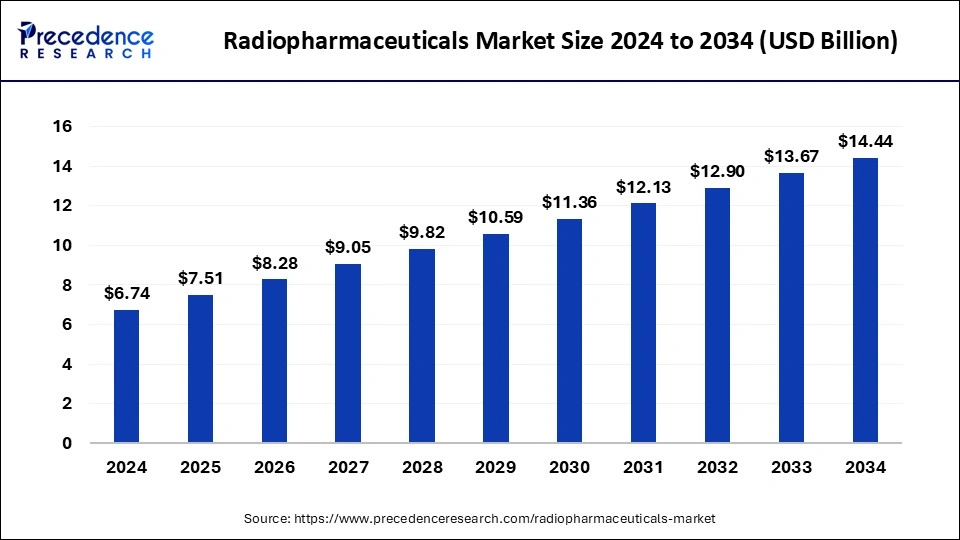
by The global radiopharmaceuticals market, valued at USD 7.51 billion in 2025, is forecasted to nearly double to USD 14.44 billion by 2034, growing at a CAGR of 7.53% over the forecast period. The market’s growth is fueled by rising adoption of personalized medicine, expanding use of advanced imaging techniques such as PET and SPECT, and the increasing prevalence of chronic and oncological diseases worldwide.
Read Also: Clinical Trial Supply and Logistics Market
Market Opportunities: How is AI Revolutionizing Radiopharmaceuticals?
Artificial Intelligence is transforming radiopharmaceutical development and clinical application. AI-driven in silico modeling accelerates the discovery of new compounds, optimizing efficacy and safety while reducing time-to-market. In imaging, AI enhances PET and SPECT precision through advanced algorithms for noise reduction and lesion detection. Theranostics—a combination of diagnostics and therapy—is being optimized with AI to personalize treatment plans, improving outcomes and minimizing side effects.
Segmentation Analysis:
-
By Type: Therapeutic radiopharmaceuticals are growing fastest due to targeted cancer therapies, while diagnostics maintain strong revenue from PET/SPECT imaging.
-
By End User: Hospitals and clinics dominate, though specialized medical imaging centers are emerging as a fast-growing segment.
-
By Radioisotope: Technetium-99m remains the most widely used, while Gallium-68 is rapidly gaining adoption in neuroendocrine tumor imaging and personalized medicine.
-
By Application: Oncology leads, comprising over 50% of market revenue; cardiology is the fastest-growing application area.
Regional and Segmentation Insights
North America remains the market leader, supported by robust healthcare infrastructure, active R&D programs, favorable reimbursement frameworks, and a high incidence of chronic conditions. The U.S. alone is projected to grow from USD 2.43 billion in 2024 to USD 5.13 billion by 2034, at a CAGR of 7.38%.
Asia-Pacific is expected to register the fastest growth due to rising healthcare investments, expanding medical imaging infrastructure, and increasing awareness of nuclear medicine benefits. Europe, Latin America, and the Middle East & Africa are also witnessing incremental adoption, driven by advanced cancer care and diagnostic services expansion.
Market Challenges and Cost Pressures
The market faces stringent regulatory requirements, high costs of radioisotope production, and logistical challenges due to the short half-lives of many isotopes. Reimbursement inconsistencies across regions further complicate widespread adoption.
Case Study: Gallium-68 PET Imaging in Neuroendocrine Tumors
Background:
Neuroendocrine tumors (NETs) are a rare and heterogeneous group of malignancies that are often challenging to detect and monitor due to their small size and slow growth. Traditional imaging techniques such as CT and MRI frequently fail to provide sufficient resolution, leading to delayed diagnosis and suboptimal treatment planning.
Solution
Gallium-68 (Ga-68) labeled radiopharmaceuticals, particularly Ga-68 DOTATATE, have emerged as a breakthrough diagnostic tool for NETs. Ga-68 PET imaging offers superior sensitivity and specificity by binding to somatostatin receptors highly expressed on NET cells.
Implementation
A leading U.S. hospital partnered with a radiopharmaceutical provider to implement an on-site Ga-68 generator system. This allowed rapid production of Ga-68 tracers, reducing transportation delays and ensuring that the short half-life of Ga-68 (≈68 minutes) did not compromise imaging quality. The hospital integrated AI-assisted PET imaging software for improved image reconstruction, noise reduction, and lesion detection, enabling more accurate staging and treatment planning.
Results
-
Diagnosis Accuracy: Improved detection of primary and metastatic NET lesions by 40% compared to conventional imaging.
-
Treatment Planning: Enabled precise targeting for peptide receptor radionuclide therapy (PRRT), reducing radiation exposure to healthy tissues.
-
Operational Efficiency: On-site production decreased tracer delivery time by 60%, allowing more patients to be scanned per day.
-
Patient Outcomes: Early and accurate detection contributed to personalized therapy plans, improving patient survival rates and quality of life.
Conclusion
This case study exemplifies how emerging radioisotopes like Gallium-68, combined with AI-powered imaging solutions, are revolutionizing diagnostics and therapy in oncology. Hospitals and imaging centers adopting these technologies can offer precision medicine approaches, optimize resource utilization, and improve clinical outcomes.
For inquiries regarding discounts, bulk purchases, or customization requests, please contact us at sales@precedenceresearch.com
