
 by
by What is the Particulate Matter Monitoring Market Size in 2026?
The global particulate matter monitoring market size was valued at USD 2.11 billion in 2025 and is projected to grow from USD 2.35 billion in 2026 to approximately USD 6.19 billion by 2035, expanding at a CAGR of 11.36% during the forecast period.
The market growth is primarily driven by rising air pollution levels, stringent environmental regulations, and increasing awareness of the health risks associated with particulate matter exposure.
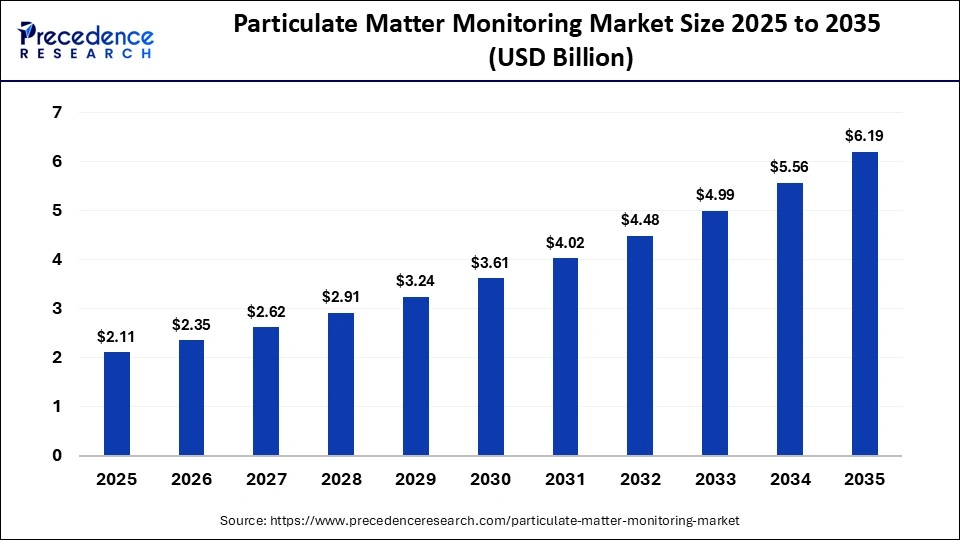
Read Also: Smartwatch Battery Market
Key Takeaways
-
North America dominated the market with a 40% share in 2025
-
Asia-Pacific is expected to grow at the fastest CAGR
-
Indoor monitoring segment held the largest share
-
Outdoor monitoring is projected to grow at the fastest rate
-
Light scattering technology dominated the market
-
Beta attenuation technology is expected to grow rapidly
-
Ambient air monitoring led the market by application
-
Indoor air monitoring is expected to expand at the fastest rate
-
PM2.5 segment held the largest market share
-
PM1 segment is expected to grow at the fastest CAGR
Why is the Particulate Matter Monitoring Market Growing?
The particulate matter monitoring market is expanding steadily due to increasing concerns about air pollution and its impact on human health and the environment.
Key growth drivers include:
-
Rising particulate emissions from vehicles and construction activities
-
Implementation of strict environmental regulations
-
Growing adoption of advanced monitoring technologies
-
Increasing use of IoT-enabled sensors and real-time analytics
Governments and industries are actively deploying monitoring systems to track pollutants such as PM2.5 and PM1, ensuring compliance with air quality standards.
Future Market Outlook
-
Smart City Initiatives: Driving demand for advanced air monitoring networks
-
Indoor Air Quality Focus: Increasing adoption in homes, offices, and hospitals
-
Emerging Economies Growth: Rapid urbanization boosting demand
-
Industrial Monitoring Expansion: Industries adopting systems for compliance
-
Sensor Technology Advancements: Enabling compact and cost-effective devices
Government Initiatives Supporting the Market
-
India: National Clean Air Program – expanding air quality monitoring networks
-
India: National Air Quality Index Program – providing real-time pollution data
-
United States: AirNow Program – delivering public air quality information
-
European Union: Clean Air Policy Package – strengthening air quality regulations
-
Global: Climate and Clean Air Coalition – reducing particulate emissions worldwide
How AI is Transforming the Market
Artificial Intelligence (AI) is enhancing particulate matter monitoring systems by enabling:
-
Real-time air quality tracking
-
Faster data processing
-
Predictive analytics for pollution trends
-
Early warning systems for high pollution levels
AI-powered platforms help governments and organizations take proactive measures to improve air quality and reduce environmental risks.
Key Market Trends
Smart Air Quality Monitoring Systems
Cities and industries are adopting intelligent systems that provide real-time pollution insights and improve environmental management.
IoT Integration
IoT-enabled sensors allow continuous data collection and remote monitoring across large networks.
Portable Monitoring Devices
Handheld devices are gaining popularity for their flexibility in industrial, construction, and research applications.
Strict Environmental Regulations
Governments worldwide are enforcing policies that encourage the use of advanced monitoring technologies.
Expansion of Urban Monitoring Networks
Cities are investing in large-scale monitoring systems to track and manage pollution effectively.
AI and Data Analytics Adoption
Advanced analytics are improving accuracy and enabling better prediction of pollution trends.
Growing Health Awareness
Rising awareness of air pollution’s health impact is increasing demand for monitoring solutions.
Development of Low-Cost Sensors
Affordable technologies are making monitoring accessible to a broader range of users.
Market Scope
| Report Coverage | Details |
|---|---|
| Market Size 2025 | USD 2.11 Billion |
| Market Size 2026 | USD 2.35 Billion |
| Market Size 2035 | USD 6.19 Billion |
| CAGR (2026–2035) | 11.36% |
| Dominating Region | North America |
| Fastest Growing Region | Asia Pacific |
| Base Year | 2025 |
| Forecast Period | 2026–2035 |
Segment Insights
Type Insights
Why Did Indoor Monitoring Dominate?
The indoor monitoring segment led the market due to:
-
Increased awareness of indoor air pollution
-
Growing time spent indoors
-
Adoption in homes, offices, hospitals, and schools
Fastest Growing: Outdoor Monitoring
Growth is driven by:
-
Government initiatives for urban air quality
-
Rising industrial emissions
-
Expansion of smart city projects
Technology Insights
Dominant Segment: Light Scattering
This technology led the market due to:
-
Real-time particle detection
-
High sensitivity
-
Cost-effectiveness
-
Wide usage in portable devices
Fastest Growing: Beta Attenuation
Growth is driven by:
-
High accuracy and regulatory compliance
-
Use in government monitoring stations
-
Advancements in automated monitoring systems
Application Insights
Leading Segment: Ambient Air Monitoring
This segment dominated due to:
-
Rising urban pollution levels
-
Government monitoring programs
-
Increased installation of monitoring stations
Fastest Growing: Indoor Air Monitoring
Growth is fueled by:
-
Rising health awareness
-
Adoption of smart home technologies
-
Demand in commercial spaces
Particle Size Insights
Dominant Segment: PM2.5
PM2.5 led the market due to:
-
Severe health risks
-
Ability to penetrate deep into lungs
-
Strict regulatory focus
Fastest Growing: PM1
Growth is driven by:
-
Increasing awareness of ultrafine particle risks
-
Advances in detection technologies
-
Growing demand for detailed air quality analysis
Regional Analysis
North America
North America dominated the market in 2025 due to:
-
Strong regulatory frameworks
-
Advanced monitoring technologies
-
High investments in environmental monitoring
The U.S. is a key contributor with widespread adoption of IoT-enabled monitoring systems.
Asia-Pacific
Asia-Pacific is expected to grow at the fastest rate due to:
-
Rapid urbanization and industrialization
-
Increasing pollution levels
-
Government initiatives for air quality improvement
India and China are major growth drivers in the region.
Europe
Europe is experiencing steady growth due to:
-
Strict environmental policies
-
Strong sustainability focus
-
Expansion of monitoring infrastructure
Latin America & Middle East & Africa
These regions are growing due to:
-
Increasing environmental awareness
-
Government initiatives
-
Expanding urban infrastructure
Key Companies in the Market
-
Thermo Fisher Scientific Inc.
-
Siemens AG
-
Honeywell International Inc.
-
Teledyne Technologies Incorporated
-
TSI Incorporated
-
Horiba Ltd.
-
3M Company
-
ABB Ltd.
-
AMETEK Inc.
-
Emerson Electric Co.
-
Aeroqual Ltd.
-
Vaisala Oyj
-
Palas GmbH
-
GRIMM Aerosol Technik
-
Kanomax USA Inc.
-
Opsis AB
-
Testo SE & Co. KGaA
-
PerkinElmer Inc.
-
Sick AG
Conclusion
The particulate matter monitoring market is poised for steady growth as governments, industries, and communities prioritize air quality management and environmental sustainability. With advancements in AI, IoT, and sensor technologies, monitoring systems are becoming more efficient, accessible, and accurate.
As global awareness of air pollution continues to rise, the demand for advanced particulate monitoring solutions will remain strong through 2035.
Get Sample: https://www.precedenceresearch.com/sample/8162
For inquiries regarding discounts, bulk purchases, or customization requests, please contact us at sales@precedenceresearch.com
