
 by
by The nuclear reactor market is set for steady growth, driven by the global shift toward low-carbon energy. Innovations such as small modular reactors and AI integration, along with rising investments in nuclear infrastructure, are expected to fuel a projected 6.04% CAGR through 2034.
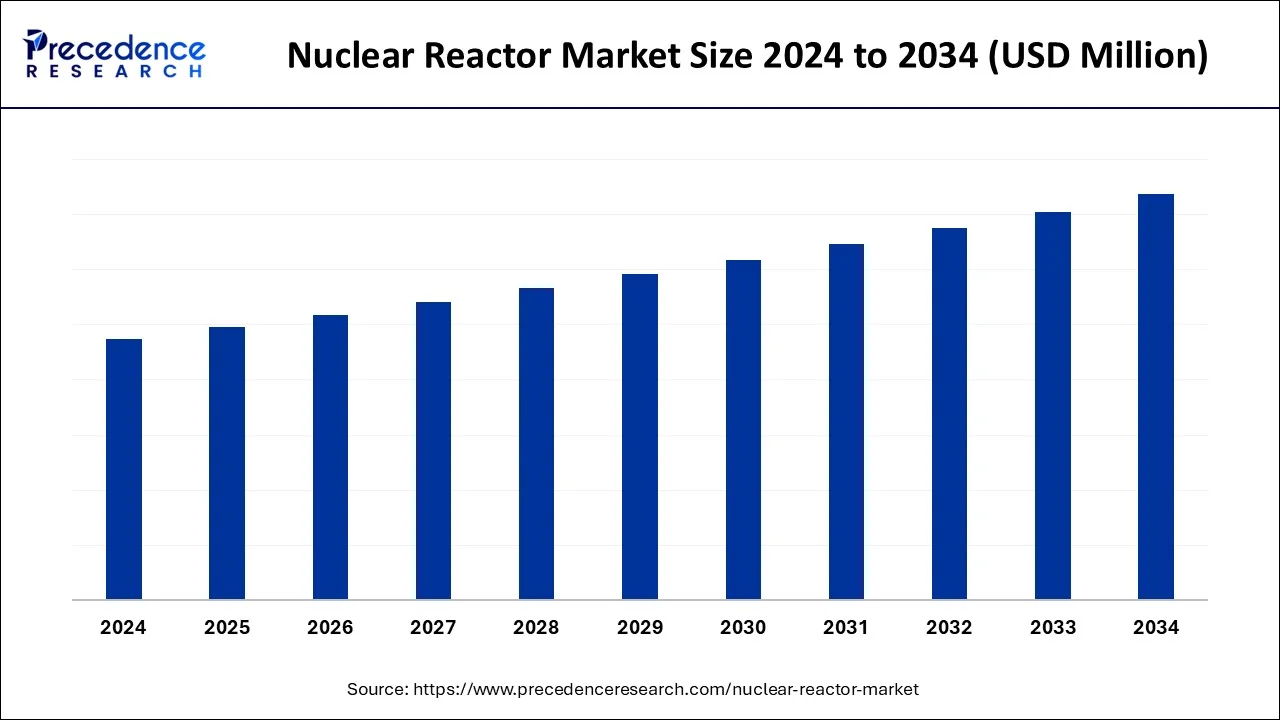
Table of Contents
ToggleImpact of AI on the Nuclear Reactor Market
Artificial Intelligence (AI)is really transforming the nuclear reactor market by enhancing both efficiency and safety. Predictive analysis is one of the key advantages—AI helps anticipate maintenance needs and potential faults, reducing downtime and costs. Real-time performance monitoring through machine learning enables operators to adjust and optimize reactor conditions continuously. This technology not only streamlines operations but also plays a critical role in the development of next-generation nuclear reactors, which are more reliable and efficient, ultimately boosting energy production.
Report Scope
| Report Coverage | Details |
| Market Size by 2034 | USD 50.37 Billion |
| Market Size in 2025 | USD 29.71 Billion |
| Market Size in 2024 | USD 28.02 Billion |
| Market Growth Rate from 2025 to 2034 | CAGR of 6.04% |
| Largest Market | Asia Pacific |
| Base Year | 2024 |
| Forecast Period | 2025 to 2034 |
| Segments Covered | Type, Equipment, and Regions |
| Regions Covered | North America, Europe, Asia-Pacific, Latin America and Middle East & Africa |
The Growing Nuclear Reactor Market: Opportunities, Challenges, and the Role of Clean Energy
The nuclear reactor market is on the brink of significant expansion, driven by the global shift towards clean energy and the increasing investments in nuclear infrastructure. As the world grapples with the challenges of climate change and growing energy demands, nuclear power is emerging as a key solution to meet these needs. However, the market also faces some formidable challenges, particularly in the management of nuclear waste. Understanding the dynamics driving the market, as well as the opportunities and hurdles it faces, is essential for stakeholders involved in the energy sector.
Drivers of Growth: Rising Demand for Clean Energy
A primary driver of growth in the nuclear reactor market is the increasing demand for clean, reliable energy sources. As the world moves toward reducing carbon emissions, nuclear power has garnered attention due to its ability to generate large amounts of electricity without emitting greenhouse gases. Unlike fossil fuels, which contribute significantly to global warming, nuclear reactors provide a clean and efficient alternative. This shift is especially important for governments and energy providers who have set green targets for the future.
The International Energy Agency (IEA) forecasts that nuclear energy, which currently accounts for about 10% of global electricity production, will rise to 12% by 2040. This growth is particularly evident in regions like Asia-Pacific, where countries such as China and India are investing heavily in nuclear infrastructure to meet their energy needs. These countries are expanding their nuclear power capabilities, enabling them to reduce their reliance on coal and other non-renewable energy sources, which further boosts the nuclear market.
Rising Investment in Clean Energy: A Global Trend
Investment in clean energy, including nuclear power, has witnessed a notable increase in recent years. Between 2019 and 2023, global investments in clean energy sources have surged, creating an even stronger case for nuclear power as a sustainable energy solution. Nations across the globe, particularly in the Asia-Pacific, are ramping up efforts to develop nuclear reactors as a core part of their long-term energy strategies.
In addition to government-led initiatives, private sector investments are also playing a crucial role in advancing nuclear energy. In the U.S., for instance, the Department of Energy has announced up to USD 900 million in funding to support the deployment of Generation III+ small modular reactors (SMRs). These advanced reactors are expected to provide a safer, more efficient alternative to traditional nuclear reactors and play a pivotal role in achieving the nation’s clean energy goals. The ongoing investment in nuclear power plants is expected to continue, with projections showing annual growth of 6% through 2030, according to the World Nuclear Association.
Challenges and Restraints: Nuclear Waste Management
Despite the promising outlook, the nuclear reactor market faces several challenges, the most pressing being the issue of nuclear waste management. The handling, storage, and disposal of nuclear waste are not only highly complex but also expensive. As the number of reactors increases, so does the volume of waste, which requires long-term solutions that are safe, sustainable, and globally acceptable.
The absence of universal regulations governing nuclear waste disposal further complicates the situation. Without consistent standards, international cooperation on waste disposal becomes difficult, hindering the market’s expansion. Finding viable solutions to the nuclear waste problem is essential to the future of nuclear power, as unresolved waste management issues could slow down the growth of nuclear energy.
Nuclear Reactor Market Companies
- Alstom
- AREVA
- BWX Technologies, Inc.
- Dongfang Electric Corp., Ltd.
- Doosan Corporation
- General Electric
- Korea Electric Power Corporation
- Larsen & Toubro Limited
- Mitsubishi Heavy Industries, LTD.
- Shanghai Electric
- The State Atomic Energy Corporation
- Toshiba Corporation
Read Also : Automotive Cybersecurity Market
For inquiries or to place an order, please contact us at: 📧 sales@precedenceresearch.com | ☎️ +1 804 441 9344
