
 by
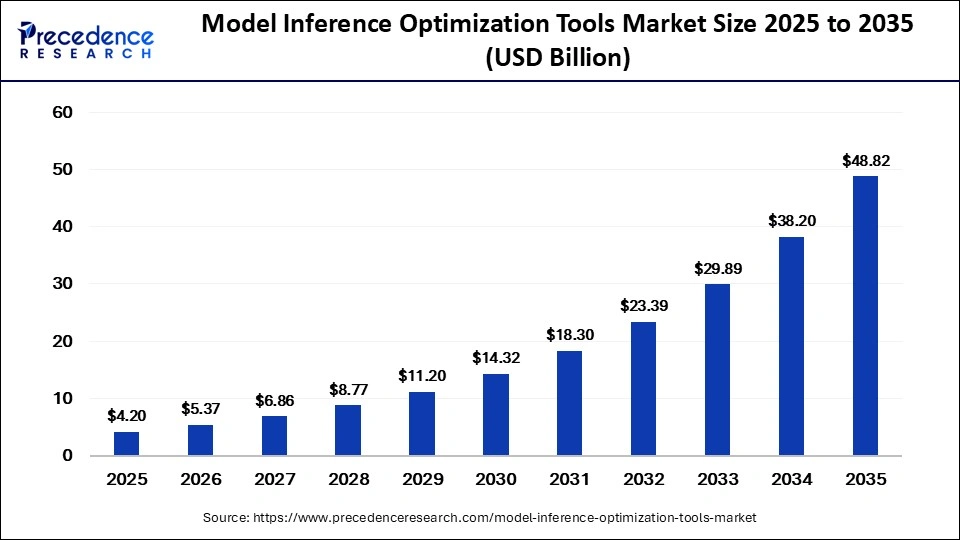
by The global model inference optimization tools market is expected to reach USD 18.92 billion by 2035, growing at a CAGR of 24.8%. Explore AI trends, edge computing growth, market dynamics, segmentation, and future opportunities.
Read Also: Data Center Cable Market
Model Inference Optimization Tools Market: Powering the Next Generation of Scalable Artificial Intelligence
Introduction: The Growing Importance of AI Inference Optimization
Artificial intelligence is rapidly transforming industries worldwide, but deploying AI models efficiently in real-world environments has become one of the industry’s biggest technical and economic challenges. While AI training requires enormous computational resources, inference—the stage where trained AI models generate predictions and responses in real time—has become equally critical as enterprises scale AI adoption across cloud, edge, and on-device environments.
Modern AI systems, especially generative AI models and large language models (LLMs), demand massive processing power, low latency, and high operational efficiency. This growing complexity has accelerated demand for model inference optimization tools, software solutions specifically designed to improve the speed, efficiency, scalability, and resource utilization of AI inference workloads.
As enterprises increasingly deploy AI into mission-critical operations, inference optimization is emerging as a foundational layer of the global AI infrastructure ecosystem.
Market Overview: Rapid Expansion Driven by Enterprise AI Adoption
The global model inference optimization tools market was valued at USD 2.45 billion in 2025 and is projected to grow from USD 3.05 billion in 2026 to approximately USD 18.92 billion by 2035, expanding at an impressive CAGR of 24.80% during the forecast period.
The market is witnessing strong momentum due to:
- Rising deployment of generative AI and LLMs
- Increasing demand for low-latency AI applications
- Rapid growth of edge AI infrastructure
- Escalating AI cloud computing costs
- Increasing adoption of AI accelerators and GPUs
- Growing need for energy-efficient AI deployment
As organizations seek to reduce AI operational costs while maintaining performance, optimization technologies are becoming essential for scalable AI implementation.
Understanding Model Inference Optimization Tools
Model inference optimization tools are specialized software platforms designed to improve the execution efficiency of trained AI models during deployment.
These tools optimize:
- Inference speed
- Latency
- Throughput
- Memory usage
- Energy consumption
- Hardware utilization
Optimization tools are widely used across:
- Cloud AI infrastructure
- Edge devices
- Smartphones
- Autonomous vehicles
- Industrial IoT systems
- Healthcare AI platforms
- Financial analytics systems
They help organizations maximize AI performance while minimizing computational costs and resource consumption.
Key Market Trends
1. Explosive Growth of Generative AI and Large Language Models
The rapid adoption of generative AI platforms is significantly increasing demand for inference optimization technologies.
Large language models require substantial computing resources during inference, especially when deployed across millions of users. Optimization tools help enterprises:
- Reduce GPU consumption
- Lower inference latency
- Improve scalability
- Minimize cloud infrastructure costs
As AI chatbots, copilots, and multimodal AI systems become mainstream, inference optimization is becoming a critical operational requirement.
2. Expansion of Edge AI Applications
Edge AI is rapidly gaining adoption across industries such as:
- Automotive
- Manufacturing
- Retail
- Healthcare
- Telecommunications
- Smart cities
Edge devices often operate under strict power and computing limitations, making optimization essential for real-time AI processing.
Inference optimization tools enable AI models to run efficiently on:
- Embedded systems
- IoT devices
- Mobile platforms
- Industrial sensors
- Autonomous systems
The rise of edge computing is expected to remain a major growth driver throughout the forecast period.
3. Rising Adoption of Quantization and Compression Technologies
Quantization emerged as the dominant optimization technique in 2025 due to its ability to significantly reduce computational overhead.
Popular Optimization Techniques Include:
- Quantization
- Pruning
- Tensor optimization
- Graph optimization
- Distillation
- Kernel fusion
These techniques improve inference efficiency while maintaining acceptable model accuracy levels.
Organizations increasingly rely on these technologies to reduce infrastructure costs and improve AI deployment scalability.
4. Hardware-Aware Optimization Becoming Essential
AI optimization tools are increasingly designed to work closely with advanced AI hardware such as:
- GPUs
- TPUs
- NPUs
- AI accelerators
- FPGA systems
Hardware-aware optimization helps maximize performance across heterogeneous computing environments.
As semiconductor companies continue developing AI-specific chips, optimization software is becoming increasingly important for unlocking hardware efficiency.
5. Growing Focus on Energy-Efficient AI Infrastructure
The rapid expansion of AI workloads is significantly increasing global data center energy consumption.
Organizations are increasingly using inference optimization tools to:
- Reduce power consumption
- Improve computational efficiency
- Lower cooling requirements
- Enhance sustainable AI deployment
Energy-efficient AI infrastructure is becoming a major strategic priority for enterprises and cloud providers.
Market Dynamics
Market Drivers
Increasing Enterprise AI Deployment
Businesses across industries are integrating AI into:
- Customer service automation
- Fraud detection
- Predictive analytics
- Industrial automation
- Healthcare diagnostics
- Recommendation systems
This widespread AI adoption is increasing demand for scalable inference optimization solutions.
Demand for Real-Time AI Processing
Applications such as:
- Autonomous driving
- Video analytics
- Financial trading
- Medical imaging
- Smart surveillance
require ultra-low-latency AI processing, making optimization technologies essential.
Rapid Expansion of AI Cloud Infrastructure
Cloud service providers are increasingly offering AI inference services at scale.
Optimization tools help improve:
- Resource allocation
- GPU utilization
- Infrastructure scalability
- Service efficiency
As AI cloud workloads continue expanding, optimization technologies are becoming critical for sustainable cloud economics.
Advancements in AI Accelerators
The rapid evolution of AI chips and accelerators is creating new opportunities for specialized optimization platforms capable of supporting diverse hardware architectures.Market Challenges
Complexity of Modern AI Models
Modern AI architectures are becoming increasingly complex, making optimization more technically challenging.
Organizations often face difficulties related to:
- Multi-model orchestration
- Cross-platform deployment
- Hardware-specific tuning
- Accuracy preservation
Balancing Optimization and Accuracy
Aggressive optimization methods can sometimes reduce model precision and reliability.
Maintaining performance without compromising accuracy remains a major challenge for AI developers.
Shortage of Skilled AI Infrastructure Talent
Deploying and optimizing large-scale AI systems requires specialized expertise in:
- Machine learning engineering
- AI infrastructure
- GPU optimization
- Distributed computing
The global shortage of AI infrastructure professionals remains a significant barrier for many organizations.
Regional Insights
North America – Dominant Region
North America accounted for the largest market share in 2025 due to:
- Strong AI ecosystem
- Presence of major cloud providers
- Advanced semiconductor industry
- High enterprise AI adoption
The United States remains the global leader in AI infrastructure innovation.
Asia Pacific – Fastest Growing Region
Asia Pacific is projected to witness the fastest CAGR during the forecast period.
Growth Drivers Include:
- Rapid digital transformation
- Expansion of AI startups
- Government AI initiatives
- Increasing cloud infrastructure investments
Countries such as China, India, Japan, and South Korea are driving regional market growth.
Europe
Europe continues to experience steady growth supported by:
- Enterprise digital transformation
- Industrial AI adoption
- Increasing AI regulation frameworks
Competitive Landscape
The model inference optimization tools market is becoming highly competitive as:
- AI software vendors
- Semiconductor companies
- Cloud providers
- Enterprise AI startups
expand their optimization capabilities.
Companies are focusing on:
- Hardware-software integration
- Open-source optimization frameworks
- Edge AI deployment solutions
- Low-latency AI infrastructure
- Energy-efficient AI processing
Strategic collaborations between AI infrastructure companies and semiconductor manufacturers are accelerating innovation across the industry.
Future Outlook: Toward Sustainable and Autonomous AI Infrastructure
The future of AI deployment will heavily depend on advanced inference optimization technologies.
Key Future Trends
- Autonomous AI infrastructure management
- AI-native optimization platforms
- Real-time multimodal AI inference
- Energy-aware AI deployment
- Multi-cloud AI orchestration
- Optimization for edge-native AI systems
As AI models continue to scale in size and complexity, optimization tools will become indispensable components of global AI infrastructure.
Conclusion
The model inference optimization tools market is emerging as one of the most critical pillars of the modern AI ecosystem. As enterprises increasingly deploy AI across cloud, edge, and real-time environments, efficient inference optimization is becoming essential for scalable and cost-effective AI adoption.
