
 by
by The global data labeling and annotation tools market is experiencing rapid expansion as artificial intelligence (AI) and machine learning (ML) applications continue to scale across industries. The market was valued at USD 3.20 billion in 2025 and is projected to grow from USD 4.06 billion in 2026 to approximately USD 34.38 billion by 2035, registering a strong CAGR of 26.80% during the forecast period.
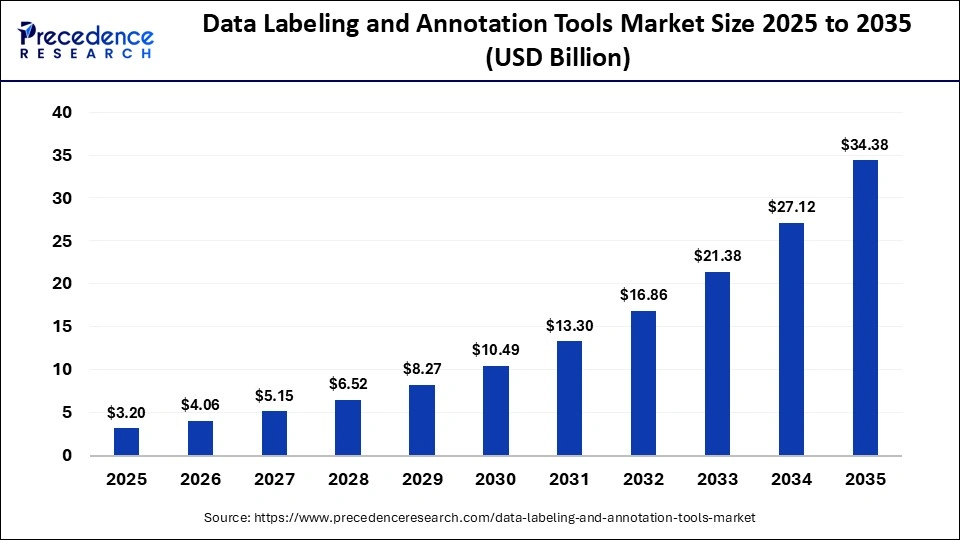
The increasing reliance on AI models for automation, analytics, and decision-making has created a critical need for high-quality labeled datasets, positioning data annotation tools as the backbone of modern AI systems.
Read Also: Federated Learning Market
Quick Insights (Market Snapshot)
- North America dominated the market with 40% share in 2025
- Asia Pacific is expected to grow at the fastest CAGR
- Cloud-based platforms led with 60% market share
- Automotive (autonomous vehicles) segment held 25% share
- Healthcare & life sciences segment is expected to grow significantly
How is AI Transforming Data Labeling and Annotation?
Artificial intelligence is not only driving demand for labeled data—it is also transforming how data annotation is performed. AI-powered tools now leverage computer vision and natural language processing (NLP) to automate labeling processes, significantly improving speed and consistency.
Moreover, the rise of human-in-the-loop (HITL) systems combines automation with human validation, ensuring both scalability and accuracy. This hybrid model is becoming essential for training high-performance AI systems at scale.
Market Growth Drivers
Why is the Demand for Data Annotation Increasing?
The rapid adoption of AI across industries—from healthcare diagnostics to financial analytics—is driving the need for structured and labeled data. High-quality annotations are essential for training accurate machine learning models.
How Are Autonomous Systems Driving Growth?
The expansion of autonomous vehicles, drones, and robotics is a major growth driver. These technologies rely heavily on annotated datasets such as images, videos, and sensor data for object detection and navigation.
What Role Does Cloud Adoption Play?
Cloud-based annotation platforms are gaining traction due to their scalability, cost efficiency, and ability to support distributed teams, making them ideal for large-scale AI projects.
Segment Analysis
By Deployment Mode: Why Do Cloud Platforms Dominate?
- Cloud-based platforms hold 60% market share, driven by scalability and collaboration features
- On-premise solutions (20%) are preferred for sensitive data environments
- Hybrid platforms (20%) are the fastest-growing due to flexibility and security balance
By End-Use Industry: Which Sectors Lead Adoption?
- Automotive (25%) leads due to demand for autonomous driving systems
- Healthcare & life sciences (15%) is rapidly growing with AI-driven diagnostics
- Retail & e-commerce (15%) uses annotation for personalization
- IT & telecommunications (15%) leverages it for network optimization
- BFSI (10%) focuses on fraud detection and analytics
- Government & defense (10%) ensures secure AI deployment
Regional Analysis
Why Does North America Lead the Market?
North America dominates due to its advanced AI ecosystem, strong cloud infrastructure, and early adoption of machine learning technologies.
Why is Asia Pacific the Fastest-Growing Region?
Asia Pacific is experiencing rapid growth due to digital transformation, rising internet penetration, and increasing AI adoption across industries.
What Role Does Europe Play?
Europe contributes significantly with its focus on data governance, privacy regulations, and ethical AI frameworks.
Competitive Landscape
Key companies operating in the market include:
- Appen Ltd.
- Scale AI
- Amazon Mechanical Turk Inc.
- Labelbox
- iMerit
- CloudFactory
- Lionbridge Technologies LLC
- Cogito Tech LLC
- Clickworker GmbH
- Google LLC
These players are focusing on AI-driven automation, scalable platforms, and industry-specific solutions to strengthen their market presence.
Challenges and Cost Pressures
Despite strong growth, the market faces several challenges:
- Data privacy and security concerns due to outsourcing and distributed teams
- High operational costs for large-scale annotation projects
- Complexity of maintaining data quality and consistency
- Regulatory restrictions on cross-border data transfer
Opportunities & Emerging Trends
How is Multimodal Data Shaping the Market?
The growing use of multimodal datasets (text, image, video, audio) is creating demand for advanced annotation tools capable of handling diverse data types.
What Opportunities Exist in Industry-Specific Solutions?
Different industries require specialized annotation approaches. For example, healthcare requires expert-labeled medical data, while autonomous systems demand precise object detection.
How is AI-Assisted Annotation Evolving?
AI-assisted labeling combined with human validation is becoming the standard approach, improving efficiency and reducing costs.
Case Insight: Autonomous Vehicles Driving Demand
The automotive industry provides a strong example of market growth. Autonomous vehicles rely on annotated datasets—such as LiDAR, images, and video—to detect objects, interpret traffic conditions, and navigate safely.
As self-driving technology advances, the demand for accurate and scalable annotation tools continues to rise.
Conclusion
The data labeling and annotation tools market is a critical enabler of the global AI revolution. As organizations increasingly rely on data-driven insights, the demand for accurate, scalable, and intelligent annotation solutions will continue to grow.
With rapid advancements in AI, cloud computing, and automation, the market is poised for exponential growth through 2035, shaping the future of artificial intelligence across industries.
Get Sample Link: https://www.precedenceresearch.com/sample/8340
For inquiries regarding discounts, bulk purchases, or customization requests, please contact us at [email protected]
