
 by
by Market Overview
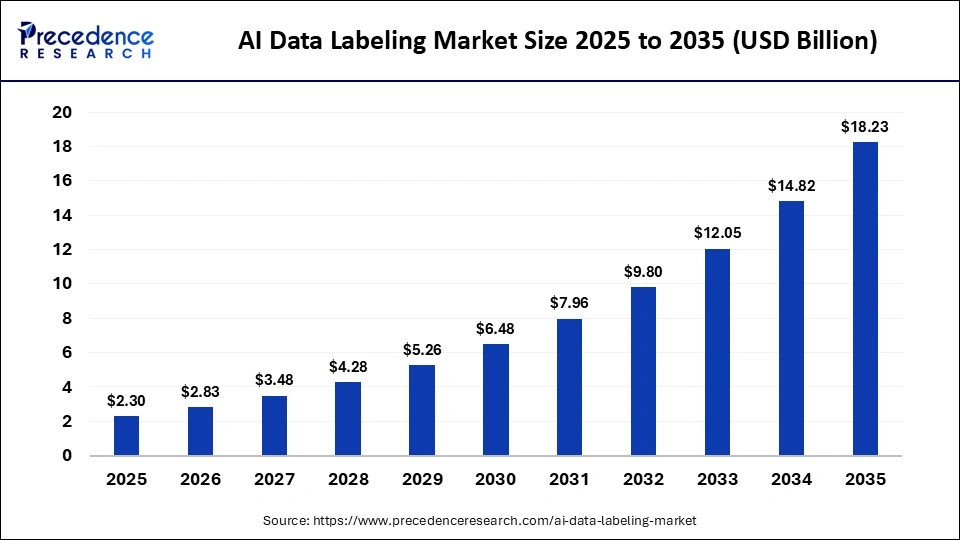
The global AI Data Labeling Market is experiencing rapid expansion, driven by the accelerating adoption of artificial intelligence across industries. The market was valued at USD 2.30 billion in 2025 and is projected to grow from USD 2.83 billion in 2026 to approximately USD 18.23 billion by 2035, registering an impressive CAGR of 23.00% during the forecast period.
This exceptional growth highlights the critical role of labeled data in enabling machine learning models to deliver accurate predictions, automation, and intelligent decision-making. As AI applications become more complex, the demand for high-quality, scalable, and diverse datasets continues to surge.
Read Also: Chemical Hydrogen Market
Understanding AI Data Labeling
AI data labeling is the process of annotating raw datasets—including text, images, videos, audio, and sensor data—to make them usable for training AI and machine learning models. It is foundational to supervised learning systems.
Why It Matters
Without labeled data, AI systems cannot:
- Identify objects in images
- Understand language context
- Recognize speech patterns
- Interpret real-world environments
From autonomous vehicles to chatbots and medical diagnostics, data labeling acts as the backbone of AI innovation.
Key Growth Drivers
1. Rising Adoption of AI Across Industries
Industries such as automotive, healthcare, finance, retail, and manufacturing are rapidly adopting AI, significantly increasing the demand for labeled datasets.
2. Explosion of Data Generation
With the proliferation of IoT devices, smartphones, and digital platforms, massive volumes of structured and unstructured data are generated daily, requiring labeling for AI training.
3. Growth of Autonomous Systems
Self-driving cars, robotics, and smart surveillance systems depend heavily on accurately labeled image, video, and sensor data.
4. Demand for High-Quality Training Data
AI model performance is directly linked to the quality of training data, pushing organizations to invest in precision labeling and quality assurance.
5. Regulatory and Compliance Requirements
Industries like healthcare and BFSI require accurate and compliant datasets, boosting demand for controlled and high-quality labeling processes.
Technological Advancements Reshaping the Market
AI-Assisted Labeling
AI models now pre-label data, while humans validate and refine it—reducing cost and time significantly.
Synthetic Data Generation
Organizations are increasingly using artificially generated datasets to:
- Reduce dependency on real-world data
- Address privacy concerns
- Simulate rare scenarios
Human-in-the-Loop Systems
Combining human expertise with machine automation ensures:
- Higher accuracy
- Continuous learning
- Better handling of edge cases
Multimodal Data Labeling
Modern AI systems require labeling across:
- Text
- Images
- Video
- Audio
- 3D point cloud data
Emerging Market Trends
Strategic Collaborations
Companies are forming partnerships with cloud providers and AI firms to scale data labeling operations efficiently.
Cloud Integration
Cloud-based labeling platforms enable:
- Real-time collaboration
- Scalability
- Seamless data pipeline integration
Localization and Language Expansion
Growing demand for multilingual datasets is driving global outsourcing and regional workforce expansion.
Data Privacy and Security Focus
Organizations are shifting toward in-house labeling to maintain control over sensitive data.
Continuous Data Pipelines
Instead of static datasets, companies are adopting continuous labeling workflows for real-time AI model updates.
Segment Analysis
By Sourcing Type
- Outsourced (Dominant in 2025):
Offers scalability, cost efficiency, and access to global talent pools. - In-House (Fastest Growing):
Preferred for sensitive data handling, ensuring security and regulatory compliance.
By Data Type
- Text (Largest Share):
Widely used in NLP, chatbots, and generative AI applications. - Image (Fastest Growing):
Driven by computer vision use cases such as facial recognition, medical imaging, and retail analytics.
By Labeling Method
- Manual Labeling (Dominant):
Ensures high accuracy for complex datasets requiring human judgment. - Automatic Labeling (Fastest Growing):
Reduces cost and accelerates large-scale data processing. - Human-in-the-Loop:
Combines automation with human validation for optimal results.
By End-User Industry
- Automotive & Mobility (Leading Segment):
Driven by autonomous vehicles and ADAS technologies. - Healthcare & Life Sciences (Fastest Growing):
Increasing use of AI in diagnostics, imaging, and drug discovery. - Other sectors include:
- Retail & e-commerce
- BFSI
- IT & telecom
- Industrial robotics
Regional Insights
🇺🇸 North America (Market Leader)
North America dominated the market in 2025 due to:
- Strong AI ecosystem
- Advanced cloud infrastructure
- Presence of major tech companies
The U.S. leads with significant investments in AI research, startups, and automation technologies.
Asia Pacific (Fastest Growing Region)
Asia-Pacific is expected to grow at the highest CAGR, driven by:
- Rapid digital transformation
- Government AI initiatives
- Cost-effective workforce for labeling
Countries like China and India are emerging as key hubs for data annotation services.
Europe (Steady Growth)
Europe is growing steadily due to:
- Strong regulatory frameworks
- Increasing adoption of AI in healthcare and manufacturing
- Focus on data privacy and ethical AI
Value Chain Analysis
The AI data labeling market value chain includes:
- Data Collection: Gathering raw datasets
- Annotation & Labeling: Manual or automated tagging
- Quality Assurance: Validation and error correction
- Data Management: Storage, integration, and processing
- Deployment: Feeding labeled data into AI models
Key Companies
Major players in the AI data labeling market include:
- Amazon Web Services
- Google LLC
- Microsoft Azure
- Appen Limited
- Scale AI Inc
- Sama Inc
- iMerit Technologies Pvt Ltd
- Labelbox Inc
- Dataloop AI Ltd
- Lionbridge AI
These companies focus on expanding automation capabilities, improving accuracy, and scaling global operations.
Recent Developments
- Advanced annotation tools and automation platforms are improving labeling efficiency.
- AI-powered metadata generation is reducing manual effort in video and multimedia labeling.
- Human-in-the-loop systems are becoming standard for complex datasets.
Future Outlook
The AI data labeling market is poised for transformative growth, driven by:
- Expansion of generative AI and large language models
- Growth in autonomous systems and robotics
- Increasing adoption of AI in healthcare and finance
- Advancements in synthetic data and automation tools
As AI continues to evolve, the demand for accurate, scalable, and high-quality labeled data will remain a cornerstone of innovation.
Conclusion
The AI data labeling market is set to grow dramatically, reaching USD 18.23 billion by 2035. With a strong CAGR of 23.00%, the industry represents one of the fastest-growing segments within the AI ecosystem.
Organizations that invest in advanced labeling technologies, automation, and quality data pipelines will be best positioned to leverage the full potential of AI.
Get Sample Copy: https://www.precedenceresearch.com/sample/7902
For inquiries regarding discounts, bulk purchases, or customization requests, please contact us at sales@precedenceresearch.com
