
 by
by 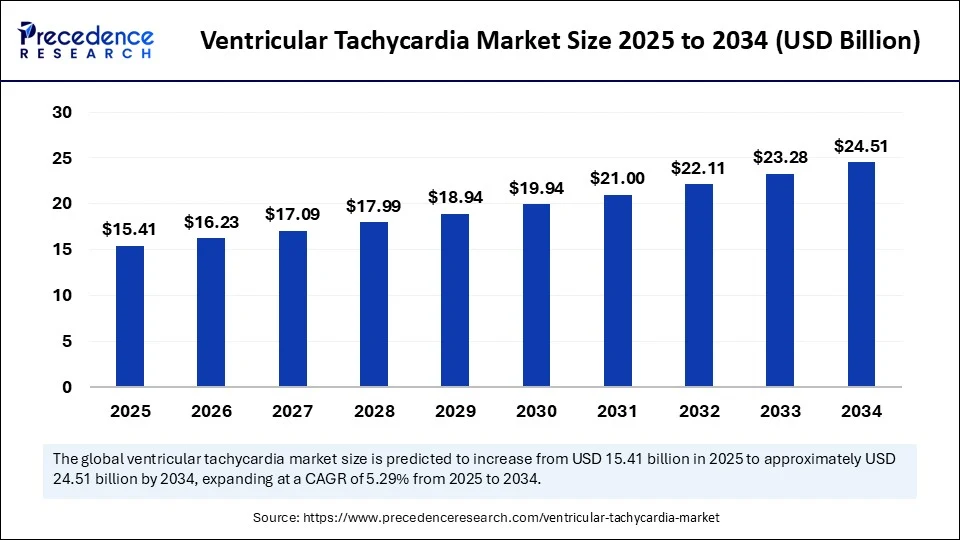
Ventricular Tachycardia Market Key Highlights
-
The global ventricular tachycardia market was valued at USD 14.64 billion in 2024 and is projected to reach USD 24.51 billion by 2034, growing at a CAGR of 5.29% from 2025 to 2034.
-
North America led the market in 2024, while the Asia Pacific region is expected to register the fastest CAGR during the forecast period.
-
By diagnostic technique, the electrocardiogram (ECG) segment held the largest market share in 2024, whereas the continuous ambulatory monitoring segment is projected to grow at the highest CAGR through 2034.
-
In terms of treatment, the emergency treatment segment dominated in 2024, while the long-term treatment segment is expected to grow at the fastest pace over the forecast period.
-
Based on disease type, ischemic ventricular tachycardia accounted for the highest market share in 2024, while non-ischemic ventricular tachycardia is anticipated to grow at the fastest CAGR in the upcoming years.
-
By end user, hospitals were the leading contributors in 2024, whereas specialty clinics are projected to expand at the highest growth rate during the forecast period.
Ventricular Tachycardia Market Overview
The ventricular tachycardia (VT) market is evolving rapidly in response to growing awareness, increasing cardiac disease prevalence, and technological advancements in cardiac diagnostics and treatment. VT is a life-threatening arrhythmia originating from the lower chambers of the heart, often associated with structural heart diseases such as myocardial infarction, cardiomyopathy, and heart failure. The global VT market encompasses antiarrhythmic drugs, catheter ablation procedures, implantable cardioverter-defibrillators (ICDs), advanced mapping systems, and supportive diagnostic tools.
As of 2024, the market is estimated to be valued in the multi-billion-dollar range and is poised to grow at a steady CAGR over the next decade due to rising demand for early diagnosis and treatment of life-threatening arrhythmias, along with ongoing innovations in electrophysiology and device therapy.
Ventricular Tachycardia Market Growth Factors
Several key factors are driving market growth. Firstly, the global burden of cardiovascular diseases (CVDs)—particularly ischemic heart disease and heart failure—is rising significantly due to aging populations and lifestyle risk factors such as obesity, hypertension, and diabetes. This leads to an increase in the incidence of ventricular arrhythmias, including VT.
Secondly, advancements in cardiac electrophysiology, such as three-dimensional electroanatomic mapping and improved radiofrequency ablation catheters, have enhanced procedural safety and efficacy, encouraging the adoption of catheter ablation as a preferred therapy. Furthermore, increased awareness and screening initiatives have enabled earlier diagnosis, improving patient outcomes and expanding the pool of patients eligible for treatment. The growing emphasis on cardiac monitoring through wearable and remote technologies is also contributing to market expansion by facilitating early detection of arrhythmic events.
AI Role in the Ventricular Tachycardia Market
Artificial intelligence is revolutionizing the ventricular tachycardia landscape through predictive analytics, personalized care, and clinical decision support. AI algorithms are being trained on large datasets from electrocardiograms (ECGs), Holter monitors, and implantable devices to detect subtle patterns and identify patients at risk of VT.
In interventional settings, AI-assisted electroanatomical mapping systems help electrophysiologists better localize the arrhythmogenic foci, thereby improving the success rates and reducing procedure times in VT ablation. Machine learning models also aid in optimizing ICD programming and predicting arrhythmic burden post-device implantation, leading to fewer unnecessary shocks and better patient management. Additionally, AI is being used in drug development to model the cardiac effects of new antiarrhythmic compounds and reduce the risk of proarrhythmia.
Market Scope
| Report Coverage | Details |
| Market Size by 2034 | USD 24.51 Billion |
| Market Size in 2025 | USD 15.41 Billion |
| Market Size in 2024 | USD 14.64 Billion |
| Market Growth Rate from 2025 to 2034 | CAGR of 5.29% |
| Dominating Region | North America |
| Fastest Growing Region | Asia Pacific |
| Base Year | 2024 |
| Forecast Period | 2025 to 2034 |
| Segments Covered | Diagnostic Techniques, Treatment, Disease Type, End User, and Region |
| Regions Covered | North America, Europe, Asia-Pacific, Latin America, and Middle East & Africa |
Market Drivers
A major market driver is the increasing preference for minimally invasive VT treatments such as catheter ablation, which provides an alternative for patients who are either unresponsive or intolerant to antiarrhythmic drugs. The rising incidence of sudden cardiac death—often caused by sustained VT—has driven widespread adoption of ICDs, particularly in high-risk patients.
The proliferation of cardiac care centers and specialty electrophysiology labs in both developed and emerging economies is improving access to advanced diagnostics and treatment modalities. Additionally, favorable reimbursement policies for ablation procedures and device implantation in countries like the U.S., Germany, and Japan are supporting market growth. Clinical guidelines by leading cardiac societies recommending early intervention for VT also serve to standardize care and stimulate the market.
Opportunities
The VT market presents several promising opportunities. The continued expansion of AI and wearable cardiac monitoring solutions opens the door for early risk identification and outpatient VT management. There is significant opportunity for innovation in device therapy, particularly in the development of leadless ICDs and devices with enhanced longevity and safety profiles.
The growing adoption of robotic-assisted and image-guided ablation procedures also holds potential for improved precision and reduced complication rates. In pharmaceutical innovation, the demand for newer-generation antiarrhythmic drugs with improved efficacy and fewer side effects presents a viable development path, especially for long-term management of patients unsuitable for ablation. Moreover, telecardiology and remote patient management platforms represent an untapped area for follow-up care and VT monitoring, especially in rural and under-resourced regions.
Challenges
Despite advancements, the VT market faces a number of challenges. A major issue is the complexity and invasiveness of VT ablation procedures, which require high clinical expertise and are associated with potential procedural risks, especially in patients with structural heart disease. High costs of ablation systems, ICDs, and follow-up care can also limit access, particularly in low- and middle-income countries. Reimbursement challenges and variations in health insurance coverage can hinder patient uptake of newer therapies.
Antiarrhythmic drugs, while still used, are often associated with toxicity and limited efficacy, creating concerns about long-term safety. Additionally, despite growing awareness, VT remains underdiagnosed, especially in asymptomatic or low-resource populations where access to cardiac screening is limited.
Ventricular Tachycardia Market Regional Outlook
North America dominates the VT market, primarily due to the high prevalence of cardiovascular diseases, widespread use of advanced technologies, and supportive healthcare infrastructure. The United States, in particular, benefits from a robust electrophysiology ecosystem, high adoption of ICDs, and well-established reimbursement frameworks. Europe follows closely, with Germany, France, and the UK leading in terms of advanced electrophysiology labs and integration of VT management guidelines into clinical practice.
Asia-Pacific is expected to witness the fastest growth over the coming years due to rapid urbanization, growing healthcare investment, and increasing incidence of CVDs in populous countries like China and India. Improved healthcare access and awareness initiatives are also contributing to market expansion in the region.
Latin America and the Middle East & Africa currently represent smaller market shares but are gradually progressing due to public health efforts, improving healthcare infrastructure, and partnerships with global device manufacturers.
Ventricular Tachycardia Market Companies
- CardioDx, Inc.
- Advanced Instrumentations Inc.
- Cameron Health, Inc.
- Bexen Cardio
- CU Medical Systems, Inc.
- Biotronik SE & Co. KG
- Pfizer Inc.
- Heritage Pharmaceuticals Inc.
- Baxter International Inc.
- INOVYTEC MEDICAL SOLUTIONS Ltd.
- Cardiac Science Co
- Abbott
- Vasorum Ltd.
- Terumo Corporation Essential Medical, Inc..
- Merit Medical Systems,
- TZ Medical
Segments covered in the report
By Diagnostic Techniques
- Electrocardiogram
- Continuous ambulatory
- Intra-cardiac electrophysiology study
- Loop recorder
By Treatment
- Emergency treatment
- Cardiopulmonary resuscitation
- Electric defibrillation
- Anti-arrhythmic medication
- long-term treatment
- Oral antiarrhythmic medication
- Implantable cardioverter defibrillator
- Catheter Ablation
- Cardiac resynchronization therapy
By Disease Type
- Non-Ischemic Ventricular Tachycardia
- Ischemic Ventricular Tachycardia
By End User
- Hospitals
- Ambulatory Surgical Centres
- Specialty Clinics
Read Also: Vacuum Blood Collection Tube Market
You can place an order or ask any questions, please feel free to contact at sales@precedenceresearch.com |+1 804 441 9344
