
 by
by 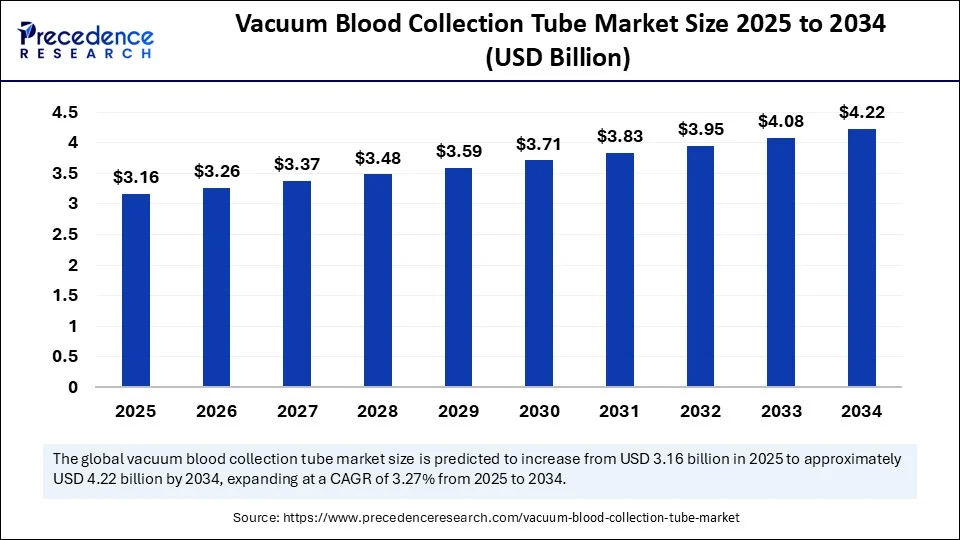
Vacuum Blood Collection Tube Market Key Highlights
-
The global vacuum blood collection tube market was valued at USD 3.06 billion in 2024 and is projected to reach USD 4.22 billion by 2034, growing at a CAGR of 3.27% from 2025 to 2034.
-
North America led the market in 2024 with a 36% share, while the Asia Pacific region is expected to witness the fastest growth during the forecast period.
-
By product type, serum tubes held the largest share at 32% in 2024, and the plasma separation tubes segment is anticipated to grow significantly in the coming years.
-
In terms of material, plastic tubes dominated the market with an 88% share in 2024, while the glass segment is projected to experience notable growth over the forecast period.
-
Based on application, routine chemistry was the leading segment with a 28% share in 2024, whereas infectious disease testing is expected to grow considerably.
-
Among end users, hospitals accounted for the largest share at 41% in 2024, while diagnostic laboratories are anticipated to expand significantly during the forecast period.
-
By distribution channel, the direct tender segment held the largest market share at 46% in 2024, with the online sales segment expected to grow substantially in the coming years.
Market Overview
Vacuum tubes remain a staple of modern phlebotomy because the pre‑evacuated barrel delivers a safer, closed‑loop draw, reduces hemolysis, and standardizes sample volume for downstream automation. Growth is underpinned by the widening menu of routine chemistry, infectious disease, and molecular assays that require uncontaminated, high‑integrity specimens. Healthcare networks in both mature and emerging economies are scaling centralized labs and point‑of‑care diagnostics that depend on assured specimen logistics.
Vacuum Blood Collection Tube Market Growth Factors
Three forces are steering the market upward. First is the rising prevalence of chronic and infectious diseases—such as diabetes, cardiovascular conditions, cancer, HIV, and hepatitis—which drives steady, recurrent blood testing. Second, the capacity expansion of hospitals, diagnostic chains, and blood banks in Asia-Pacific, Latin America, and parts of Africa is creating fresh demand for consumables that meet international safety standards. Third, ongoing technological innovation—such as PET (polyethylene‑terephthalate) tubes, color‑coded safety caps, pre‑barcoded labels, and heparin coatings—is boosting laboratory throughput and compatibility with automated analyzers, encouraging upgrades from older glass vials.
Role of AI in the Vacuum Blood Collection Tube Market
Artificial intelligence is increasingly enhancing vacuum tube workflows from procurement through result delivery. Predictive inventory algorithms analyze historical draw patterns and chronic-care registries to forecast tube consumption, preventing shortages that can disrupt operations. Computer-vision systems embedded in automated sorters confirm cap color, additive type, and fill volume in milliseconds, reducing pre-analytical errors. At the point of draw, handheld AI-enabled phlebotomy assistants recommend the correct tube sequence for multi-panel orders and flag potential additive cross-reactivity. On the analytical side, machine learning models can correlate hemolysis indices, clot detection, and sample age to suggest reruns before results reach clinicians, enhancing diagnostic accuracy.
Regional Outlook
In 2024, North America led the global market with around 36% share, supported by high test volumes, bundled reimbursement schemes, and established players. Europe followed closely, benefiting from universal healthcare testing mandates and lab automation.
Asia-Pacific is expected to experience the fastest growth, driven by government healthcare investments, expanding insurance coverage in countries like China and India, and the rise of medical tourism.
Latin America and the Middle East & Africa remain price-sensitive but offer long-term potential, especially as public health programs expand and reference labs are established. Success in these regions will depend on affordable, robust vacuum tube solutions and efficient distribution networks.
Market Scope
| Report Coverage | Details |
| Market Size by 2034 | USD 4.22 Billion |
| Market Size in 2025 | USD 3.16 Billion |
| Market Size in 2024 | USD 3.06 Billion |
| Market Growth Rate from 2025 to 2034 | CAGR of 3.27% |
| Dominating Region | North America |
| Fastest Growing Region | Asia Pacific |
| Base Year | 2024 |
| Forecast Period | 2025 to 2034 |
| Segments Covered | Product Type, Material, Application, End User, Distribution Channel, and Region |
| Regions Covered | North America, Europe, Asia-Pacific, Latin America, and Middle East & Africa |
Market Drivers
Beyond disease burden, two commercial drivers stand out. Value-based-care initiatives in North America and Western Europe pay laboratories for accurate, first-pass results, incentivizing upgraded consumables that minimize redraws.
Meanwhile, pharmaceutical R&D and precision-medicine programs are running larger biomarker and genetic trials, each mandating high-quality plasma or serum harvested via vacuum systems. The rising popularity of direct-tender procurement models gives large hospital chains negotiating leverage, but also guarantees volume commitments to suppliers, bolstering revenue visibility for market incumbents.
Opportunities
Several promising opportunities are emerging. Miniaturized and wearable micro-collection devices—which enable painless capillary sampling—are fueling growth in the home-based diagnostics segment. Vendors that integrate vacuum technology with dried-blood-spot or microfluidic cartridges can expand into tests that traditionally bypassed tubes.
Additionally, product customization for personalized medicine—such as tubes pre-loaded with stabilizers for cell-free DNA or circulating tumor cells—can command premium pricing and align customers with proprietary assay systems. Expanding access to underserved rural clinics presents another growth pathway, especially when suppliers adapt pack sizes and logistics to local infrastructure.
Challenges
Despite a steady growth outlook, the market faces several challenges. Volatile raw-material costs—particularly for PET resin—impact manufacturing expenses and pricing stability. Adherence to increasingly stringent regulatory and quality-management standards has escalated validation and compliance costs, affecting smaller manufacturers more severely.
Global supply-chain vulnerabilities, exposed by events like pandemics and geopolitical disruptions, pose additional risks. Moreover, in many regions, a shortage of trained phlebotomists limits uptake, even when equipment is available, due to procedural inefficiencies and safety concerns.
Vacuum Blood Collection Tube Market Companies
- Becton, Dickinson and Company (BD)
- Greiner Bio-One GmbH
- Terumo Corporation
- SARSTEDT AG & Co. KG
- FL Medical
- Improve Medical Instruments Co., Ltd.
- Narang Medical Limited
- CML Biotech Pvt. Ltd.
- Medtronic plc
- Labtech Disposables
- Biosigma S.p.A.
- Guangzhou Wondfo Biotech Co., Ltd.
- Hebei Xinle Sci & Tech Co., Ltd.
- Sekisui Medical Co., Ltd.
- Zhejiang Gongdong Medical Technology Co., Ltd.
- Hindustan Syringes & Medical Devices Ltd.
- Kabe Labortechnik GmbH
- Nipro Corporation
- Vital Diagnostics
- Jiangsu Kangjie Medical Devices Co., Ltd.
Segments Covered in the Report
By Product Type
- Serum Tubes
- Plasma Separation Tubes
- Heparin Tubes
- EDTA Tubes
- Glucose Tubes
- ESR Tubes
- Others (Thrombin Tubes, Trace Element Tubes, etc.)
By Material
- Plastic
- Glass
By Application
- Routine Chemistry
- Blood Sugar Testing
- Coagulation Testing
- Lipid Profile
- Infectious Disease Testing
- Others
By End User
- Hospitals
- Diagnostic Laboratories
- Blood Banks
- Ambulatory Surgical Centers
- Others (Academic Institutes, Research Labs)
By Distribution Channel
- Direct Tender
- Retail Sales
- Online Sales
- Distributors
Read Also: Ophthalmology PACS Market
You can place an order or ask any questions, please feel free to contact at sales@precedenceresearch.com |+1 804 441 9344
