
 by
by Market Overview
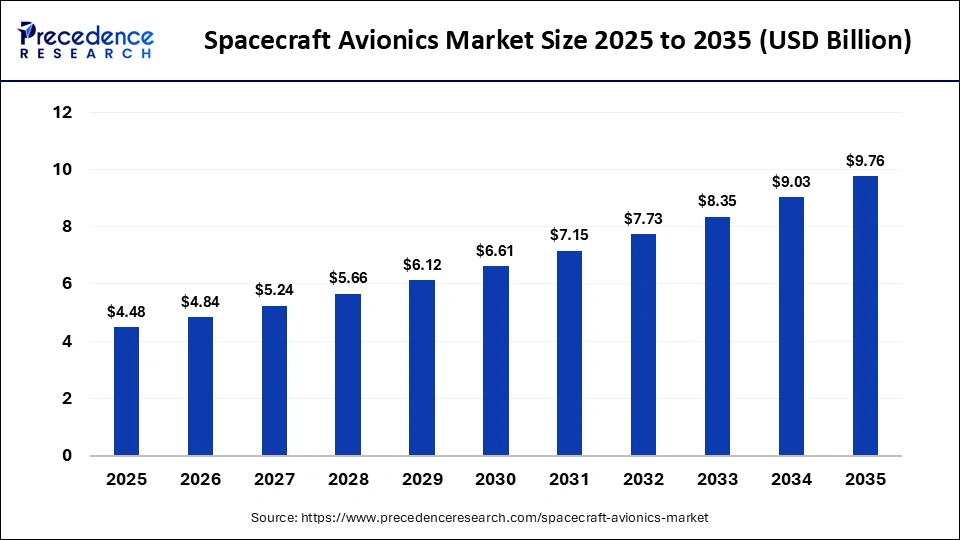
The global spacecraft avionics market is experiencing robust growth, fueled by rapid advancements in aerospace technology, increased adoption of artificial intelligence, and rising investments in space exploration and satellite infrastructure. The market was valued at USD 4.48 billion in 2025 and is projected to grow from USD 4.84 billion in 2026 to USD 9.76 billion by 2035, expanding at a CAGR of 8.10%.
Spacecraft avionics are the backbone of modern space missions, enabling navigation, communication, power management, flight control, and real-time data processing. These systems play a critical role in ensuring mission success across commercial, scientific, and defense applications.
Read Also: Electronic Control Access Systems Market
Key Takeaways
- North America dominated with 41% market share in 2025
- Asia Pacific is the fastest-growing region
- Command & Data Handling systems led with 30% share
- Satellites dominated the platform segment with 52% share
- Low Earth Orbit (LEO) accounted for 58% market share
- Commercial segment led with 60% share
Impact of AI on Spacecraft Avionics
Artificial Intelligence is revolutionizing spacecraft avionics by enabling:
- Predictive maintenance & condition monitoring
- Autonomous navigation and mission planning
- Real-time data analysis and anomaly detection
- Enhanced decision-making with minimal human intervention
AI-powered avionics systems can analyze massive datasets, optimize mission operations, and improve spacecraft reliability, making them essential for next-generation space missions.
Key Market Trends
Shift Toward Energy-Efficient Systems
The growing focus on electric and hybrid systems is driving innovation in energy-efficient avionics, reducing power consumption and enhancing performance.
Advancements in C&DH and SSA Technologies
Continuous innovation in Command & Data Handling (C&DH) and Space Situational Awareness (SSA) is improving data processing, mission control, and system reliability.
Radiation-Tolerant Computing
Space environments demand radiation-hardened electronics, ensuring consistent performance and durability under extreme conditions.
Market Dynamics
Drivers: Government Funding & Commercial Expansion
Government investments in space programs and defense, combined with the rise of private space companies, are accelerating demand for advanced avionics systems.
Restraints: High Costs & Cybersecurity Risks
Expensive testing and qualification processes, along with growing cybersecurity threats, pose challenges to market growth.
Opportunities: Defense & Remote Operations
Increasing demand for resilient avionics systems in extreme environments is opening new opportunities in defense and remote space missions.
Segment Insights
By System
- Command & Data Handling (30%): Core system managing spacecraft operations and data
- Communication Systems (24%): Enables real-time data transfer between spacecraft and Earth
- Navigation & Guidance (18%): Fastest-growing due to autonomous missions
- Power Management (15%): Ensures efficient energy distribution
- Flight Control (13%): Maintains stability and orientation
By Platform
- Satellites (52%) dominate due to communication and Earth observation demand
- Launch Vehicles (20%) driven by rising launch frequency
- Crew Spacecraft (16%) fastest-growing with space tourism and human missions
- Space Probes (12%) expanding with interplanetary exploration
By Orbit Type
- Low Earth Orbit (58%) leads due to satellite constellations
- Geostationary Orbit (20%) supports telecom and broadcasting
- Medium Earth Orbit (14%) used for navigation systems
- Deep Space (8%) fastest-growing segment
By End User
- Commercial (60%) dominates due to private space ventures
- Government & Defense (40%) fastest-growing with rising security initiatives
Regional Insights
North America Leads the Market
North America dominates due to:
- Strong presence of aerospace giants like Lockheed Martin Corporation and Northrop Grumman Corporation
- Significant government funding (NASA & defense programs)
- Advanced R&D infrastructure and early adoption of next-gen technologies
Asia Pacific: Fastest Growing Region
Growth is driven by:
- Expanding space programs in China, India, and Japan
- Rising satellite launches and private space startups
- Increasing government investments
Europe: Strong Growth Potential
Europe holds a significant share due to:
- Collaborative space missions
- Strong aerospace manufacturing base
- Presence of companies like Airbus Defence and Space and Thales Group
Key Companies
- Honeywell International Inc.
- Collins Aerospace
- Northrop Grumman Corporation
- Lockheed Martin Corporation
- Thales Group
- BAE Systems plc
- L3Harris Technologies, Inc.
Recent Developments
- Aurora Avionics secured a contract for PHOENIX 2.1 mission (2026)
- Palladyne AI’s subsidiary partnered with Portal Space Systems for next-gen spacecraft platforms
Future Outlook
The spacecraft avionics market is entering a new era of innovation driven by AI, automation, and deep space exploration. With increasing commercial space activities and defense investments, avionics systems will become more intelligent, autonomous, and resilient.
Conclusion
As space missions grow in complexity and scale, spacecraft avionics will remain a critical enabler of mission success. Despite cost and cybersecurity challenges, advancements in AI, energy efficiency, and autonomous systems are set to drive sustained growth in the coming decade.
Get Sample: https://www.precedenceresearch.com/sample/8263
For inquiries regarding discounts, bulk purchases, or customization requests, please contact us at sales@precedenceresearch.com
