
 by
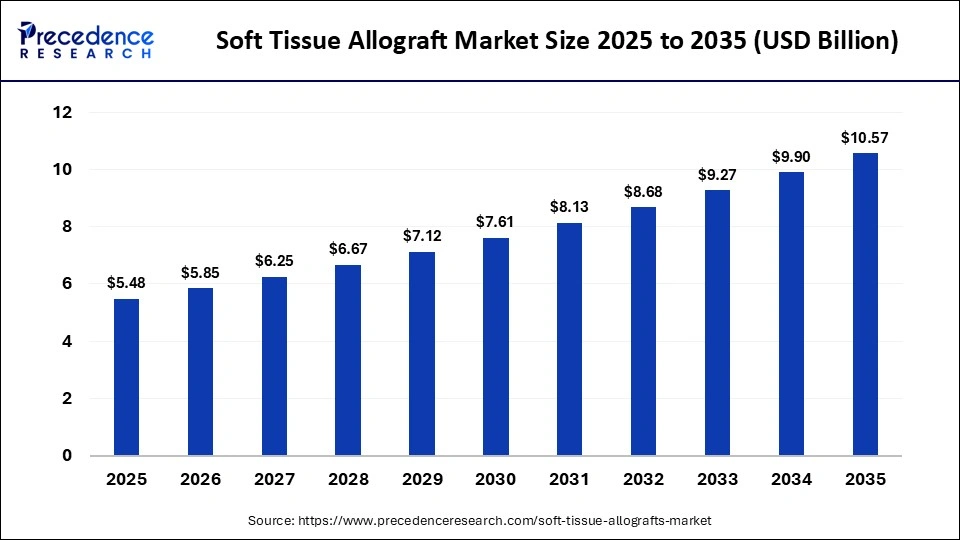
by The global soft tissue allograft market is experiencing strong and sustained growth, driven by advancements in regenerative medicine, increasing surgical procedures, and a rising incidence of musculoskeletal disorders. The market size was valued at USD 5.48 billion in 2025 and is projected to grow from USD 5.85 billion in 2026 to approximately USD 10.57 billion by 2035, expanding at a CAGR of 6.79% during the forecast period. The growing adoption of minimally invasive surgical techniques, combined with improvements in graft preservation technologies, is significantly enhancing clinical outcomes and driving widespread adoption across healthcare systems globally.
Read Also: Track Laying Equipment Market
Table of Contents
ToggleMarket Overview
Soft tissue allografts are biological materials derived from human donors and used in various medical procedures such as orthopedic reconstruction, dental surgeries, and wound care management. Unlike autografts, these eliminate the need for harvesting tissue from the patient’s own body, thereby reducing surgical time, minimizing complications, and improving patient recovery.
The market is witnessing rapid expansion due to increasing demand for advanced treatment options that offer superior healing outcomes. Rising healthcare awareness, expanding healthcare infrastructure in emerging economies, and increasing investments in tissue engineering are further accelerating market growth. Additionally, the growing prevalence of sports injuries and age-related degenerative diseases has significantly increased the demand for soft tissue repair procedures.
Key Market Drivers
Rising Incidence of Sports Injuries
The increasing participation in sports and fitness activities has led to a surge in ligament tears, tendon injuries, and joint damage. This has created a strong demand for high-quality allografts that enable faster recovery and improved performance outcomes.
Aging Population and Degenerative Disorders
The global aging population is more susceptible to conditions such as osteoarthritis, tendon degeneration, and musculoskeletal disorders. This demographic trend is significantly driving demand for orthopedic surgeries and soft tissue grafts.
Advancements in Tissue Engineering
Technological innovations in tissue processing, sterilization, and preservation have improved graft safety, durability, and effectiveness. Modern allografts now offer reduced immune response and longer functional lifespan.
Increasing Demand for Minimally Invasive Procedures
Patients and healthcare providers increasingly prefer minimally invasive surgical techniques that reduce hospital stays and recovery time. Soft tissue allografts play a critical role in supporting such procedures.
Role of Artificial Intelligence in Market Growth
Artificial Intelligence (AI) is transforming the soft tissue allograft market by enhancing efficiency across research, production, and clinical applications. AI-driven analytics are being used to:
- Optimize donor-recipient matching
- Improve inventory management and demand forecasting
- Accelerate research in tissue engineering
- Enable personalized treatment approaches
Machine learning algorithms also help in identifying optimal graft characteristics and predicting patient outcomes, thereby improving surgical success rates and reducing complications.
Market Trends
Growth in Regenerative Medicine
The shift toward regenerative healthcare is significantly boosting demand for biologically derived graft materials that promote natural healing.
Expansion in Dental Applications
The use of allografts in dental procedures, especially for bone regeneration and periodontal treatments, is growing rapidly.
Increasing Adoption of Advanced Sterilization Techniques
Innovations in sterilization methods are improving graft safety and reducing the risk of disease transmission.
Rising Healthcare Investments in Emerging Markets
Countries in Asia-Pacific and Latin America are investing heavily in healthcare infrastructure, increasing access to advanced surgical treatments.
Segment Analysis
By Type
Tendon allografts dominated the market in 2025, accounting for approximately 39% of the total share. Their widespread use in ligament reconstruction surgeries, combined with reduced surgical complexity and improved recovery outcomes, makes them highly preferred.
Meanwhile, cartilage allografts are expected to grow at the fastest rate due to increasing cases of joint injuries and advancements in cartilage repair technologies.
By Application
The orthopedic segment led the market with around 45% share in 2025. This dominance is attributed to the high prevalence of musculoskeletal injuries and the growing number of joint reconstruction procedures.
The wound care segment is projected to witness the fastest growth due to increasing cases of chronic wounds, diabetes-related complications, and demand for advanced healing solutions.
By End-User
Hospitals held the largest market share of approximately 57% in 2025, driven by their advanced infrastructure, skilled professionals, and ability to handle complex surgical procedures.
Orthopedic clinics are expected to grow at the fastest CAGR, supported by the rising trend of outpatient surgeries and specialized treatment centers.
Regional Insights
North America
North America dominated the global market with a share of approximately 45% in 2025. The region benefits from:
- Advanced healthcare infrastructure
- High awareness of innovative treatments
- Strong presence of leading market players
- Established tissue banking systems
The United States, in particular, plays a crucial role due to high healthcare spending and rapid adoption of advanced surgical technologies.
Asia-Pacific
Asia-Pacific is expected to witness the fastest growth during the forecast period. Key growth factors include:
- Rapid urbanization and rising disposable income
- Increasing healthcare investments
- Growing medical tourism
- Expanding patient population
Countries like China and India are emerging as major markets due to improving healthcare accessibility and rising awareness of advanced medical treatments.
Europe
Europe is also experiencing steady growth driven by an aging population, increased incidence of sports injuries, and strong regulatory frameworks ensuring product safety and efficacy.
Competitive Landscape
The soft tissue allograft market is highly competitive, with key players focusing on innovation, partnerships, and product development. Major companies include:
- Zimmer Biomet Holdings Inc.
- Stryker Corporation
- Smith & Nephew Plc
- Arthrex, Inc.
- Integra LifeSciences Corporation
- Becton, Dickinson and Company
- LifeNet Health
- MTF Biologics
These companies are investing heavily in research and development to introduce advanced graft products with improved performance and safety.
Recent Developments
Recent innovations and product launches are shaping the market landscape. Companies are focusing on developing next-generation grafts that enhance healing, reduce complications, and improve patient outcomes. Regulatory approvals and clinical advancements continue to support market expansion.
Future Outlook
The soft tissue allograft market is poised for significant growth over the next decade. The increasing adoption of regenerative medicine, combined with technological advancements and rising healthcare demand, will continue to drive market expansion.
Key future opportunities include:
- Development of bioengineered and customized grafts
- Expansion in emerging markets
- Integration of AI-driven healthcare solutions
- Growth in outpatient and minimally invasive procedures
Conclusion
In conclusion, the global soft tissue allograft market is on a strong growth trajectory, driven by medical advancements, rising healthcare needs, and increasing awareness of advanced treatment options. With continuous innovation and expanding applications across multiple medical fields, the market is expected to witness sustained growth through 2035.
