
 by
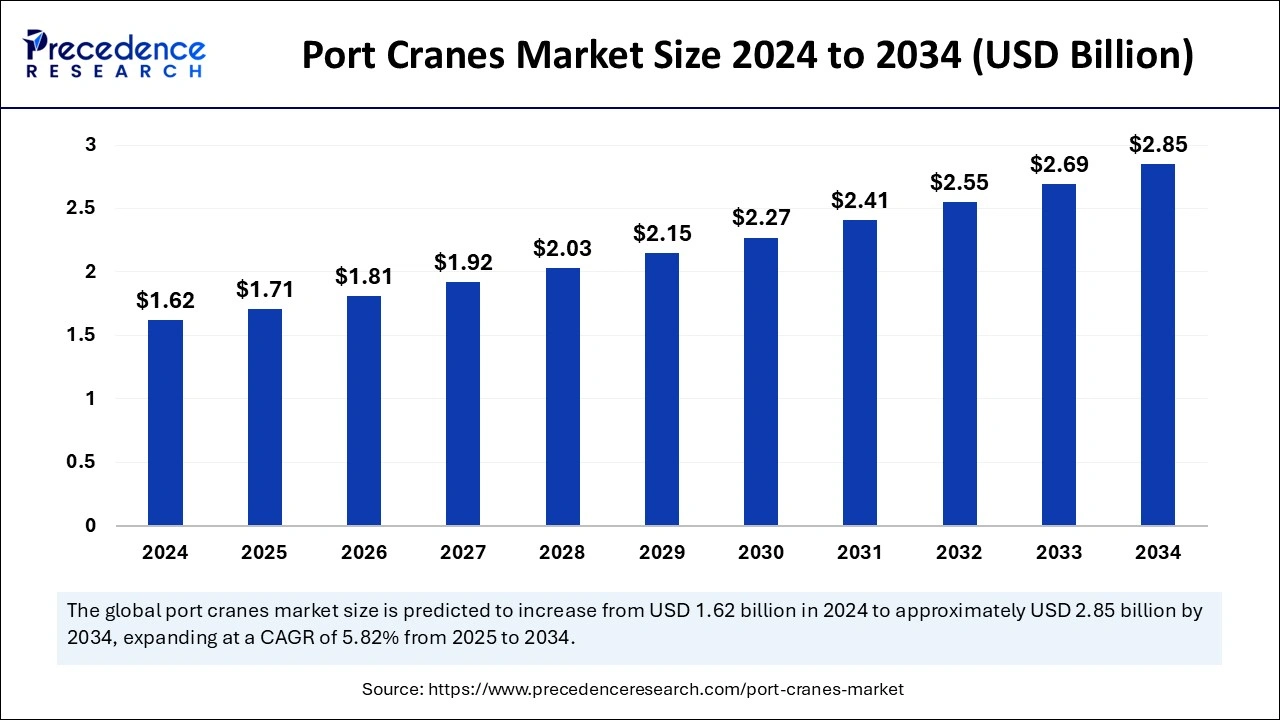
by The global port cranes market is anticipated to grow from an estimated USD 1.71 billion in 2025 to a robust USD 2.85 billion by 2034, marking a compound annual growth rate (CAGR) of 5.82 % over the period 2025–2034. Growth is being driven by rising global trade volumes, urbanization, government infrastructure push, and strong adoption of advanced automation and energy-efficient technologies.
Market Overview
Port cranes are indispensable for handling cargo in seaports, enabling the loading, unloading, and stacking of containers and bulk materials. Increasing globalization and international trade agreements have led to a surge in cargo traffic, creating pressure on port authorities to adopt advanced crane systems that enhance efficiency and reduce downtime.
Government initiatives to modernize port infrastructure, particularly in emerging economies, are another major driver of demand. For instance, India’s Maritime Amrit Kaal Vision is reshaping its ports with digital infrastructure, while China continues to lead in container port capacity expansion.
Read Also : Albumin Market
How Artificial Intelligence (AI) is Transforming the Port Cranes Market
Artificial intelligence (AI) is emerging as a game-changer in the port cranes market, ushering in a new era of automation, efficiency, and safety. With global trade volumes surging and ports under pressure to increase throughput, the integration of AI into crane operations and port infrastructure is enabling smarter, faster, and more sustainable logistics systems. It helps in providing enhancements in security improvements, vessel turnaround time, vessel route, and container dwell time optimization.
Key Market Drivers
-
Rising Global Trade – Continuous growth in containerized shipping is increasing the demand for high-capacity cranes.
-
Automation & AI Adoption – Automated cranes reduce operational errors, improve turnaround times, and enhance worker safety.
-
Environmental Sustainability – Hybrid and electric cranes are becoming mainstream as ports push toward carbon neutrality.
-
Government Infrastructure Spending – Large-scale investments in Asia, North America, and Europe are supporting crane modernization projects.
Market Challenges
Despite its positive outlook, the market faces certain headwinds:
-
High Capital Investment: Port cranes are expensive and involve long payback periods, making adoption difficult for smaller ports.
-
Raw Material Volatility: Rising steel and electronic component costs increase manufacturing expenses.
-
Cybersecurity Risks: Growing concerns about data security in automated and connected cranes have sparked regulatory scrutiny, particularly in the U.S. and Europe.
-
Tariff Pressures: Trade restrictions and tariffs on Chinese-manufactured cranes may disrupt supply chains and raise costs.
Segmentation Insights
By Type
-
Gantry Cranes dominated the market in 2024, widely used for container handling.
-
Overhead Cranes are projected to witness significant growth due to their flexibility in shipbuilding and logistics.
By Power Source
-
Diesel-powered cranes remain dominant.
-
Hybrid and electric cranes are rapidly gaining traction, supported by sustainability goals and operational cost benefits.
By Control Method
-
Manual cranes still account for the largest share.
-
Automated cranes are the fastest-growing segment, reflecting the digital transformation of ports.
By Application
-
Shipbuilding industry remains the leading consumer of port cranes.
-
Construction and logistics sectors are emerging as secondary growth contributors.
Regional Outlook
Asia Pacific – The Global Leader
Holding over 34% of the global share (USD 550 million in 2024), Asia Pacific leads the port cranes market. The region’s dominance is supported by high cargo traffic in China, India, Japan, and South Korea. Investments in smart ports and adoption of AI-driven vessel traffic management systems further strengthen its position.
North America – Fastest Growth Ahead
North America is forecast to witness significant growth during 2025–2034. Modernization of aging port infrastructure, coupled with strong government support and adoption of automation, makes the region highly attractive for crane manufacturers.
Europe, Latin America, Middle East & Africa
These regions are experiencing steady growth, fueled by infrastructure upgrades and digital transformation of maritime logistics. Government-backed smart port initiatives are paving the way for wider adoption of hybrid and automated cranes.
Industry Innovations
Recent developments highlight how leading companies and port operators are embracing sustainability and efficiency:
-
Adani Gangavaram Port (India) deployed the country’s first economic grab electric ship cranes in December 2024, showcasing electrification as a viable path forward.
-
Port of Greenock (UK) commissioned £25 million worth of new cranes in October 2024 to expand container handling capacity.
-
ZPMC, a global crane leader, has been at the center of cybersecurity discussions but continues to invest in innovation and smart crane solutions.
Opportunities: Where Is the Market Headed?
The shift toward smart ports represents the biggest opportunity for growth. AI-powered predictive maintenance, IoT-enabled crane monitoring, and hybrid energy solutions are expected to transform port operations over the next decade.
With sustainability regulations tightening worldwide, operators who invest early in hybrid and electric cranes will enjoy long-term cost savings and regulatory advantages. Additionally, the growing application of port cranes in the construction sector opens new revenue streams for manufacturers.
Port Cranes Market Key Players
- Kito Corporation
- Anupam Industries
- RAM Spreaders
- Mi-Jack Products
- Sumitomo Heavy Industries
- Konecranes
- Liebherr Group
- Cargotec (Kalmar)
- Shanghai Zhenhua Heavy Industries (ZPMC)
- Terex Corporation
- Hyundai Heavy Industries
- Tadano
- SANY Group
- Mitsubishi Heavy Industries
- Conductix-Wampfler
- Künz
- Paceco
- Doosan Heavy Industries & Construction
- Weihua Group
- Eilbeck Cranes
Segments Covered in the Report
By Type
- Ship-to-Shore (STS) Cranes
- Rubber-Tyred Gantry (RTG) Cranes
- Rail-Mounted Gantry (RMG) Cranes
- Mobile Harbor Cranes
- Level Luffing Cranes
- Floating Cranes
- Portal Cranes
- Others
By Operation
- Manual
- Semi-Automated
- Fully Automated
By Lifting Capacity
- Below 40 Tons
- 40–80 Tons
- 80–100 Tons
- Above 100 Tons
By Application
- Container Handling
- Bulk Material Handling
- Ship Loading/Unloading
- Others (e.g., heavy project cargo)
By Port Type
- Sea Ports
- Inland Ports
- Dry Ports
By End User
- Commercial Ports
- Industrial Ports
- Naval Ports
By Geography
- North America
- Asia Pacific
- Europe
- Latin America
- Middle East and Africa
For inquiries regarding discounts, bulk purchases, or customization requests, please contact us at sales@precedenceresearch.com
