
 by
by Explore the global pharmaceutical excipients market, projected to grow from USD 8.82 billion in 2024 to USD 15.43 billion by 2034, with a CAGR of 5.75%. Learn about key trends, regional insights, and growth drivers shaping the industry.
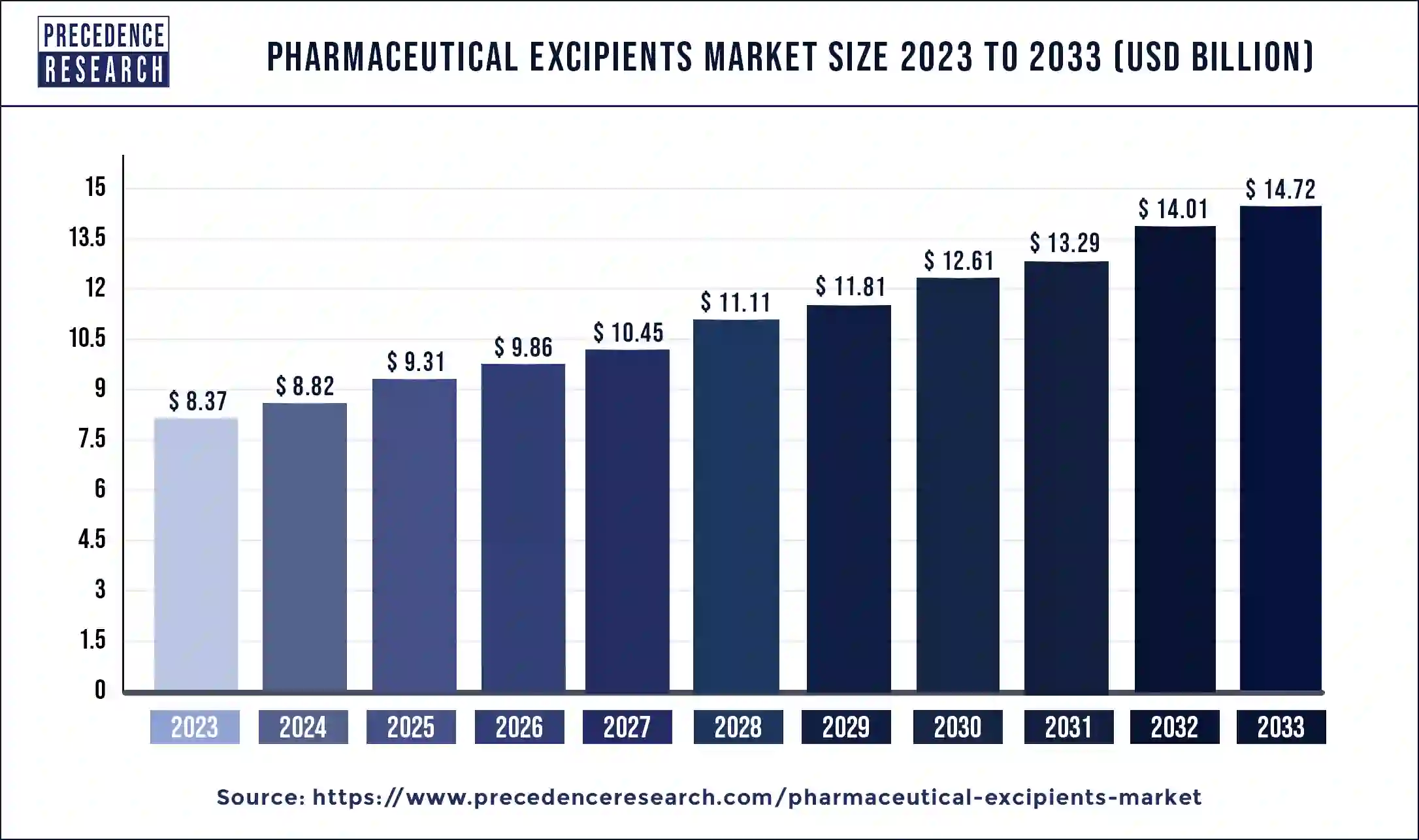
Table of Contents
ToggleKey Takeaways
-
Market Size in 2024: USD 8.82 billion
-
Projected Market Size by 2034: USD 15.43 billion
-
CAGR (2025–2034): 5.75%
-
Largest Market: North America
-
Fastest Growing Market: Asia-Pacific
Regional Market Insights
-
North America: The North American pharmaceutical excipients market was valued at USD 3.15 billion in 2024 and is projected to reach USD 5.66 billion by 2034, growing at a CAGR of 6.04%. This growth is driven by strong pharmaceutical manufacturing, extensive research capabilities, and a favorable regulatory environment.
-
Europe: Europe’s pharmaceutical excipients market was valued at USD 2.35 billion in 2024, with projections to reach USD 3.95 billion by 2034, growing at a CAGR of 5.30%. The market is supported by the increasing demand for generics, biosimilars, and advanced dosage forms.
-
Asia-Pacific: The Asia-Pacific market accounted for USD 1.94 billion in 2024 and is expected to grow at the highest rate, with a CAGR of 6.53%, reaching USD 3.65 billion by 2034. Factors driving this growth include low-cost manufacturing, skilled labor, and investments in pharmaceutical R&D in countries like China and India.
-
Middle East & Africa (MEA): The MEA market was valued at USD 294.40 million in 2024 and is expected to expand to USD 454.85 million by 2034, growing at a CAGR of 4.44%.
Excipients Market Overview
Pharmaceutical excipients are inert substances used in drug formulations that do not have pharmacological activity but play a crucial role in enhancing the stability, bioavailability, and patient compliance of pharmaceutical products. These excipients are primarily used to
-
Bind tablets
-
Fill tablets and capsules
-
Lubricate tablets for easy compression
-
Preserve the drug’s shelf life
-
Enhance the flavor for better patient adherence
With the growing demand for more sophisticated drug formulations, excipients are evolving to meet the requirements of novel therapies, biologics, and personalized medicines.
Market Growth Drivers
-
Rising Pharmaceutical Production:
The continuous growth of the pharmaceutical sector, particularly the increasing production of generics, over-the-counter drugs, and biologics, is fueling the demand for excipients. These ingredients play a vital role in improving drug formulations by enhancing stability, bioavailability, and dosage precision. -
Prevalence of Chronic Diseases:
Chronic diseases, such as diabetes, cancer, and cardiovascular disorders, are on the rise globally, driving demand for complex drug formulations. Excipients enable the creation of sustained-release drugs, which are crucial for the management of these diseases. -
Advances in Drug Delivery Systems:
Pharmaceutical excipients are crucial in the development of novel drug delivery systems (NDDS). These systems, which offer controlled, targeted, and sustained drug release, depend heavily on excipient innovation to ensure better therapeutic efficacy.
Key Trends in the Pharmaceutical Excipients Market
-
AI Integration:
Artificial intelligence is revolutionizing the pharmaceutical excipients market by enabling predictive analytics for drug formulation. AI models help predict the interaction between excipients and active pharmaceutical ingredients (APIs), improving drug stability, bioavailability, and shelf life. AI also plays a significant role in quality control, ensuring consistency across batches and regulatory compliance. -
Green Excipients:
There is a growing demand for green excipients, typically derived from plant-based or bio-based materials. These excipients offer lower environmental impact during manufacturing and disposal, making them more sustainable. Governments are incentivizing pharmaceutical companies to adopt green manufacturing practices, which will drive innovation in this sector. -
Emerging Markets:
Developing regions like Asia-Pacific and Latin America are expected to see rapid growth in the pharmaceutical excipients market. Low-cost labor, cost-effective raw materials, and increased pharmaceutical manufacturing capabilities in these regions are fueling demand.
Pharmaceutical Excipients by Functionality
The pharmaceutical excipients market can be segmented by functionality, with the fillers and diluents segment dominating in 2024. Fillers, which add bulk to tablets and capsules, improve consistency, compressibility, and stability. They are widely used in the development of oral solid dosage forms for chronic disease management.
Other important functionality segments include:
-
Coating Agents: Used for drug delivery and improving the taste, appearance, and stability of drugs.
-
Binders: Used to bind powder together and create solid formulations.
-
Disintegrants: Facilitate the rapid dissolution of tablets and capsules.
-
Lubricants: Ease the manufacturing process by reducing friction.
Pharmaceutical Excipients by Type
The lactose-based excipients segment held a substantial share in 2024, driven by the low cost and high compatibility of lactose with most APIs. Lactose remains a popular excipient for oral solid dosage forms, particularly in the treatment of chronic diseases.
The cellulose-based excipients segment is also growing significantly. Cellulose derivatives, such as microcrystalline cellulose (MCC) and hydroxypropyl methylcellulose (HPMC), are increasingly used in advanced drug delivery systems like sustained-release tablets.
Challenges & Restraints:
-
High Costs of Specialized Excipients:
The development and production of novel excipients can be expensive, particularly for small and medium-sized pharmaceutical companies. The complex nature of these excipients and the regulatory hurdles involved make their production cost-prohibitive. -
Regulatory Compliance:
Stringent regulations from agencies such as the U.S. Food and Drug Administration (FDA) and the European Medicines Agency (EMA) impose challenges on excipient manufacturers, particularly with regard to quality control, safety, and batch-to-batch consistency.
Recent Developments in the Pharmaceutical Excipients Market:
-
Gelita launched an Endotoxin Controlled Excipients (ECE) portfolio in January 2025, aimed at stabilizing vaccines and medical-grade gelatin.
-
Evonik opened a new spray-drying facility in Darmstadt in September 2024, producing EUDRAGIT polymers, functional excipients for oral drug delivery.
-
Roquette launched hydroxypropyl pea starch (LYCAGEL Flex) in May 2024, a versatile excipient for flexible pharmaceutical and nutraceutical softgel formulations.
Pharmaceutical Excipients Market Companies
- Ashland Global Holdings
- BASF SE
- DuPont
- Roquette Feres
- Evonik Industries AG
- Associated British Foods
- Archer Daniels Midland Company
- Lubrizol Corporation
- Croda International
- Kerry Group
Segments Covered in the Report
By Functionality
- Fillers and Diluents
- Suspending and Viscosity Agents
- Coating Agents
- Binders
- Disintegrants
- Colorants
- Lubricants and Glidants
- Preservatives
- Emulsifying Agents
- Flavoring Agents and Sweeteners
- Other Functionalities
By Excipient Type
- Lactose-based Excipients
- α-lactose monohydrate
- Anhydrous α-lactose
- Anhydrous β-lactose
- Amorphous Lactose
- Cellulose-based
- Microcrystalline Cellulose (MCC)
- Cellulose Ethers
- Others
- Starches
- Carboxymethylcellulose Sodium (CCS)
- Sodium Starch Glycolate (SSG)
- Fine Chemicals
- Mannitol
- Biopharma Excipients
- Others
By Geography
- North America
- U.S.
- Canada
- Europe
- U.K.
- Germany
- France
- Asia-Pacific
- China
- India
- Japan
- South Korea
- Malaysia
- Philippines
- Latin America
- Brazil
- Rest of Latin America
- Middle East & Africa (MEA)
- GCC
- North Africa
- South Africa
- Rest of the Middle East & Africa
For inquiries regarding discounts, bulk purchases, or customization requests, please contact us at sales@precedenceresearch.com
