
 by
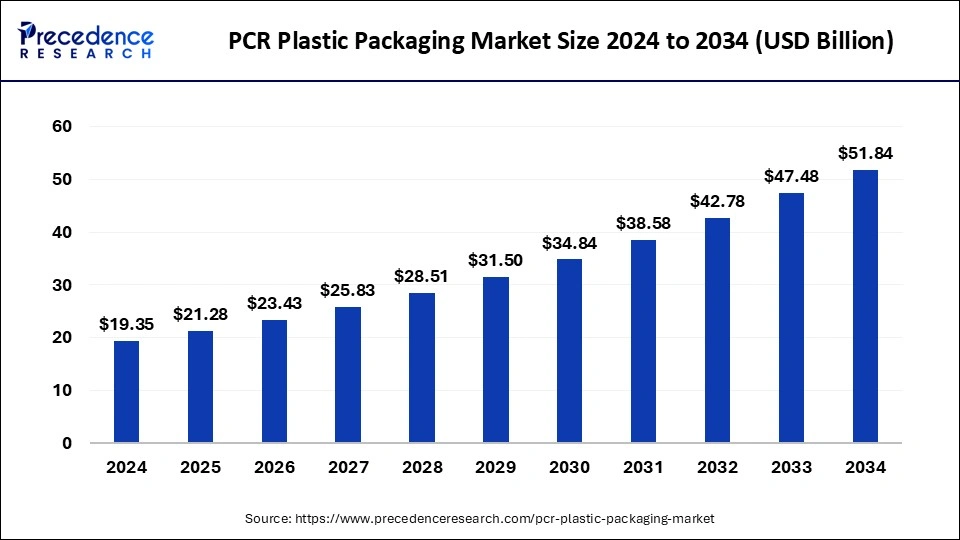
by The global PCR plastic packaging market is witnessing robust expansion as sustainability becomes a core focus across industries. The market size was estimated at USD 19.35 billion in 2024 and is projected to grow from USD 21.28 billion in 2025 to approximately USD 51.84 billion by 2034, registering a compound annual growth rate (CAGR) of 10.40% during the forecast period.
Read Also: Industrial Electrification Market
Market Dynamics
Key Market Drivers
-
Eco-Friendly Branding and Corporate Sustainability Goals
Companies are rapidly integrating sustainability into their brand identity. By adopting PCR plastic packaging, brands signal environmental responsibility, strengthen consumer loyalty, and comply with eco-labelling regulations. This trend has notably increased the adoption of PCR content in FMCG and personal care packaging. -
Government Regulations Promoting Recycled Plastics
Several governments have introduced policies mandating minimum recycled content in packaging. For instance, the European Union’s Single-Use Plastics Directive and U.S. Plastic Pact are pushing manufacturers to adopt PCR materials to meet compliance standards. -
Advancements in Recycling Technologies
Innovation in mechanical and chemical recycling techniques has improved the quality, color consistency, and strength of PCR plastics, making them suitable for high-value applications like beverage bottles and cosmetic containers. -
Consumer Awareness and Environmental Concerns
Consumers are increasingly choosing brands that use recycled materials. According to industry studies, over 70% of global consumers prefer products with sustainable packaging, driving strong market momentum for PCR plastics.
Restraints
-
Contamination and Quality Concerns
The primary challenge in the PCR packaging supply chain lies in the contamination of feedstock materials. Variations in polymer types and impurities can compromise product integrity, limiting applications in high-standard sectors like food and healthcare. -
High Processing and Production Costs
Transforming post-consumer waste into usable PCR material involves advanced sorting, cleaning, and extrusion systems. These cost-intensive processes can make PCR packaging less competitive against virgin plastics in cost-sensitive markets.
Opportunities
-
Sustainable Branding and Green Marketing
As global companies like Unilever, Nestlé, and L’Oréal commit to using 100% recyclable or reusable packaging by 2030, PCR plastics offer substantial growth opportunities. Brands leveraging PCR packaging can enhance their ESG profiles and appeal to eco-conscious consumers. -
Technological Innovation and Material Diversification
The introduction of 100% PCR PET and PVC materials, such as those developed by Clariant, Borealis, and Cascades, is expanding material options for manufacturers while ensuring durability and performance comparable to virgin plastics. -
Circular Economy and Closed-Loop Systems
Many companies are now investing in closed-loop recycling systems where used packaging is continuously collected and reprocessed, creating an endless cycle of reuse. This presents immense potential for innovation partnerships between recyclers and packaging companies.
Growth Factors
-
Increasing focus on zero-waste manufacturing and corporate carbon neutrality.
-
Expansion of recycling infrastructure and better waste collection in developing nations.
-
Integration of digital traceability and labeling for transparent recycling.
-
Growing application of PCR plastics in healthcare and industrial packaging due to their proven safety and reliability.
Segmentation Analysis
By Material
-
PET (Polyethylene Terephthalate) – 33.10% market share in 2024.
PET is favored for its clarity, durability, and compatibility with high-quality recycling streams. Major beverage and food packaging firms increasingly use high-PCR-content PET bottles to align with circular economy goals. -
PVC (Polyvinyl Chloride) – fastest-growing segment with CAGR of 12.58%.
PVC packaging is gaining popularity due to its enhanced recyclability and suitability for cosmetic and industrial applications. Manufacturers are transitioning to recycled PVC to meet sustainability benchmarks.
By Product
-
Bottles – largest segment, 42.61% market share in 2024.
Bottles made from PCR plastics dominate due to their wide use in beverages, personal care, and household products. Brands are adopting lightweight and innovative bottle designs that reduce plastic usage while maintaining functionality. -
Trays – fastest-growing segment with a CAGR of 10.66%.
The rise of food delivery, ready-to-eat meals, and sustainable food packaging solutions is driving the demand for PCR-based trays in the F&B sector.
By End User
-
Food & Beverages – leading segment with 57.61% share in 2024.
Companies in this sector prioritize PCR packaging for its compliance with food-grade safety standards and recyclability. -
Cosmetics – fastest-growing end-user segment.
Cosmetic brands emphasize eco-friendly and aesthetically appealing PCR containers to align with sustainable brand narratives.
Key Market Players
-
Berry Global Group, Inc.
-
Amcor Limited
-
Plastipak Holdings, Inc.
-
Sealed Air Corporation
-
Mondi Group
-
Sonoco Products Company
-
Huhtamäki Oyj
-
DS Smith Plc
-
Winpak Ltd.
-
Silgan Holdings Inc.
-
Coveris Holdings S.A.
-
Printpack, Inc.
-
Greif, Inc.
-
Constantia Flexibles Group GmbH
-
ProAmpac Holdings, Inc.
For inquiries regarding discounts, bulk purchases, or customization requests, please contact us at sales@precedenceresearch.com
