
 by
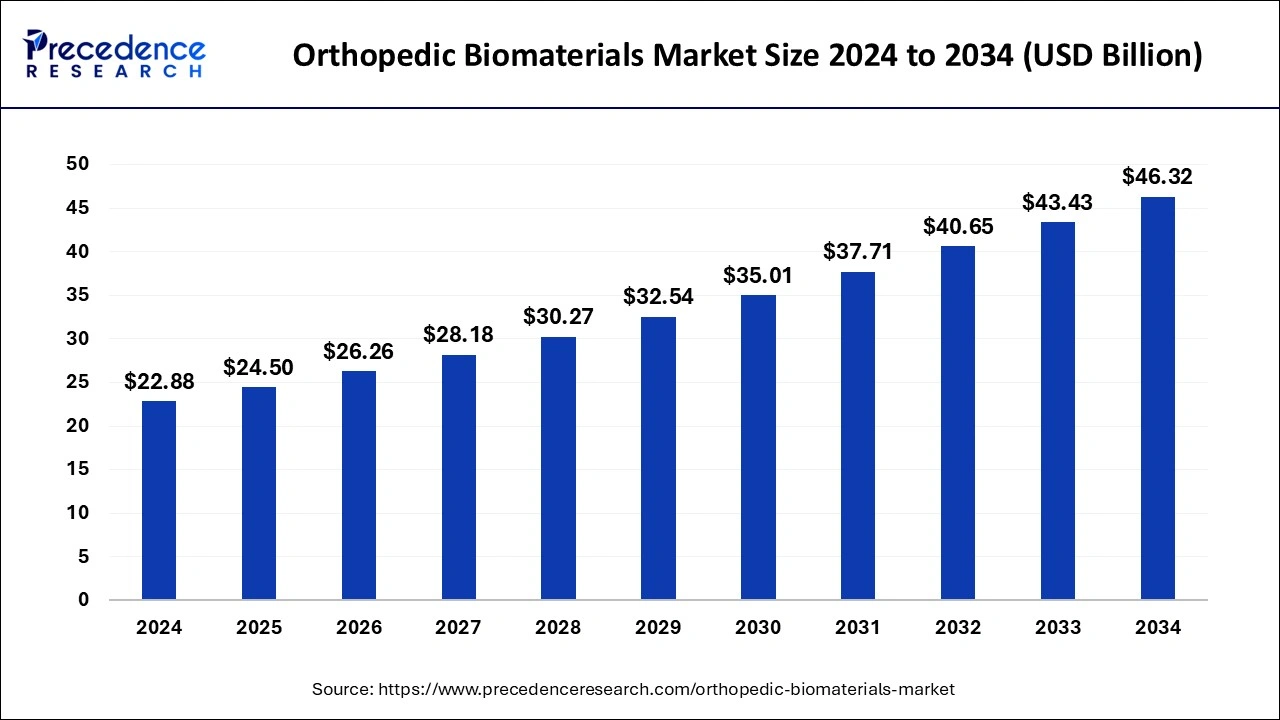
by The orthopedic biomaterials market, valued at USD 22.88 billion in 2024, is expected to reach USD 46.32 billion by 2034, growing at a CAGR of 7.30%.
Orthopedic Biomaterials Market Key Takeaways
- North America led the global market in 2024, holding the highest share of 37%.
- Asia-Pacific is projected to grow at the fastest CAGR from 2025 to 2034.
- The ceramics & bioactive glass segment dominated the market by material in 2024.
- The orthopedic implant segment was the leading application in the global market in 2024.
Key Drivers
Opportunities
- Growing demand for bioresorbable and smart biomaterials in orthopedic applications.
- Advancements in 3D printing technology for personalized orthopedic implants.
- Increasing healthcare investments and infrastructure development in emerging markets.
- Rising preference for minimally invasive surgeries, driving the adoption of innovative biomaterials.
- Expanding research in regenerative medicine and tissue engineering for orthopedic applications.
Challenges
- High costs associated with advanced orthopedic biomaterials and implant procedures.
- Stringent regulatory approvals and compliance requirements.
- Biocompatibility issues and risks of implant rejection or failure.
- Limited availability of skilled professionals for complex orthopedic procedures.
- Supply chain disruptions and raw material shortages impact production.
Regional Insights
North America dominated the orthopedic biomaterials market in 2024, accounting for the largest share due to advanced healthcare infrastructure, high adoption of innovative biomaterials, and a growing geriatric population. The Asia-Pacific region is expected to witness the fastest growth from 2025 to 2034, driven by rising healthcare investments, increasing orthopedic surgeries, and growing awareness of advanced medical treatments. Europe holds a significant market position, supported by strong research initiatives and favorable reimbursement policies. Meanwhile, Latin America and the Middle East & Africa are experiencing steady growth, fueled by improving healthcare facilities and increasing demand for orthopedic procedures.
Don’t Miss Out: High Potency Active Pharmaceutical Ingredients Market
Market Key Players
- Globus Medical, Inc.
- Stryker Corporation
- Koninklijke DSM N.V.
- Exactech, Inc.
- Johnson & Johnson
- Zimmer Biomet
- Wright Medical Group, Inc.
- NuVasive, Inc.
Recent News
As of August 2024, the U.S. orthopedic biomaterials market was valued at over $5 billion, with projections indicating a growth to more than $7.2 billion by 2030, driven by a 5.3% CAGR. Key players such as Medtronic, DePuy Synthes, and Stryker continue to dominate the market, with Medtronic leading in bone graft substitutes and growth factors, notably with its INFUSE™ product.
In March 2022, Evonik introduced VESTAKEEP® Fusion PEEK filament, designed for 3D-printed orthopedic implants, enhancing the customization and performance of implantable devices. Additionally, Synergy Biomedical launched BIOSPHERE® FLEX SP EXTREMITIES, a synthetic bioactive bone graft, expanding treatment options for extremity surgeries. The market’s growth is further supported by technological advancements and an increasing prevalence of orthopedic conditions.
Market Segmentation
By Material
- Polymers
- Ceramics & Bioactive Glasses
- Calcium Phosphate Cement
- Composites
- Metal
By Application Outlook
- Orthobiologics
- Orthopedic Implants
- Viscosupplementation
- Joint Replacement
- Bio-resorbable Tissue Fixation
By End User
- Hospitals
- Orthopedic Clinics
- Others
