
 by
by The global aviation industry is undergoing a profound transformation, driven by the urgent need for sustainability, efficiency, and next-level performance. At the center of this shift is the rapid evolution of next-generation aircraft propulsion systems—technologies that are redefining how aircraft are powered in a low-carbon future.
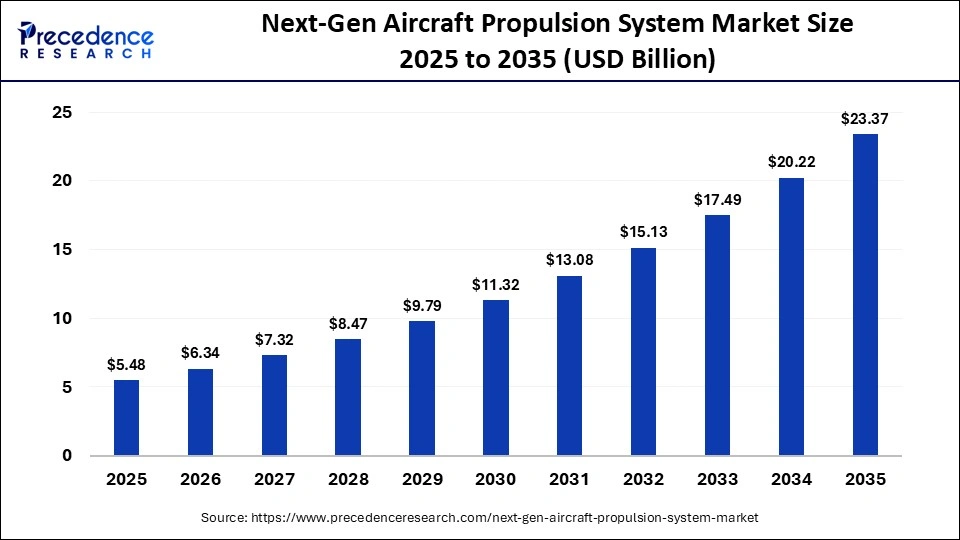
According to Precedence Research, the global next-gen aircraft propulsion system market size was valued at USD 5.48 billion in 2025 and is projected to grow from USD 6.34 billion in 2026 to USD 23.37 billion by 2035, expanding at a remarkable CAGR of 15.61%. This surge is fueled by stringent environmental regulations, growing air travel demand, and the industry’s commitment to reducing operational costs and emissions.
Read Also: Aircraft Turbofan Engine Market
Market Overview: The Future of Flight is Sustainable
- Hybrid-electric propulsion
- Fully electric engines
- Hydrogen-powered systems
- Advanced open-rotor technologies
The integration of high-density batteries, hydrogen fuel systems, and solid oxide fuel cells is enabling aircraft manufacturers to move closer to zero-emission aviation.
How AI is Powering Smarter Propulsion Systems
Artificial Intelligence (AI) is emerging as a critical enabler in this market. By leveraging AI-driven insights, aviation companies can:
- Optimize engine performance in real-time
- Enhance fuel efficiency and reduce emissions
- Enable predictive maintenance using IoT sensors
- Minimize operational downtime and maintenance costs
AI is also accelerating the design and testing of advanced propulsion systems, helping manufacturers innovate faster while improving safety and reliability.
Key Market Trends Driving Growth
- Shift Toward Zero-Emission Flights: Increasing investments in hydrogen storage and refueling infrastructure
- Adoption of Hybrid & Electric Aircraft: Integration of lithium-sulfur and solid-state batteries
- Advanced Engine Innovations: Development of efficient engines like the CFM Leap family using ceramic matrix composites
- AI & IoT Integration: Real-time monitoring and predictive maintenance capabilities
- Sustainable Aviation Fuels (SAF): Growing use of biofuels and synthetic fuels to reduce carbon footprint
Market Dynamics
Driver: Military Modernization
The push for advanced 5th and 6th-generation fighter jets is driving demand for propulsion systems with higher thrust-to-weight ratios, improved fuel efficiency, and enhanced thermal performance.
Restraint: Technological Barriers
Despite rapid innovation, challenges such as low battery energy density and complex certification processes continue to hinder large-scale adoption of fully electric aircraft.
Opportunity: Sustainable Aviation Engines
The development of engines compatible with biofuels (HEFA, FT-SPK) and next-gen electric components is opening new growth avenues, enabling immediate emission reductions without major infrastructure changes.
Segment Insights
By Propulsion Type
- Conventional turbofan/turboprop dominated with 58% share (2025) due to reliability and efficiency
- Hybrid-electric propulsion is the fastest-growing segment, offering a practical bridge toward full electrification
- Hydrogen propulsion is gaining traction as a long-term zero-carbon solution
By Component
- Engine systems led the market with 50% share, forming the core of propulsion technology
- Energy storage systems are rapidly expanding due to the rise of electric aviation
By Platform
- Commercial aircraft dominated with 52% share, driven by fleet modernization
- Urban Air Mobility (UAM) is the fastest-growing segment with the rise of eVTOL aircraft
By Technology
- Conventional propulsion still leads, but
- Hybrid propulsion is expected to witness the fastest growth due to its balance of performance and sustainability
Regional Insights
North America accounted for 39% of the market share in 2025, driven by strong R&D investments and the presence of industry leaders like General Electric and Honeywell Aerospace. Support from organizations such as NASA further strengthens innovation.
Europe – Innovation Hub
Europe holds the second-largest share, supported by strict environmental policies and major players like Airbus SE, driving advancements in zero-emission aircraft.
Asia-Pacific – Fastest Growing
Rapid air travel growth, fleet expansion, and government initiatives are positioning Asia-Pacific as the fastest-growing region, with China leading investments in next-gen propulsion technologies.
Key Companies Shaping the Market
Leading players driving innovation include:
- Rolls-Royce Holdings plc
- Pratt & Whitney
- Safran S.A.
- MTU Aero Engines AG
- Boeing Company
- Joby Aviation
- ZeroAvia Inc
These companies are investing heavily in hybrid-electric systems, hydrogen propulsion, and sustainable aviation technologies.
Get Sample: https://www.precedenceresearch.com/sample/8266
For inquiries regarding discounts, bulk purchases, or customization requests, please contact us at sales@precedenceresearch.com
