
 by
by What is the Neurorehabilitation Devices Market Size in 2026?
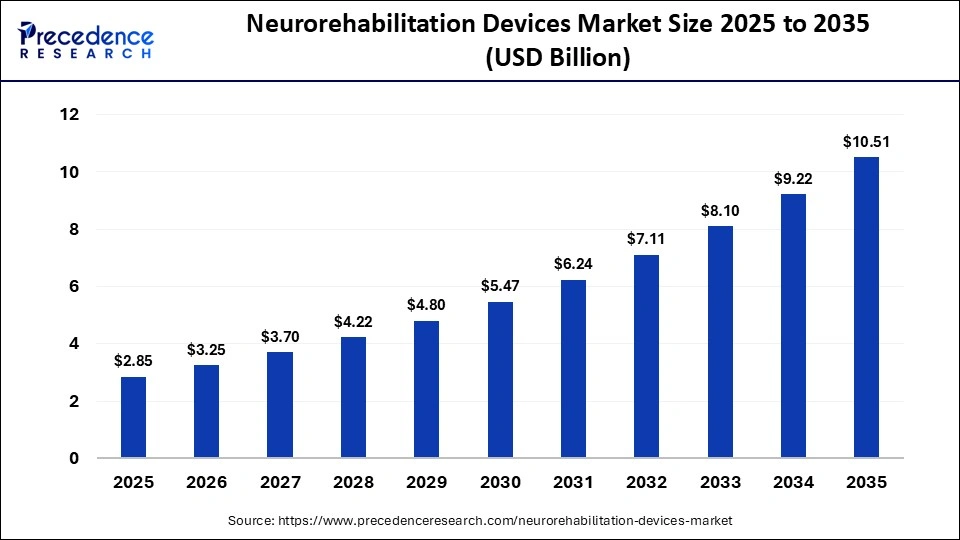
The global neurorehabilitation devices market size was valued at USD 2.85 billion in 2025 and is projected to grow from USD 3.25 billion in 2026 to approximately USD 10.51 billion by 2035, expanding at a robust CAGR of 13.94% from 2026 to 2035.
This rapid growth is primarily driven by the increasing prevalence of neurological disorders such as stroke, spinal cord injuries, traumatic brain injuries, and neurodegenerative diseases. Additionally, advancements in robotics, artificial intelligence, and digital health technologies are significantly enhancing rehabilitation outcomes and driving adoption across hospitals, rehabilitation centers, and home-care settings.
Read Also: AI Data Labeling Market
Market Overview
Neurorehabilitation devices are advanced medical technologies designed to aid recovery from neurological impairments by restoring motor functions, cognitive abilities, and mobility. These devices include robotic rehabilitation systems, wearable sensors, brain-computer interfaces, and neurostimulation devices.
With a rising global aging population and increasing awareness of early rehabilitation, healthcare providers are investing heavily in innovative solutions that offer personalized, efficient, and continuous therapy. The shift toward minimally invasive and home-based rehabilitation solutions is further accelerating market expansion.
Key Market Highlights
- North America dominated the global market in 2025
- Asia-Pacific is expected to grow at the fastest CAGR
- Neurorobotic systems led the product segment
- Wearable devices are projected to grow the fastest
- Stroke rehabilitation accounted for the largest application share
- Hospitals and clinics remained the leading end-users
Growth Drivers of the Neurorehabilitation Devices Market
Rising Neurological Disorders
The increasing incidence of stroke, Parkinson’s disease, and spinal cord injuries is significantly boosting demand for rehabilitation solutions. These conditions often require long-term therapy, making neurorehabilitation devices essential for recovery.
Aging Population
A growing elderly population is more susceptible to neurological conditions, which increases the need for rehabilitation technologies globally.
Technological Advancements
Innovations in robotics, wearable devices, and AI-based systems are improving treatment outcomes, enhancing patient engagement, and reducing recovery time.
Increasing Awareness of Early Rehabilitation
Early intervention plays a critical role in recovery. Growing awareness among patients and healthcare providers is driving early adoption of advanced rehabilitation devices.
Impact of Artificial Intelligence (AI)
Artificial intelligence is revolutionizing neurorehabilitation by enabling personalized and adaptive therapy. AI-powered systems analyze patient movements, neurological responses, and recovery patterns in real time.
Key benefits of AI integration include:
- Real-time motion tracking and feedback
- Predictive recovery modeling
- Adaptive therapy programs based on patient progress
- Improved accuracy in treatment planning
Machine learning algorithms also help optimize therapy intensity, improving motor recovery and patient outcomes.
Emerging Market Trends
1. Rise of Wearable and Home-Based Devices
Portable neurorehabilitation devices are gaining popularity as they allow patients to continue therapy at home. These devices improve convenience, reduce hospital visits, and enhance patient compliance.
2. Growth of Neurorobotics and Exoskeletons
Robotic-assisted therapy and powered exoskeletons are transforming rehabilitation by enabling repetitive, high-intensity exercises essential for recovery.
3. Tele-rehabilitation and Remote Monitoring
Cloud-based platforms and telemedicine solutions are enabling remote therapy sessions, particularly benefiting rural and underserved populations.
4. Personalized Rehabilitation Programs
Advanced analytics and AI are enabling customized therapy plans tailored to individual patient needs, improving overall clinical outcomes.
Segmental Insights
By Product
Neurorobotic Systems (Dominant Segment)
Neurorobotic systems held the largest market share in 2025 due to their ability to deliver high-precision, repetitive therapy. These systems are widely used in hospitals for gait training and upper-limb rehabilitation.
Wearable Devices (Fastest Growing)
Wearable devices are expected to grow rapidly due to their portability and ability to provide continuous monitoring and therapy outside clinical settings.
By Application
Stroke (Leading Segment)
Stroke rehabilitation dominated the market as stroke remains one of the leading causes of long-term disability worldwide. Neurorehabilitation devices play a crucial role in restoring mobility and coordination.
Parkinson’s Disease (Fastest Growing)
The increasing elderly population and rising Parkinson’s disease cases are driving demand for wearable and neurostimulation devices for long-term symptom management.
By End-User
Hospitals and Clinics (Dominant)
Hospitals and clinics led the market due to access to advanced infrastructure, skilled professionals, and early-stage rehabilitation services.
Rehabilitation Centers (Fastest Growing)
Rehabilitation centers are gaining traction due to their focus on long-term recovery and cost-effective treatment options.
Regional Analysis
North America
North America dominated the market in 2025 due to:
- Advanced healthcare infrastructure
- High adoption of innovative technologies
- Strong reimbursement policies
- Presence of leading medical device manufacturers
The U.S. leads the region due to high stroke incidence and strong investment in rehabilitation technologies.
Asia-Pacific
Asia-Pacific is expected to grow at the fastest rate due to:
- Rapid healthcare infrastructure development
- Rising awareness of rehabilitation therapies
- Increasing investments in hospitals and rehabilitation centers
- Growing middle-class population
Countries like China and India are major contributors due to large patient pools and expanding healthcare access.
Europe
Europe is witnessing steady growth driven by:
- Aging population
- Government-supported healthcare systems
- Strong focus on patient-centric rehabilitation
- Advancements in neurorobotics and digital health
Competitive Landscape
The neurorehabilitation devices market is highly competitive, with key players focusing on innovation, product launches, and strategic collaborations.
Leading Companies
- Bionik Labs
- DIH International Limited (Hocoma AG)
- Ekso Bionics
- Ottobock SE & Co. KGaA
- NeuroMetrix, Inc.
- Helius Medical Technologies
- MagVenture A/S
Recent Developments
- 2025: Launch of advanced neurorehabilitation systems for Parkinson’s disease and gait recovery
- 2025: FDA approval of innovative wearable neurostimulation devices
- 2025: Expansion of technology-driven rehabilitation programs across Europe
These developments highlight the growing focus on technology-driven, patient-centric rehabilitation solutions.
Future Outlook
The neurorehabilitation devices market is expected to witness strong growth due to:
- Increasing integration of AI and robotics
- Expansion of home-based rehabilitation solutions
- Rising investments in digital healthcare
- Growing demand for personalized therapy
As healthcare systems continue to evolve, neurorehabilitation devices will play a critical role in improving quality of life for patients with neurological conditions.
Conclusion
The global neurorehabilitation devices market is on a strong growth trajectory, driven by technological advancements, increasing neurological disorders, and rising awareness of early rehabilitation. With continuous innovation in AI, robotics, and wearable technologies, the market is expected to transform significantly over the next decade, offering more efficient, accessible, and personalized rehabilitation solutions.
Get Sample Copy: https://www.precedenceresearch.com/sample/7894
For inquiries regarding discounts, bulk purchases, or customization requests, please contact us at sales@precedenceresearch.com
