
 by
by Table of Contents
ToggleMachine Automation Controller Market Size in 2026
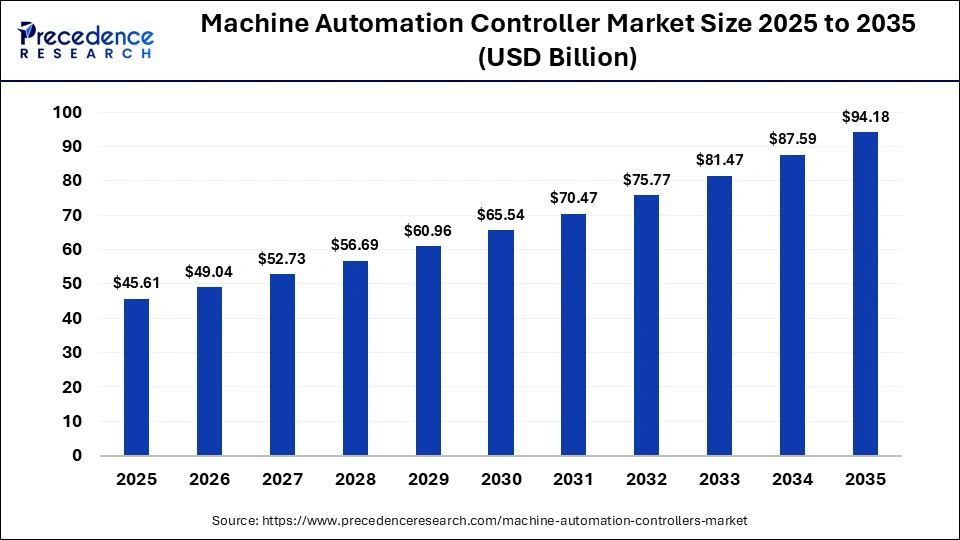
The global machine automation controller market is projected to reach USD 49.04 billion in 2026, rising from USD 45.61 billion in 2025. With strong industrial demand and rapid digital transformation, the market is forecasted to grow to approximately USD 94.18 billion by 2035, expanding at a CAGR of 7.52% from 2026 to 2035.
Read Also: Robotic Refueling System Market
Expanded Market Overview
Machine Automation Controllers (MACs) are the backbone of modern industrial automation, enabling real-time monitoring, precision control, and intelligent decision-making across manufacturing and process industries. These controllers combine the capabilities of:
- Programmable Logic Controllers (PLCs)
- Programmable Automation Controllers (PACs)
- Distributed Control Systems (DCS)
- Industrial PC-based controllers
They are widely used in smart factories, robotics systems, CNC machines, energy management, and industrial IoT ecosystems.
With the acceleration of Industry 4.0, MACs are evolving into intelligent, connected systems that enhance operational efficiency, reduce downtime, and improve product quality.
Key Market Highlights
- 2026 Market Size: USD 49.04 Billion
- 2035 Forecast: USD 94.18 Billion
- CAGR (2026–2035): 7.52%
- Dominant Region: Asia-Pacific (40% share in 2025)
- Fastest Growing Region: North America
- Leading Controller Type: Distributed Control Systems (DCS)
- Fastest-Growing Controller: Programmable Automation Controllers (PACs)
- Top End-Use Industry: Oil & Gas
Growth Drivers
1. Rising Demand for Industrial Automation
Industries are increasingly adopting automation controllers to:
- Improve productivity
- Ensure precision and consistency
- Reduce human intervention
- Lower operational costs
Automation controllers are essential for managing temperature, pressure, motion, and flow processes across industries.
2. Shift Toward Smart Manufacturing (Industry 4.0)
The transition toward digitized and connected factories is a major growth driver. Machine automation controllers enable:
- Real-time data processing
- Predictive maintenance
- Seamless machine-to-machine communication
3. Need for Enhanced Safety and Reliability
Automation controllers reduce human error and improve safety in hazardous environments such as:
- Oil refineries
- Chemical plants
- Power generation facilities
Impact of Artificial Intelligence (AI)
AI is transforming machine automation controllers into self-learning and adaptive systems. Key benefits include:
- Predictive analytics to prevent machine failures
- Real-time anomaly detection
- Automated decision-making
- Process optimization using machine learning models
AI-enabled controllers can analyze large volumes of machine data and provide actionable insights, significantly improving production efficiency and minimizing downtime.
Emerging Market Trends
Integration with Robotics
Automation controllers are increasingly integrated with robotic systems to handle:
- Complex assembly tasks
- Repetitive operations
- Precision manufacturing
Focus on Energy Efficiency
Industries are adopting controllers that:
- Optimize energy consumption
- Reduce carbon footprint
- Align with sustainability goals
Rising Cybersecurity Concerns
As industrial systems become more connected, there is a growing emphasis on:
- Secure communication protocols
- Protection against cyber threats
- Resilient automation infrastructure
Segment Insights
By Controller Type
- Distributed Control Systems (DCS):
Dominated in 2025 due to scalability, reliability, and ability to manage complex industrial processes. - Programmable Automation Controllers (PACs):
Fastest-growing segment due to advanced features like:- High-speed processing
- Network connectivity
- Integration with enterprise systems
By Machine Operation Type
- Discrete Manufacturing:
Led the market due to demand in industries such as automotive, electronics, and aerospace. - Batch Processing:
Fastest-growing due to flexibility in producing customized products.
By End-Use Industry
- Oil & Gas:
Largest market share due to heavy reliance on automation for:- Exploration
- Refining
- Distribution
- Power Generation & Utilities:
Fastest-growing segment due to increasing need for:- Grid stability
- Fault detection
- Efficient energy management
Regional Insights
Asia-Pacific (Market Leader)
Asia-Pacific dominates the market due to:
- Strong manufacturing base (China, Japan, South Korea)
- Rapid industrialization
- Government initiatives supporting automation
Countries like China are heavily investing in AI-driven automation and semiconductor manufacturing, strengthening regional dominance.
North America (Fastest Growth)
North America is expected to grow rapidly due to:
- Adoption of advanced manufacturing technologies
- Investments in AI and edge computing
- Modernization of industrial infrastructure
The U.S. leads with strong R&D and innovation in smart automation systems.
Competitive Landscape
Key companies operating in the machine automation controller market include:
- Siemens AG
- ABB Ltd.
- Schneider Electric SE
- Rockwell Automation, Inc.
- Mitsubishi Electric Corporation
- Honeywell International Inc.
- Emerson Electric Co.
- Omron Corporation
- FANUC Corporation
- Yokogawa Electric Corporation
These players are focusing on AI integration, IoT connectivity, and advanced control technologies to maintain a competitive edge.
Recent Developments
- March 2026: Indian innovators developed an AI-based PLC programming platform using natural language inputs
- October 2025: Rockwell Automation launched Micro820 controllers for improved performance and faster deployment
- September 2025: Trio Motion Technology introduced advanced Motion PLC systems with EtherCAT integration
Conclusion
The machine automation controller market is experiencing steady and sustained growth, driven by the global push toward automation, digitalization, and smart manufacturing. With increasing adoption of AI, IoT, and robotics, these controllers are evolving into intelligent control hubs that power next-generation industrial systems.
As industries prioritize efficiency, safety, and scalability, machine automation controllers will remain a critical component in shaping the future of global manufacturing and industrial automation.
Get Sample Copy: https://www.precedenceresearch.com/sample/8228
For inquiries regarding discounts, bulk purchases, or customization requests, please contact us at sales@precedenceresearch.com
