
 by
by 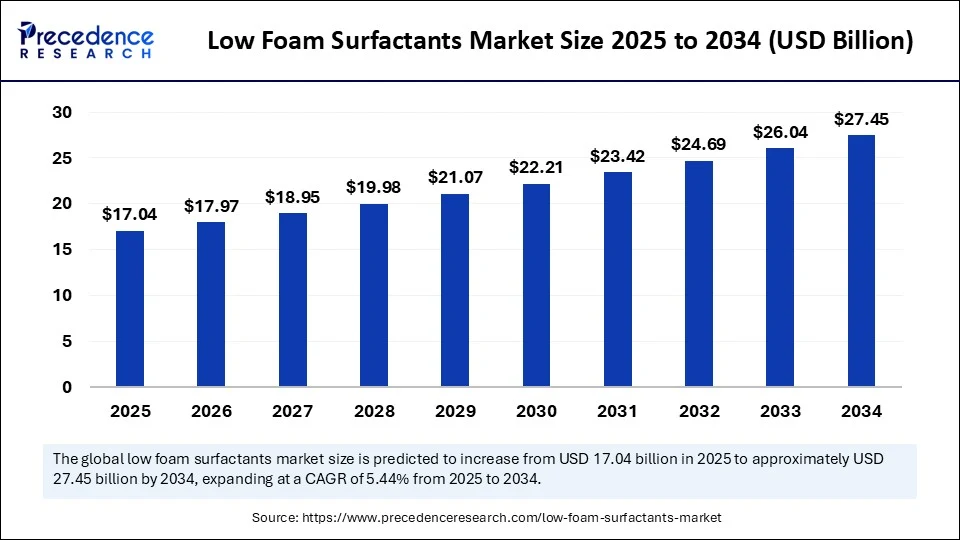
Low Foam Surfactants Market Key Highlights
- Asia Pacific led the market in 2024 with a dominant 40% share, while North America is projected to grow at a notable CAGR during the forecast period.
-
By type, nonionic surfactants held the largest market share of 65% in 2024, whereas natural/bio-based surfactants are anticipated to register the fastest growth through 2034.
-
Based on foam performance mechanism, the low-foaming by structure category accounted for a significant 70% market share in 2024, while low-foaming via antifoam additives is expected to grow at the fastest CAGR.
-
In terms of functionality, wetting agents were the leading segment with a 28% share in 2024, whereas dispersing agents are emerging as the fastest-growing functionality.
-
By application, the home care and industrial & institutional (I&I) cleaning segment contributed the largest share of 35% in 2024, while agrochemical formulations are projected to expand at the highest growth rate during the forecast period.
-
On the basis of source, synthetic-based surfactants dominated the market with a 78% share in 2024, while the bio-based/renewable segment is poised to grow at the fastest CAGR.
-
By end-use industry, consumer goods led the market with a 32% share in 2024, whereas the agriculture segment is forecasted to witness the fastest growth through 2034.
Low Foam Surfactants Market Overview
Low foam surfactants are specialized surface-active agents designed to minimize foam formation while maintaining high detergency and wetting properties. Unlike traditional surfactants, they are crucial in applications where excessive foam can hinder processes, such as clean-in-place (CIP) systems, automated dishwashing, industrial cleaning, agrochemical formulations, and textile processing.
Their growing adoption stems from the need for efficient, automated, and sustainable industrial and consumer operations. By reducing foam without compromising cleaning efficacy, low foam surfactants enable faster rinsing, lower water consumption, and compatibility with high-speed manufacturing setups — making them integral to modern industrial protocols.
Low Foam Surfactants Market Scope
| Report Coverage | Details |
| Market Size by 2034 | USD 27.45 Billion |
| Market Size in 2025 | USD 17.04 Billion |
| Market Size in 2024 | USD 16.16 Billion |
| Market Growth Rate from 2025 to 2034 | CAGR of 5.44% |
| Dominating Region | Asia Pacific |
| Fastest Growing Region | North America |
| Base Year | 2024 |
| Forecast Period | 2025 to 2034 |
| Segments Covered | Type, Foam Performance Mechanism, Functionality, Application, Source, End-Use Industry, and Region |
| Regions Covered | North America, Europe, Asia-Pacific, Latin America, and Middle East & Africa |
Low Foam Surfactants Market Dynamics
What Is Driving the Growth of the Low Foam Surfactants Market?
-
Rising Demand for Eco-Friendly Products: Consumers and industries are shifting toward green surfactants that reduce environmental impact, fueling demand for low foam and biodegradable formulations.
-
Growth in Industrial Automation: Automated processes in manufacturing, food processing, and cleaning rely on low-foam systems to avoid process disruption, increasing adoption across sectors.
-
Stringent Environmental Regulations: Government regulations promoting low-VOC and low-emission formulations are pushing manufacturers to adopt sustainable surfactant solutions.
-
Emerging Use Cases: Novel applications in food sanitation, pharmaceutical cleaning, and agricultural adjuvants are opening up new growth avenues.
What Are the Restraints Impacting Market Expansion?
-
Limited Use in High-Foam Required Applications: In some industries, high-foam detergents are preferred for visual validation or scrubbing action, limiting low foam surfactants’ applicability.
-
Raw Material Volatility and Supply Disruptions: Fluctuating prices of petrochemical and bio-based feedstocks, along with geopolitical factors, can impact production costs and profit margins.
What Opportunities Lie Ahead for Market Participants?
-
Bio-Based and Renewable Surfactants: Increasing R&D in plant-derived surfactants offers scope for innovation and regulatory compliance.
-
AI-Driven Formulation Development: The use of artificial intelligence in designing smart surfactants with multifunctional capabilities tailored for specific environments will revolutionize product portfolios.
Low Foam Surfactants Market Regional Insights
Why Is Asia Pacific Leading the Market?
Asia Pacific accounted for the largest regional share (40%) in 2024, led by China, India, and Southeast Asia. This dominance is driven by:
-
Large-scale detergent production and consumption
-
Cost-effective manufacturing bases
-
High demand from oil & gas, food processing, and textile sectors
-
Favorable industrialization and infrastructure investments
What Drives Growth in North America?
North America is witnessing the fastest CAGR during the forecast period, driven by:
-
Adoption of green chemistry and sustainable technologies
-
Advancements in AI-integrated production and formulation
-
Growing awareness and use of bio-based home and industrial cleaning products
-
Strong regulatory oversight from EPA and FDA supporting eco-safe chemicals
Role of AI in the Low Foam Surfactants Market
Artificial Intelligence (AI) is transforming the low foam surfactants market through data-driven formulation, process optimization, and quality control. AI algorithms enable real-time monitoring and adjustment of surfactant properties such as foam suppression, viscosity, and cleaning efficacy. These tools can predict the optimal mix for specific applications, reducing trial-and-error cycles and time to market.
Moreover, AI supports contamination detection, predictive maintenance, and smart manufacturing systems. For instance, integrating machine learning into CIP systems can help dynamically adjust surfactant dosages based on soil load, improving cleaning performance while minimizing waste and water usage.
Low Foam Surfactants Market Segmentation Analysis
Type Insights: Why Are Nonionic Surfactants Dominating?
Nonionic low foam surfactants lead the market due to their excellent stability, mildness, and compatibility across diverse pH levels. Their lower foaming nature makes them ideal for CIP, textile, and dishwashing applications, contributing significantly to their market share.
Foam Mechanism: How Do Structure-Based Surfactants Lead?
Surfactants designed with structure-based foam suppression mechanisms are gaining traction. These formulations offer foam control at the molecular level without requiring external anti-foaming agents, making them more reliable in automated systems.
Functionality: What Makes Wetting Agents a Key Segment?
Wetting agents dominate the functional segment owing to their use in agriculture, paints, coatings, and cleaning agents, where rapid surface penetration and uniform spreading are essential. Their low foam nature ensures efficiency in spray systems and automated lines.
Application: Why Is Home Care & I&I Segment the Largest?
The Home Care and Industrial & Institutional (I&I) cleaning segment holds the largest share, driven by increasing demand for efficient and fast-rinse cleaning solutions, particularly in automated dishwashers, floor scrubbers, and sanitizing equipment.
Source: What Fuels the Growth of Bio-Based Surfactants?
The market for bio-based low foam surfactants is growing due to consumer preferences for plant-derived, non-toxic alternatives and regulatory support for sustainable sourcing. Ingredients like coconut oil and sugar derivatives are commonly used.
End-Use: Why Is the Consumer Goods Segment Leading?
The consumer goods segment, including personal care and home cleaning products, leads due to the growing demand for mild, efficient, and sustainable formulations that provide low foam yet effective cleaning results.
Competitive Landscape
Key players in the low foam surfactants market include:
-
BASF SE – Offers sustainable and biodegradable surfactants for home and industrial care.
-
Dow Inc. – Focuses on performance surfactants for I&I and agricultural use.
-
Evonik Industries AG – Known for eco-efficient nonionic surfactant technologies.
-
Clariant AG – Provides structure-based, multifunctional surfactants.
-
Stepan Company – Offers customizable low-foam surfactant solutions for varied end-uses.
Low Foam Surfactants Market Recent Developments
-
March 2024 – Nouryon launched a new line of biodegradable low-foam surfactants targeting the food processing and institutional cleaning sector. This initiative aligns with its sustainability roadmap and demand from the European market.
-
January 2024 – Unilever’s Domestos brand introduced a low-foam spray cleaner leveraging advanced surfactant technology for public washroom sanitization. The formulation reduces water use by 30%, enhancing sustainability.
Read Also: Ophthalmology PACS Market
You can place an order or ask any questions, please feel free to contact at sales@precedenceresearch.com |+1 804 441 934
