
 by
by Fueled by surging demand for better adherence, relentless drug delivery innovations, and AI-driven market dynamics, the LAIs market is projected to soar at a CAGR of 12.95% through 2034, reshaping standards in psychiatric care, infectious diseases, and beyond.
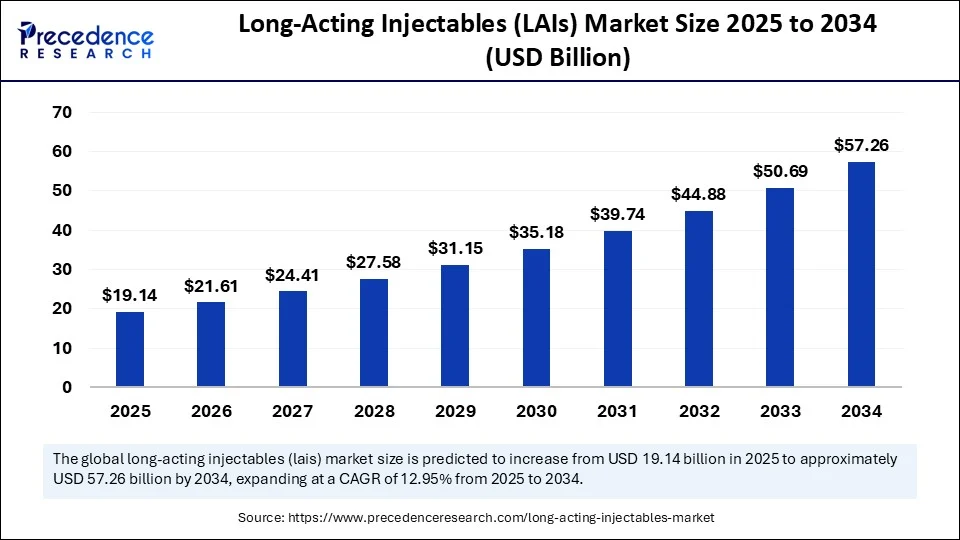
The global long-acting injectables (LAIs) market has entered a phase of rapid expansion, valued at USD 16.94 billion in 2024 and expected to reach USD 57.26 billion by 2034, according to Precedence Research. This growth driven by a robust 12.95% CAGR from 2025 to 2034, reflects the increasing need for therapies that ensure consistent drug exposure, minimize missed doses, and boost outcomes in chronic and specialty diseases. The integration of advanced drug delivery platforms and AI-fueled innovations is transforming both R&D and commercialization strategies for LAIs.
Long-Acting Injectables (LAIs) Market Key Insights: What You Need to Know
-
The LAIs market reached USD 16.94 billion in 2024 and is forecasted to hit USD 57.26 billion by 2034.
-
North America leads the market, owing to a mature healthcare ecosystem and high adoption rates of innovative therapies.
-
Asia Pacific is the fastest-growing region, driven by large patient populations and healthcare investment.
-
The U.S. market alone was worth USD 5.42 billion in 2024 and is projected to jump to USD 18.47 billion by 2034.
-
Top players dominate the antipsychotic segment, while anti-infectives and nanoparticles are set for the fastest segmental growth.
-
Leading companies continue to innovate in both delivery technology and therapeutic expansion.
-
Advancements in AI are improving patient adherence, pharmaceutical R&D, and commercial intelligence.
Long-Acting Injectables (LAIs) Market Revenue Table (2024-2034)
| Year | Global Market Size (USD Billion) |
|---|---|
| 2024 | 16.94 |
| 2025 | 19.14 |
| 2034 | 57.26 |
North America dominates, with the U.S. as the top national market; Asia Pacific is fastest-growing.
Get this report to explore global market size, share, CAGR, and trends, featuring detailed segmental analysis and an insightful competitive landscape overview @ https://www.precedenceresearch.com/sample/6590
The Role of AI: Revolutionizing LAIs
AI is no longer a “nice to have” but a must in the LAIs market. R&D teams use AI for predictive modeling, optimizing controlled-release kinetics, and simulating virtual patient scenarios to forecast real-world adherence and outcomes. AI-driven formulation optimization—via in silico screening—brings unprecedented precision to matching excipients and active ingredients, accelerating product development timelines.
On the commercial side, AI empowers pharma companies to pinpoint ideal patient cohorts, optimize temperature-sensitive supply chains, and facilitate real-time pharmacovigilance. This enables earlier detection of safety signals and supports value-based provider contracting, tying reimbursement to genuine patient outcomes. Result: faster, more efficient market launches—and greater access for patients who benefit most.
What’s Driving LAI Market Growth?
-
Improved Adherence: LAIs minimize missed doses and reduce relapse, hospitalization, and variability in drug exposure—especially crucial for chronic diseases.
-
Innovative Delivery Platforms: Breakthroughs in depot chemistry, microsphere and nanoparticle systems, and smart device integration continue to redefine therapeutic options.
-
Wider Therapeutic Usage: Expanding indications into oncology, metabolic, and autoimmune diseases offer broad entry points for pharma innovators.
-
Supportive Regulatory Ecosystem: Especially in North America, where value-based care and evidence-driven reimbursement underpin rapid adoption.
Opportunity and Trend:
How Are New Technologies and Partnerships Shaping the Future of LAIs?
Opportunities are unfolding as global health initiatives, government programs, and NGOs prioritize LAIs for HIV, TB, and contraception, particularly in underserved regions. Could cross-industry partnerships and platform technology licensing fuel the next era of LAI expansion? Will deeper AI integration in clinical trial design and patient targeting radically accelerate launches?
Long-Acting Injectables (LAIs) Market Regional and Segmentation Analysis
North America
-
Leads the market, buoyed by specialty care networks, high healthcare spend, and early adoption of digital health tools. The U.S. is especially dominant in antipsychotic and HIV therapies.
-
Payers and regulators support evidence-based LAI launches with innovative reimbursement models.
Asia Pacific
-
Fastest growth, mostly from China’s investment in biotech, R&D, and healthcare reforms.
-
Expanding manufacturing capability and rising demand across chronic, psychiatric, and infectious diseases.
Europe, Latin America, Middle East & Africa
-
Gradual growth driven by increased awareness, growing specialty care access, and evolving regulatory pathways.
Leading Segments
-
Drug Type: Antipsychotics dominate; anti-infectives see highest future growth.
-
Delivery Technology: Microsphere-based systems lead, with nanoparticles gaining rapid traction.
-
Route of Administration: IM injections currently rule, but subcutaneous delivery is surging due to greater patient comfort.
-
Indication: Schizophrenia leads; HIV/AIDS is the fastest-growing indication.
-
Patient Group: Adults are the largest consumers, while geriatrics represent the sharpest rise in demand.
-
Distribution: Hospital pharmacies are main sales channels; online pharmacies quickly expanding.
Long-Acting Injectables (LAIs) Market Breakthroughs
New LAI formulations for psychiatric, infectious, and hormonal indications are hitting the market, driven by innovation in both branded and biosimilar products. Top companies—partnering with CROs/CDMOs—are advancing new delivery platforms, scaling up sterile manufacturing, and piloting digital health support programs.
Long-Acting Injectables (LAIs) Market Challenges and Cost Pressures: What Holds the Market Back?
-
High development and manufacturing costs—especially in sterile injectables—deter smaller players.
-
Infrastructure needs (cold chain, trained personnel) limit access in resource-constrained regions.
-
Long clinical trial timelines and stricter regulatory demands can slow launches.
-
Payer hesitation and insufficient cost-effectiveness data in some regions create reimbursement hurdles.
Case Study: LAIs in Schizophrenia Care
In the U.S., LAI antipsychotics have transformed outcomes for thousands with schizophrenia, reducing rates of relapse and hospitalization by combining monthly dosing with support initiatives. Providers now use AI-based patient monitoring to tailor dosing and anticipate adherence challenges—setting the stage for a new standard of psychiatric care.
Read Also: Methyl Methacrylate (MMA) Monomer Market
You can place an order or ask any questions. Please feel free to contact us at sales@precedenceresearch.com |+1 804 441 9344
