
 by
by How Are Lignin-Based Resins Powering the Shift Toward a Circular Bioeconomy?
Lignin-based resins are rapidly emerging as a sustainable alternative to petrochemical-based resins, aligning with global efforts to transition toward a circular bioeconomy. As one of the most abundant natural polymers, lignin—derived from wood and plant biomass—offers a promising renewable feedstock for adhesives, binders, and thermosetting resins. In an era defined by climate action, zero-waste goals, and green manufacturing, lignin-based resins are gaining traction across industries ranging from construction and automotive to packaging and electronics.
The global lignin based resins market size is estimated to cross around USD 860.66 million by 2034 increasing from USD 512.05 million in 2024, with a CAGR of 5.33%. This market momentum is driven by regulatory mandates, growing environmental awareness, bio-refining innovations, and rising demand for low-carbon material alternatives.
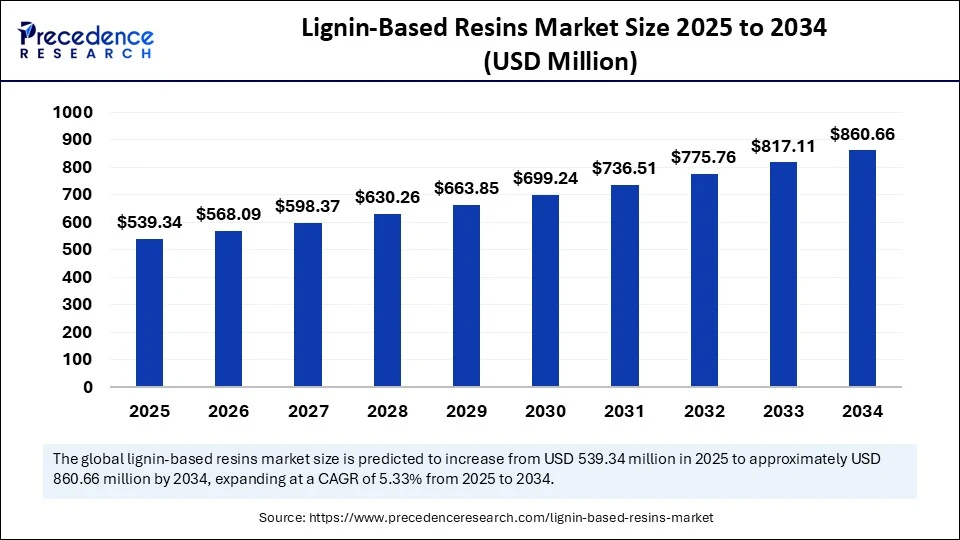
Lignin-Based Resins Market Key Insights
- Europe held the dominant position in 2024 with a market share of 36.50%, while the Asia Pacific region is anticipated to witness the fastest growth during the forecast period.
-
By resin type, phenolic resins accounted for the largest share at 49.50% in 2024, whereas polyurethane resins are expected to register the highest CAGR through 2034.
-
In terms of lignin source, kraft lignin dominated the market with a 41.50% share in 2024, while organosolv lignin is projected to grow at the fastest rate in the coming years.
-
By application, the adhesives & binders segment led the market in 2024 with a 46.50% share, and the composites segment is poised to expand at the highest CAGR throughout the forecast period.
-
Considering the end-use industry, the furniture & wood segment was the leading sector with a 39.50% share in 2024, while the automotive segment is expected to experience the fastest growth rate moving forward.
-
By technology, thermoset resins captured the largest market share at 61.50% in 2024, whereas thermoplastic resins are forecasted to grow at the highest pace from 2025 to 2034.
What Are Lignin-Based Resins and Why Are They Essential?
Lignin-based resins are bio-resins derived from technical lignin, a byproduct of the pulp and paper industry or bio-refining processes. These resins serve as partial or complete substitutes for petroleum-based phenolic, epoxy, or polyurethane resins. Their importance lies in:
-
Reducing carbon footprint by replacing fossil-derived ingredients
-
Valorizing biomass waste from agriculture and forestry
-
Enabling recyclability and biodegradability in end-use products
They are central to bio-based circularity, closing material loops in wood composites, foams, and durable goods.
Lignin Based Resins Market Technological Innovations: How AI and Bio-Refining Are Driving Change
The lignin-based resin sector is being revolutionized by AI-driven material design and advanced bio-refining technologies:
-
AI in Formulation: Machine learning models optimize resin properties like viscosity, curing speed, and bond strength by analyzing lignin chemistry variations across feedstocks.
-
Bio-Refining Advances: Modern techniques such as organosolv extraction, Kraft lignin isolation, and enzymatic conversion allow high-purity lignin tailored for specific resin applications.
-
Catalytic Upgrading: Researchers are developing green catalysts to produce aromatic building blocks from lignin that match or exceed performance benchmarks of synthetic resins.
Lignin Based Resins Market Scope
| Report Coverage | Details |
| Market Size by 2034 | USD 860.66 Million |
| Market Size in 2025 | USD 539.34 Million |
| Market Size in 2024 | USD 512.05 Million |
| Market Growth Rate from 2025 to 2034 | CAGR of 5.33% |
| Dominating Region | Europe |
| Fastest Growing Region | Asia Pacific |
| Base Year | 2024 |
| Forecast Period | 2025 to 2034 |
| Segments Covered | Resin Type, Lignin Source, Application, End-Use Industry, Technology, and Region |
| Regions Covered | North America, Europe, Asia-Pacific, Latin America, and Middle East & Africa |
Lignin Based Resins Market Growth Drivers: Why Is the Market Expanding?
-
Global Sustainability Goals and Climate Policies
Regulatory initiatives like the EU Green Deal, China’s 14th Five-Year Plan, and U.S. Inflation Reduction Act are incentivizing bio-based innovation, including funding for lignin-derived technologies. -
Industrial Decarbonization
Companies in construction, automotive, and electronics are integrating bio-resins to meet ESG targets and reduce product life-cycle emissions. -
Biomass Availability and Circular Economy Push
The abundance of agro-forestry residues, especially in Asia Pacific and Scandinavia, makes lignin an ideal circular feedstock.
What Barriers Are Slowing Down Commercial Adoption?
Despite growing interest, several hurdles remain:
-
Technical Complexity
Variability in lignin’s chemical structure from different sources makes standardization and quality control difficult. -
Limited Supply Chains
The lack of large-scale, consistent lignin refining and distribution networks hinders scalability. -
Performance Limitations
In some cases, lignin-based resins still lag behind petrochemical counterparts in terms of heat resistance, shelf life, or moisture tolerance.
Application Landscape: Where Are Lignin-Based Resins Being Used?
Construction & Wood Adhesives
A major segment where lignin-based phenol-formaldehyde resins replace conventional adhesives in plywood, OSB, and MDF panels. Adoption is led by Europe, where regulations limit formaldehyde emissions.
Automotive Composites
Used in lightweight panels, underbody parts, and interior structures, contributing to vehicle weight reduction and sustainability.
Packaging & Coatings
Lignin offers UV resistance and antimicrobial properties, making it suitable for bio-packaging and protective coatings.
Electronics
Potential applications in bio-resin printed circuit boards (PCBs) and thermally stable insulating materials.
Regional Outlook: Which Areas Are Leading the Market?
Europe
-
Largest market share in 2024 (approx. 36.5%)
-
Supported by REACH regulation, Bio-Based Industries Joint Undertaking (BBI JU), and national subsidies
-
Countries like Germany, Sweden, and Finland are front-runners in lignin valorization
Asia Pacific
-
Fastest-growing region, projected CAGR above 8.5%
-
China, India, and Japan focus on bio-based industrial materials to curb pollution and reduce imports of petrochemical inputs
-
Emerging lignin valorization projects tied to bamboo and rice husk lignin sources
Market Segmentation and Forecasts
By Resin Type
-
Phenolic Resins – Largest share (wood products, insulation)
-
Epoxy Resins – Fastest growth (electronics, coatings)
-
Polyurethane Resins – Emerging in automotive foams
-
Others – Acrylics, alkyds, and vinyl-based variants
By Lignin Source
-
Kraft Lignin – Abundant and widely used
-
Organosolv Lignin – High-purity, premium segment
-
Soda Lignin – Primarily from non-wood biomass
-
Hydrolysis Lignin – From biorefineries using enzymatic processes
By Application
-
Wood Adhesives
-
Insulation & Foams
-
Coatings & Paints
-
Composites & Molding
-
Packaging
By End-Use Industry
-
Construction
-
Automotive
-
Electronics
-
Furniture
-
Packaging
By Resin Technology
-
Thermoset
-
Thermoplastic
-
UV-curable
-
Water-based systems
How Are Lignin-Based Resins Replacing Petrochemical Alternatives?
Through chemical functionalization and process engineering, lignin is being engineered to offer comparable performance to fossil-derived resins. It serves as a drop-in phenol substitute in plywood adhesives and is evolving into aromatic precursors for high-value polymers.
Future applications may include:
-
Biodegradable electronics casings
-
Smart packaging with bio-resin coatings
-
3D printing filaments derived from lignin composites
What Does the Future Hold for Lignin-Based Materials?
The next decade will see lignin-based resins transform from niche bio-alternatives to mainstream industrial solutions, thanks to:
-
Public-private collaborations (e.g., Horizon Europe projects)
-
Circular design standards in building and packaging
-
Integration with digital manufacturing and AI-enabled formulation systems
Read Also: PCR Technologies Market
You can place an order or ask any questions, please feel free to contact at sales@precedenceresearch.com|+1 804 441 9344

