
 by
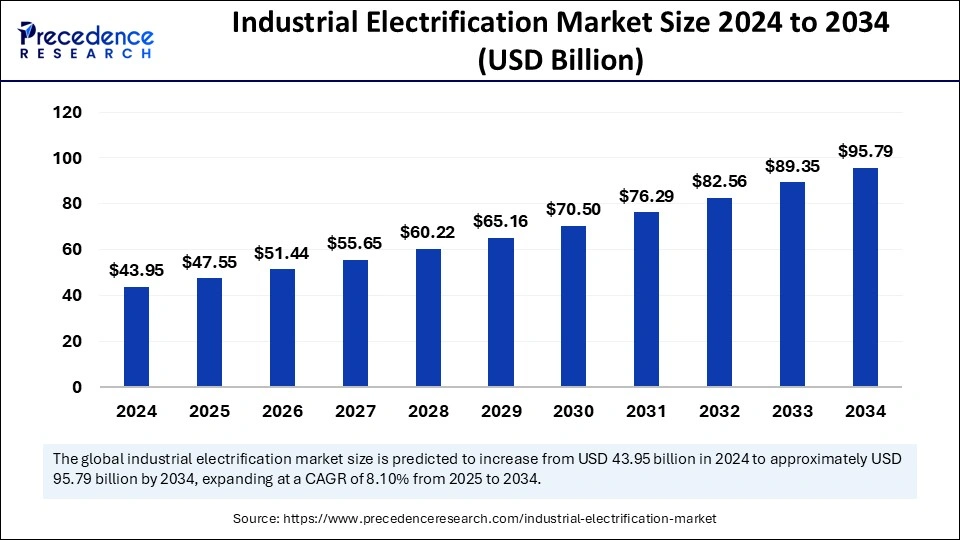
by The global industrial electrification market size was valued at USD 43.95 billion in 2024 and is projected to reach USD 95.79 billion by 2034, growing at a CAGR of 8.10%. Rising automation, decarbonization goals, and renewable energy integration are driving market expansion across manufacturing, construction, and heavy industries.
Read Also: Electric Vehicle Battery Market
Key Market Drivers
-
Growing Reliance on Renewable Energy Sources
Industries worldwide are shifting from fossil fuels to clean electricity. The International Energy Agency (IEA) reports that renewable energy accounted for 25% of global power generation in 2025, up from 22% in 2023. This transformation reduces carbon footprints while enhancing energy independence and cost-efficiency. -
Stringent Decarbonization and Net-Zero Policies
Governments are mandating emission reductions under frameworks such as the Paris Agreement and national Net-Zero 2050 initiatives. These regulations compel industrial sectors—especially manufacturing, construction, and mining—to electrify processes and adopt low-carbon technologies. -
Rising Industrial Automation and Digitalization
Increased deployment of automation, robotics, and Industry 4.0 technologies is driving demand for smart, electrified systems. Electrification supports higher precision, reduced energy losses, and predictive maintenance through IoT and AI integration. -
Advancements in Energy Storage and Battery Technologies
Innovations in solid-state and lithium-ion batteries enhance storage efficiency and reliability for industrial operations, enabling round-the-clock electrified processes even in energy-intensive environments. -
Modernization of Power Infrastructure
The global push toward smart grids, digital substations, and flexible energy networks facilitates stable power distribution and efficient integration of renewables across industrial sites. -
Government Investment and Policy Incentives
Major economies, including China (USD 359 billion), the EU (USD 106 billion), and the U.S. (USD 85 billion), invested heavily in clean energy initiatives in 2024. These policy-backed investments are accelerating industrial electrification across sectors.
Opportunities
-
Integration of Renewable Energy in Industrial Operations
The availability of affordable solar, wind, and hydropower creates vast opportunities for industries to deploy on-site clean energy generation paired with battery storage systems, reducing reliance on volatile fossil fuel markets. -
Electrification of Heavy and High-Temperature Industries
Electrified furnaces, induction heating, and electric arc technologies are enabling decarbonization in traditionally energy-intensive industries such as steel, cement, and chemicals. -
Emergence of Smart and Digitalized Factories
The convergence of electrification with AI, machine learning, and IoT enables real-time energy optimization and predictive maintenance, cutting operational costs while improving energy efficiency. -
Expansion of the Green Hydrogen Economy
The integration of hydrogen-based energy systems complements electrification efforts, offering hybrid power models for industrial operations seeking deeper emission cuts. -
Rising Adoption in Developing Regions
Asia Pacific and Latin America present lucrative growth prospects as industrialization surges alongside renewable energy expansion and favorable policy frameworks.
Growth Factors (2025–2034)
-
Widespread Transition to Electrified Manufacturing
Electrification of machinery, heating, and process equipment is gaining traction, reducing fossil fuel dependence and improving production efficiency. -
Rapid Urbanization and Infrastructure Growth
Asia Pacific, with an 8.7% CAGR, leads the shift toward electrified construction and infrastructure, integrating electric heavy equipment and solar-powered systems. -
AI-Driven Energy Management
Artificial intelligence enhances power grid stability, predicts energy consumption, and prevents downtime—boosting productivity across industrial operations. -
Rising Corporate Sustainability Goals
Global corporations are aligning with ESG frameworks, committing to carbon-neutral supply chains and investing in clean electrification technologies to meet sustainability targets. -
Electrification of Transport and Logistics Systems
As industrial fleets and construction machinery transition to electric power, demand for electrification technologies continues to rise, expanding the market’s scope. -
Synergy Between Policy and Technology
Supportive regulations such as Canada’s Clean Electricity Regulations (2024) and the U.S. Inflation Reduction Act (2022) reinforce technology adoption, ensuring steady industrial electrification growth worldwide.
Segments Covered in the Report
By Source
- Renewable Energy
- Solar Energy
- Wind Energy
- Hydropower
- Geothermal
- Nuclear Power
- Nuclear Fission
- Nuclear Fusion
- Fossil Fuel-based
- Others
By Technology
- Heat Pumps
- Electric Resistance Heating
- Electric Arc Heating
- Electric Boilers
- Energy Storage
- Others
By End-Use Industry
- Manufacturing
- Steel and Cement
- Mining
- Chemicals
- Construction
- Oil and Gas
- Pulp and Paper
- Others
By Geography
- North America
- Europe
- Asia Pacific
- Latin America
- Middle East and Africa
For inquiries regarding discounts, bulk purchases, or customization requests, please contact us at sales@precedenceresearch.com
