
Transforming Spatial Data Insights with Cutting-Edge AI: Market to Grow at a 25.75% CAGR from 2025 to 2034
The global Geospatial Analytics Artificial Intelligence (AI) Market is on an unprecedented growth trajectory, projected to expand from USD 60.11 billion in 2025 to a staggering USD 472.62 billion by 2034. This represents a robust compound annual growth rate (CAGR) of 25.75% over the forecast period, driven by the wide adoption of AI-enabled geospatial solutions that empower real-time data analytics across multiple sectors including defense, urban planning, agriculture, and environmental monitoring.
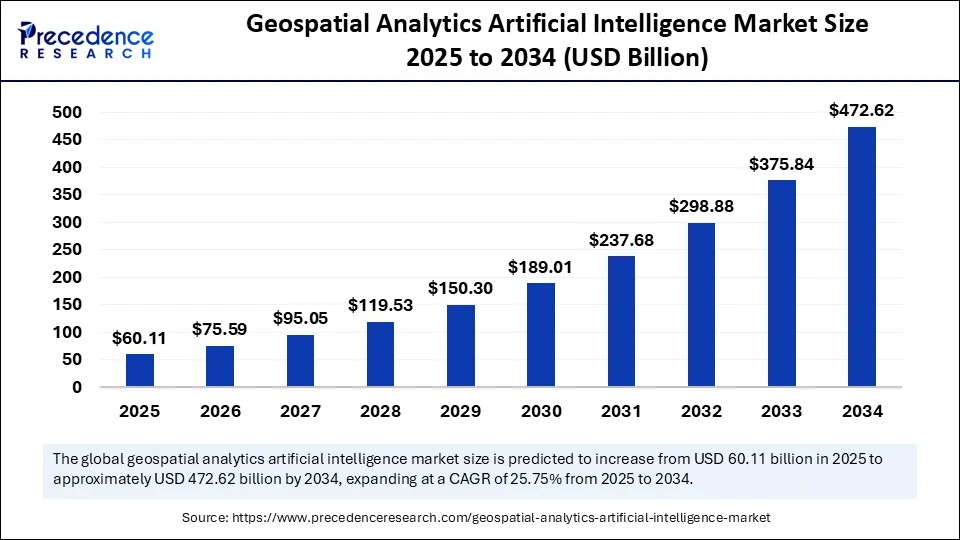
Geospatial Analytics Artificial Intelligence Market Quick Insights
- In terms of revenue, the global geospatial analytics artificial intelligence market was valued at USD 47.8 billion in 2024.
- It is projected to reach USD 472.62 billion by 2034.
- The market is expected to grow at a CAGR of 25.75% from 2025 to 2034.
- North America dominated the geospatial analytics artificial intelligence market with the largest share of 41% in 2024.
- Asia Pacific is expected to grow at the fastest CAGR from 2025 to 2034.
- By component, the software segment held a major market share of 42% in 2024.
- By component, the services segment is projected to grow at a significant CAGR between 2025 and 2034.
- By technology, the machine learning segment contributed the biggest market share of about 38% in 2024.
- By technology, the computer vision segment is expanding at a significant CAGR between 2025 and 2034.
- By data source, the satellite imagery segment accounted for the major market share of 35% in 2024.
- By data source, the UAV/drone imagery segment is expected to grow at a significant CAGR over the projected period.
- By deployment mode, cloud-based segment captured the highest market share of 48% in 2024.
- By application, the defense & security intelligence segment held the major market share of 30% in 2024.
- By application, the urban planning & smart cities segment is expected to grow at a notable CAGR from 20245 to 2034.
- By end-use industry, the government & public sector segment generated the major market share of 33% in 2024.
- By end-use industry, the agriculture segment is projected to grow at a significant CAGR in between 2025 and 2034.
Regional Revenue Breakdown (2024)
-
North America: 41% market share
-
Asia Pacific: Fastest growing region with strong investments in Earth observation satellites and AI-driven governance
-
Europe, Latin America, Middle East & Africa: Growing adoption in smart city and environmental initiatives
What Opportunities and Trends Will Shape the Future of the Geospatial Analytics AI Market?
The geospatial analytics AI market is poised to redefine how spatial data transforms decision-making. Key trends include:
-
Cloud-Based Integration: Cloud deployment dominates with scalable, flexible infrastructure to manage vast, real-time geospatial data. Adoption of cloud in AI-geospatial toolkits fosters collaboration among government agencies and enterprises, reducing costs and enhancing data sharing.
-
Defense & Security Intelligence: AI-powered geospatial analytics are revolutionizing military surveillance, threat detection, and mission planning. Programs like Project Maven in the U.S. and advanced RF geospatial intelligence by Spire Global demonstrate rapid tech adoption.
-
Urban Planning & Smart Cities: Accelerated investments in AI-geospatial for smart city infrastructure, climate adaptation, and traffic management highlight a critical growth avenue. Real-time analytics optimize resource allocation and city safety.
-
AI-Powered Satellite and UAV Data: Advanced machine learning and computer vision analyze satellite imagery and drone data for applications such as crop health monitoring, disaster response, and land use mapping.
-
Cross-Sector Collaborations: Partnerships between tech companies and public agencies drive innovation, exemplified by NASA and IBM’s Open Geospatial AI Foundation Model improving Earth observation data utility.
-
Data Privacy and Regulatory Challenges: As geospatial AI penetrates deeper into sectors, addressing data privacy and AI ethics will be crucial for sustainable growth.
Expert Insight
“The integration of AI with geospatial analytics marks a transformative leap for industries reliant on spatial intelligence. From enhancing defense capabilities to optimizing urban infrastructure and safeguarding the environment, the technology’s potential is immense. Our projections indicate that companies and governments investing in AI-based geospatial solutions will define the next decade’s innovation landscape,” stated Dr. Ananya Mehta, Principal Consultant, Precedence Research.
Market Scope
| Report Coverage | Details |
| Market Size by 2034 | USD 472.62 Billion |
| Market Size in 2025 | USD 60.11 Billion |
| Market Size in 2024 | USD 47.8 Billion |
| Market Growth Rate from 2025 to 2034 | CAGR of 25.75% |
| Dominating Region | North America |
| Fastest Growing Region | Asia Pacific |
| Base Year | 2024 |
| Forecast Period | 2025 to 2034 |
| Segments Covered | Component, Technology, Data Source, Deployment Mode, Application, End-Use Industry, and Region |
| Regions Covered | North America, Europe, Asia-Pacific, Latin America, and Middle East & Africa |
Regional and Segmentation Analysis
-
North America leads with the largest revenue share due to a mature tech ecosystem, substantial R&D investments, and presence of global AI-geospatial leaders like Esri and Palantir. Government initiatives such as NASA’s AI foundation models further bolster the market.
-
Asia Pacific is the fastest growing region, propelled by strong government backing in countries like India, China, Japan, and South Korea. Investments in precision agriculture, smart city projects, and national security are key growth factors.
-
Europe drives adoption through environmental sustainability and smart city initiatives, with countries like Germany and France leveraging AI for climate action.
-
Middle East, Africa, and Latin America are emerging markets facing infrastructural challenges but showing increased adoption in resource management and urban development solutions.
By Deployment Mode
-
Cloud-based deployment dominates (48% share in 2024), favored for cost-efficiency, scalability, and convenience in managing large datasets.
-
On-premises deployments are present but limited by infrastructure and scalability constraints.
By Application
-
Defense & Security Intelligence is the largest application segment (30% share), driven by demand for real-time surveillance and predictive threat modeling.
-
Urban Planning & Smart Cities segment is the fastest growing, reflecting investments in intelligent governance and climate resilience.
-
Other applications include disaster response, environmental monitoring, traffic management, and agriculture.
Read Also: Food Manufacturing Software Market Size to Reach USD 14.23 Billion by 2034 with a CAGR of 6.54%
Latest Breakthroughs from Leading Companies
In August 2023, NASA and IBM unveiled the Open Geospatial AI Foundation Model, a pioneering AI model built on harmonized satellite datasets from Landsat and Sentinel-2. This open-source model supports diverse applications such as land use tracking, disaster monitoring, and crop yield prediction, accelerating AI adoption in Earth sciences.
Spire Global expanded its Space Reconnaissance portfolio with advanced radio frequency geospatial intelligence capabilities to deliver continuous monitoring and multi-layer situational awareness for defense and allied operations.
Companies including Esri, Hexagon AB, Palantir Technologies, NVIDIA, Microsoft, and AWS continue enhancing their AI-geospatial platforms with cloud integration, advanced machine learning algorithms, and developer-friendly APIs and SDKs to broaden market reach and application diversity.
Challenges and Cost Pressures
Despite the promising outlook, the market faces challenges:
-
High Implementation Costs: Developing and deploying AI-enabled geospatial platforms require significant investment in hardware, software, and skilled expertise.
-
Data Privacy and Security: Handling vast amounts of sensitive spatial data necessitates stringent privacy safeguards and compliance with evolving regulations.
-
Integration Complexity: Merging legacy systems with cutting-edge AI tools demands sophisticated integration and may hinder adoption, especially for smaller enterprises.
-
Infrastructure Limitations: Emerging regions face connectivity and technological infrastructure constraints that could delay market penetration.
Case Study: Enhancing Disaster Response with AI-Driven Geospatial Analytics in North America
In 2024, the U.S. Federal Emergency Management Agency (FEMA) collaborated with multiple AI-geospatial providers to deploy an integrated platform that combines real-time satellite imagery, UAV data, and ground sensors. This system leveraged machine learning to predict wildfire spread, optimize evacuation routes, and coordinate emergency services during peak wildfire seasons. The adoption led to a 30% improvement in response times and better resource allocation, showcasing the life-saving potential of AI-powered geospatial intelligence in crisis management.
Take Action: Gain a Competitive Edge with Our In-Depth Market Report
Unlock comprehensive insights on the Geospatial Analytics Artificial Intelligence Market including detailed segmentation, competitive landscape, latest innovations, and growth strategies.
-
Request a free sample report or
-
Schedule a meeting with our Principal Consultants to discuss tailored market intelligence.
Visit: Precedence Research Geospatial Analytics Artificial Intelligence Market Report
About Precedence Research
Precedence Research is a leading global market research firm providing strategic insights and detailed market intelligence reports across industries. Our expert analysis empowers businesses, investors, and policymakers to make data-driven decisions that anticipate market trends and capitalize on emerging opportunities.
Contact Us:
Email: info@precedenceresearch.com
Phone: +1-123-456-7890
Website: www.precedenceresearch.com

