
Driving Operational Efficiency and Food Safety Compliance in a Rapidly Evolving Industry
The global food manufacturing software market is set to witness robust growth, expanding from an estimated USD 8.04 billion in 2025 to approximately USD 14.23 billion by 2034, reflecting a steady compound annual growth rate (CAGR) of 6.54% during this period. This expansion is fueled by surging consumer demand for processed and packaged foods, escalating regulatory requirements around food safety, and the increasing complexity of global food supply chains. Manufacturers are adopting intelligent software solutions that not only optimize production efficiency but also ensure traceability, compliance, and sustainability across the food production lifecycle.
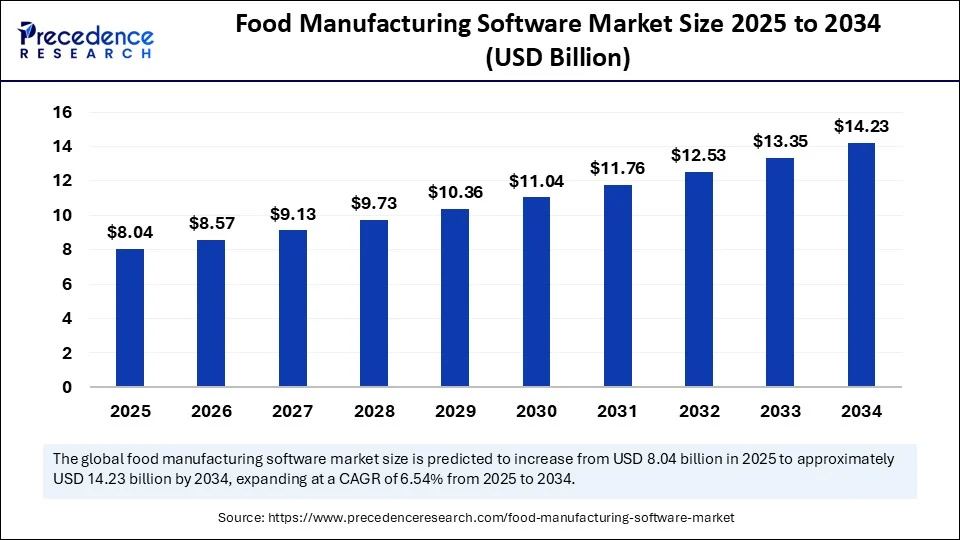
Food Manufacturing Software Market Key Points
- In terms of revenue, the global food manufacturing software market was valued at USD 7.55 billion in 2024.
- It is projected to reach USD 14.23 billion by 2034.
- The market is expected to grow at a CAGR of 6.54% from 2025 to 2034.
- North America dominated the food manufacturing software market with the largest market share of 37% in 2024.
- Asia Pacific is expected to expand at the fastest CAGR between 2025 and 2034.
- By deployment mode, the cloud-based segment held the biggest market share of 52% in 2024.
- By functionality, the enterprise resource planning (ERP) segment captured the highest market share of 27% in 2024.
- By functionality, the compliance & traceability segment is expected to grow at a remarkable CAGR between 2025 and 2034.
- By food category, the meat, poultry & seafood segment generated the major market share of 21% in 2024.
- By food category, the ready-to-eat/ready-to-cook meals segment is expected to grow at the fastest CAGR between 2025 and 2034.
- By enterprise size, the large enterprises segment contributed the highest market share of 64% in 2024.
- By enterprise size, the SMEs segment is expected to grow at a remarkable CAGR between 2025 and 2034,
- By end-user department, the production operations segment held the major market share of 31% in 2024.
- By end-user department, the regulatory & compliance segment is expected to grow at a remarkable CAGR between 2025 and 2034.
What Opportunities and Trends Are Shaping the Future of Food Manufacturing Software?
With technology revolutionizing every facet of the food production and supply chain, the market for food manufacturing software is embracing several powerful trends that present significant opportunities:
-
Artificial Intelligence and Automation: AI-driven predictive analytics, real-time quality control via machine vision, and intelligent automation in inventory and batch tracking are empowering manufacturers to reduce waste, improve yield, and accelerate innovation cycles.
-
Sustainability and Energy Optimization: Software platforms equipped with AI capabilities are vital in monitoring carbon footprint, optimizing energy consumption, and ensuring sustainable production processes.
-
Cloud-Based ERP Solutions: Cloud adoption supports scalable, integrated operations from production planning to logistics, especially important for growing e-commerce and direct-to-consumer (D2C) food models.
-
Customization and Agile Production: The rise of personalized food products—keto, vegan, organic—drives demand for software managing complex recipes, micro-batch production, and regulatory labeling compliance.
Expert Insight
“The food manufacturing software market is undergoing a paradigm shift characterized by digital transformation and smart automation. AI-powered tools and real-time data integration are no longer a competitive advantage but an operational necessity. As food manufacturers grapple with stricter safety standards and evolving consumer preferences, leveraging intelligent software solutions will become critical to sustaining growth and ensuring brand trust,” says Dr. Anjali Mehta, Principal Consultant at Precedence Research.
Market Scope
| Report Coverage | Details |
| Market Size by 2034 | USD 14.23 Billion |
| Market Size in 2025 | USD 8.04 Billion |
| Market Size in 2024 | USD 7.55 Billion |
| Market Growth Rate from 2025 to 2034 | CAGR of 6.54% |
| Dominating Region | North America |
| Fastest Growing Region | Asia Pacific |
| Base Year | 2024 |
| Forecast Period | 2025 to 2034 |
| Segments Covered | Deployment Mode, Functionality, Food Category, Enterprise Size, End-User Department, and Region |
| Regions Covered | North America, Europe, Asia-Pacific, Latin America, and Middle East & Africa |
Regional and Segmentation Analysis
North America Leads Innovation and Adoption
North America holds the largest market share, spearheaded by the U.S., which is home to early adopters of advanced technologies such as AI, IoT, and cloud platforms. Regulatory pressures from agencies like the FDA have accelerated software adoption for compliance and traceability, while growing consumer demands for transparency have pushed manufacturers to deploy real-time monitoring and batch-level tracking systems. The region’s mature digital ecosystem fosters ongoing investment in scalable, data-driven solutions.
Asia Pacific Emerges as the Fastest Growing Market
Asia Pacific is projected to lead growth in the coming years, driven by rapid urbanization, shifting dietary preferences, and increasing volumes of food production. Government initiatives enforcing food safety regulations, coupled with rising smartphone penetration and internet connectivity, are catalyzing demand for scalable, localized software solutions. Countries such as India and China are witnessing heightened adoption as manufacturers upgrade legacy systems and respond to international export compliance requirements.
Segment Performance Highlights
- By Deployment Mode: The market includes on-premises, cloud-based, and hybrid deployment modes. On-premises solutions offer manufacturers full control over data and infrastructure but come with higher upfront costs. Cloud-based deployment is gaining popularity due to scalability, remote accessibility, and lower initial investment, making it ideal for growing businesses. Hybrid models combine both approaches, providing flexibility to optimize performance, security, and cost effectiveness according to organizational needs.
- By Functionality: The market is segmented by various software functionalities such as Enterprise Resource Planning (ERP), Manufacturing Execution Systems (MES), Quality Management Systems (QMS), Inventory & Warehouse Management, Supply Chain & Logistics Management, Recipe/Formulation Management, Compliance & Traceability, Production Planning & Scheduling, Customer Relationship Management (CRM), and Laboratory Information Management Systems (LIMS). These functionalities streamline operations across production, quality control, logistics, and regulatory compliance, enabling food manufacturers to enhance efficiency, ensure safety, and meet evolving consumer demands.
- By Food Category: Food manufacturing software solutions cater to diverse food categories including beverages (alcoholic and non-alcoholic), dairy products, bakery & confectionery, meat, poultry & seafood, fruits & vegetables, canned & preserved foods, ready-to-eat/ready-to-cook meals, frozen foods, snack foods, and pet food. Each category faces unique production challenges and regulatory requirements, prompting adoption of tailored software to manage batch control, traceability, quality assurance, and inventory management.
- By Enterprise Size: Large enterprises dominate the adoption of food manufacturing software given their complex, multi-location operations and budgets for comprehensive digital transformation. However, small and medium enterprises (SMEs) are rapidly embracing modular and subscription-based solutions that are cost-effective and scalable, helping them improve operational efficiency and compete with larger players.
- By End-User Department: The software market serves multiple departments within food manufacturing organizations including Production Operations, R&D/Formulation, Quality Control/Assurance, Supply Chain & Procurement, Sales & Distribution, Regulatory & Compliance, and IT/Systems Management. Each department leverages specialized functionalities of the software to streamline workflows, optimize production planning, ensure compliance with food safety regulations, manage supplier and customer relationships, and maintain IT infrastructure effectively.
Latest Breakthroughs from Industry Leaders
Top software providers are innovating rapidly to meet nuanced market needs. Recent advancements include:
-
AI-powered recipe optimization tools enabling faster product innovation with consistent quality.
-
Cloud-based ERP platforms integrating production scheduling with logistics for enhanced supply chain agility.
-
Real-time batch tracking and temperature monitoring systems for compliance with international certifications in highly regulated segments like seafood exports.
-
Generative AI models simulating production scenarios to minimize downtime and maximize equipment utilization.
Challenges and Cost Pressures Facing the Industry
Despite its promising outlook, the food manufacturing software market confronts challenges:
-
High Initial Costs: Substantial upfront investment and integration complexity can deter smaller manufacturers from adopting advanced systems.
-
Legacy Systems and Customization Issues: Migrating from outdated platforms and tailoring software to specialized food categories remain significant hurdles.
-
Data Security Concerns: Ensuring compliance with global data protection regulations requires ongoing vigilance and investment.
-
Workforce Upskilling: Resistance to organizational change coupled with limited IT literacy slows down digital transformation efforts.
Case Study: Enhancing Efficiency in Meat Processing with AI-Driven Software
A leading North American meat processing company implemented an AI-powered food manufacturing software solution to streamline batch tracking, temperature monitoring, and sanitation scheduling. This adoption enabled real-time traceability from farm to fork, reduced product loss due to spoilage by 15%, and enhanced compliance with USDA safety standards. The integration of predictive analytics helped optimize processing schedules, reducing downtime by 12%, and improving overall equipment effectiveness.
Take the Next Step Towards Digital Transformation
As the food manufacturing landscape becomes increasingly tech-driven, companies must stay ahead of market trends to remain competitive. Precedence Research offers comprehensive market intelligence and customized insights to help businesses unlock growth opportunities and optimize their operations with cutting-edge software solutions.
Download our detailed report on the Food Manufacturing Software Market or schedule a consultation with our experts today to discover how your organization can benefit from this dynamic market shift.
About Precedence Research
Precedence Research delivers high-quality, data-driven market insights and analysis to empower decision-makers worldwide. Our expert consultants specialize in emerging technology trends and industry dynamics, providing actionable intelligence to drive strategic growth.
Contact Us:
Email: info@precedenceresearch.com
Phone: +1-123-456-7890
Website: www.precedenceresearch.com


