
 by
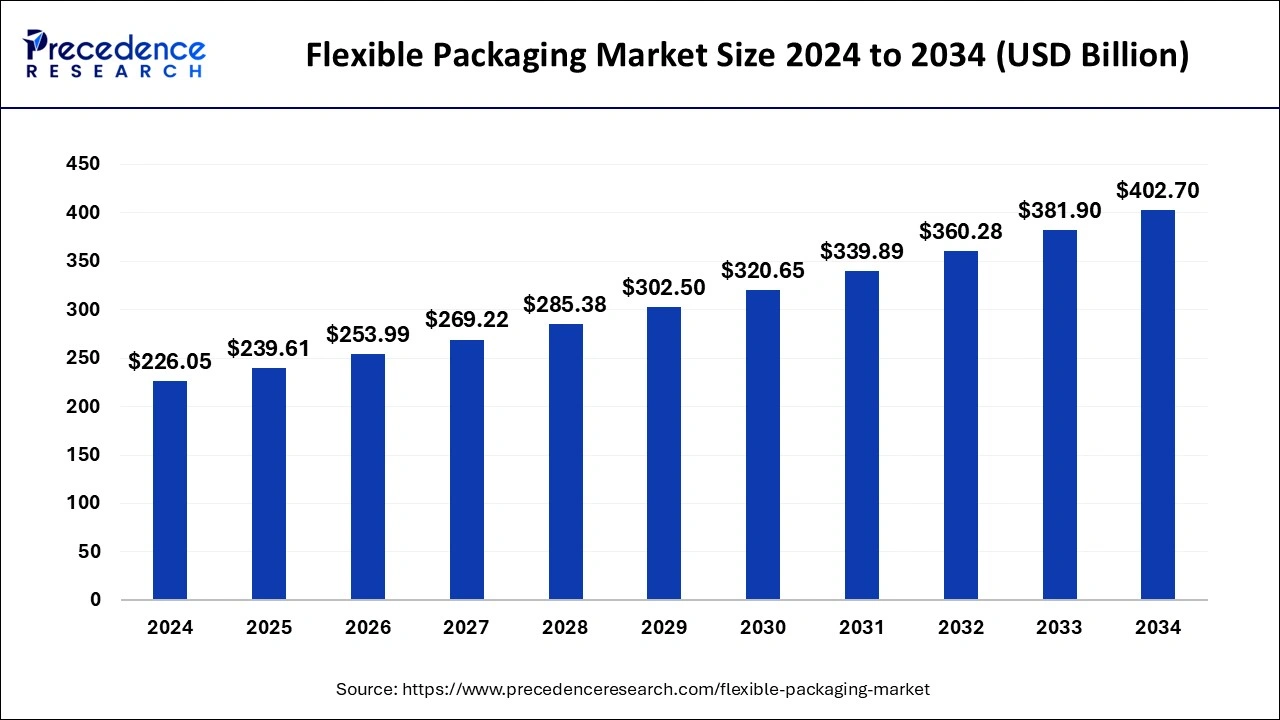
by The global flexible packaging market has witnessed remarkable growth over recent years. Valued at USD 226.05 billion in 2024, it is expected to reach approximately USD 402.70 billion by 2034, expanding at a CAGR of 5.94% from 2025 to 2034. Flexible packaging is increasingly preferred due to its cost-effectiveness, efficiency, and adaptability across various industries including food & beverage, pharmaceuticals, and personal care.
Read Also: Bioresorbable Polymers Market
Key Takeaways
-
Asia Pacific contributed the largest revenue share of 39% in 2024.
-
Plastic dominated the material segment with 70.50% market share.
-
Paper packaging is forecasted to grow at a CAGR of 5.90%.
-
Bags and pouches captured the largest market share of 38.20%.
-
Laminates and coatings are expected to grow at a CAGR of 6.30%.
-
Food and beverage industry held 48.70% market share.
-
Pharmaceutical packaging is expanding at a CAGR of 6.80%.
-
Flexographic printing dominated with 42.60% share, while digital printing is the fastest-growing segment at 7.20% CAGR.
-
High-barrier packaging films lead with 45.90% share, maintaining a growth CAGR of 6.40%.
Asia Pacific Flexible Packaging Market
The Asia Pacific flexible packaging market was valued at USD 88.16 billion in 2024 and is expected to reach USD 159.07 billion by 2034, with a CAGR of 6.08%. This growth is attributed to:
-
Large population base and growing consumption of packaged foods.
-
Expanding e-commerce and organized retail sectors.
-
Availability of low-cost labor and raw materials.
-
Increasing popularity of snacks, beverages, and ready-to-eat foods.
Market Overview
Flexible packaging uses non-rigid materials, offering:
-
Cost-effectiveness compared to rigid packaging.
-
Customization for product-specific designs and prints.
-
Energy-efficient production, reducing environmental impact.
-
Lightweight and portable packaging, simplifying storage and transportation.
-
Reusability and recyclability, supporting sustainability initiatives.
Market Scope
| Report Coverage | Details |
| Market Size in 2025 | USD 239.61 Billion |
| Market Size by 2034 | USD 402.70 Billion |
| Growth Rate from 2025 to 2034 | CAGR of 5.94% |
| Base Year | 2024 |
| Forecast Period | 2025 to 2034 |
| Segments Covered | By Raw Material, By Packaging Type, By Printing Technology, and By Application |
| Regions Covered | North America, Europe, Asia-Pacific, Latin America, and Middle East & Africa |
Driving Factors
-
Energy Efficiency & Sustainability
Flexible packaging consumes less energy during production and is often recyclable, aligning with eco-friendly practices. -
Versatility & Design Innovation
Flexible packages are available in pouches, sachets, stock bags, and sample packs. They can be customized with innovative prints and resealable closures. -
Convenience & Portability
Lightweight, compact packaging enhances consumer convenience and reduces transportation costs. -
Rising Demand in Food & Beverage
Fast-paced lifestyles and growing preference for ready-to-eat meals drive flexible packaging adoption globally. -
Regulatory Support
Government regulations promoting sustainable packaging solutions contribute to market expansion.
Material Insights
-
Plastic: Dominates due to its versatility, cost-effectiveness, and superior barrier properties, ideal for food, personal care, household, and pharmaceutical products.
-
Paper: Expected to grow rapidly, driven by eco-conscious consumer demand and innovations in barrier coatings.
Packaging Type Insights
-
Bags and Pouches: Most popular for their flexibility and customization options.
-
Laminates and Coatings: Fastest-growing segment, offering superior barrier protection and extended shelf life, particularly in the food industry.
End-Use Industry Insights
-
Food & Beverage: Largest share due to the packaging’s ability to preserve freshness and reduce food waste.
-
Pharmaceuticals: Growing segment driven by increased healthcare expenditure, aging population, and need for protective packaging for sensitive drugs.
Printing Technology Insights
-
Flexographic Printing: Dominates due to high-speed, cost-effective printing on various materials.
-
Digital Printing: Fastest-growing, offering customization, on-demand printing, and eco-friendly solutions.
Barrier Properties Insights
-
High-Barrier Films: Dominant, providing protection against oxygen, moisture, and light, extending product shelf life.
-
Advancements like multilayer films and nanotechnology enhance strength and functionality.
Leading Market Players
-
Sealed Air Corporation (US)
-
Coveris (Austria)
-
Transcontinental Inc. (Canada)
-
Amcor (Australia)
-
Sonoco (US)
-
Huhtamaki (Finland)
-
Berry Global Inc. (US)
-
Mondi (South Africa)
-
Clondalkin Group
