
 by
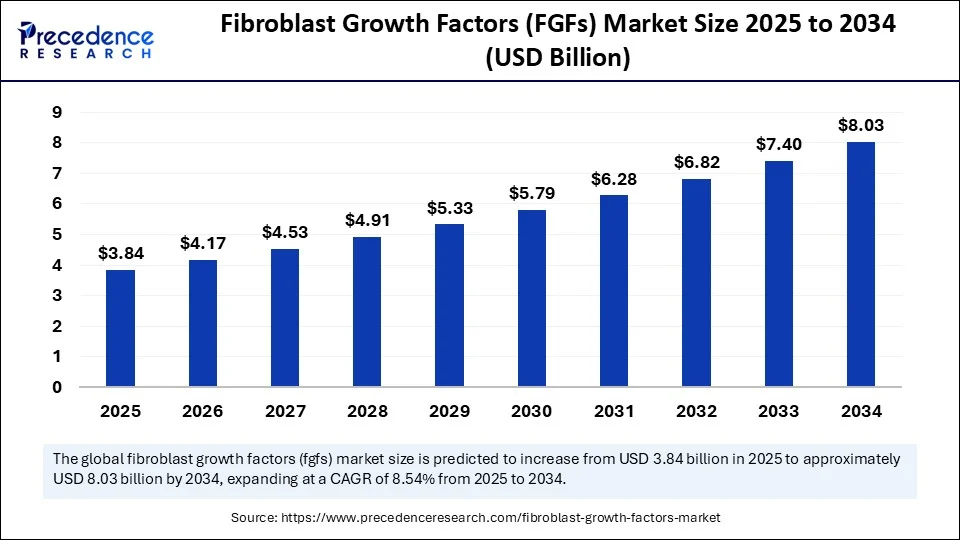
by The global fibroblast growth factors (FGFs) market is charting a remarkable growth path, with its valuation climbing from $3.54 billion in 2024 to a projected $8.03 billion by 2034. This vibrant trajectory, characterized by a CAGR of 8.54%, is fueled by breakthroughs in regenerative medicine, a surge in chronic diseases, and rapid advancements across biologics, wound healing, and oncology research. As the market expands, artificial intelligence is reshaping everything from drug discovery to therapeutics, making this sector a hotbed of innovation.
Fibroblast Growth Factors (FGFs) Market Key Insights
-
The global FGFs market was valued at $3.54 billion in 2024 and will reach $8.03 billion by 2034, maintaining a CAGR of 8.54%.
-
North America dominates, owing to advanced healthcare infrastructure, strong biotech investments, and regulatory advantages for biologics.
-
Asia Pacific is the fastest-growing region, riding the waves of industrialization, government R&D support, and a rising middle class.
-
The U.S. market alone is expected to grow from $1.02 billion (2024) to $2.35 billion (2034) at 8.7% CAGR.
-
FGF1 and FGF2 lead the FGF isoforms market thanks to their central roles in cell growth, angiogenesis, and tissue repair.
-
Pharmaceutical and biotech companies drive market share, supported by robust R&D and new clinical applications in regenerative medicine and oncology.
-
Leading players shaping the landscape include Thermo Fisher Scientific, PeproTech, R&D Systems, Abcam Limited, Cell Signaling Technology, Inc., Novus Biologicals, and Sigma-Aldrich.
Fibroblast Growth Factors (FGFs) Market Growth Table
| Year | Global Market Value (USD Billion) |
|---|---|
| 2024 | 3.54 |
| 2025 | 3.84 |
| 2034 | 8.03 |
AI is fundamentally shifting the FGF landscape. Machine learning algorithms now analyze vast datasets to identify promising drug candidates, optimize development workflows, and fast-track clinical research. By harnessing generative AI, researchers can generate synthetic datasets to overcome data limitations, expediting therapy testing without ethical hurdles. AI also enables deep biological data mining, helping to discover new drug targets and unlock novel uses for FGFs, especially in precision medicine and oncology. This acceleration in the innovation cycle means patients can access advanced treatments faster, with greater cost efficiency and higher success rates.
In addition to speeding up drug discovery, AI-powered analytics are used to pinpoint patterns across vast biological databases, revealing unrecognized links between FGF pathways and specific diseases. With AI, companies can repurpose existing therapies for new indications more swiftly—fueling a cycle of improved outcomes and broader access to advanced diagnostics and treatments.
What’s Fueling Market Growth?
-
Surging demand for regenerative medicine and chronic wound therapies, tied to a global rise in lifestyle diseases and an aging population.
-
Expanding therapeutic scope: FGFs are crucial for tissue repair, wound healing, and angiogenesis, making them central in the treatment of burns, musculoskeletal injuries, and even complex metabolic disorders.
-
Biotechnology breakthroughs: Advancements in protein engineering and biologics are facilitating the development of safer, more effective FGF therapies.
-
Critical mass in clinical trials: Increasing numbers of clinical studies and approvals are moving FGF therapies from lab to clinic more rapidly than ever.
Fibroblast Growth Factors (FGFs) Market Opportunity & Trend Section
Where Will the Next Breakthroughs in FGF-Based Therapies Emerge?
The future promises wider FGF use beyond traditional wound healing—into fields like oncology, metabolic diseases, and even personalized regenerative medicine. Long-acting injectables, stabilized FGF variants, and combination therapies are all set to redefine standards. Demand for bespoke FGF products is surging, especially as precision medicine and targeted drug delivery become healthcare’s new normal.
What Game-Changers Are Companies Innovating Now?
Top players are pushing the frontier with innovations such as:
-
Smart delivery systems for precise drug administration.
-
Synthetic FGF analogs to improve treatment durability and efficacy.
-
Integration with biomaterial scaffolds to accelerate wound and bone healing.
Fibroblast Growth Factors (FGFs) Market Company Spotlight: Leading Market Players
-
Thermo Fisher Scientific
-
PeproTech
-
R&D Systems
-
Abcam Limited
-
Cell Signaling Technology, Inc.
-
Novus Biologicals
-
Sigma-Aldrich
These companies are investing deeply in next-gen product pipelines, research collaborations, and smart manufacturing strategies to stay ahead in the evolving FGFs landscape.
Fibroblast Growth Factors (FGFs) Market Segmentation & Regional Analysis
What Segments Are Leading—and Why?
-
By FGF Type: Native isoforms FGF1 and FGF2 dominate; FGF3, FGF10, and FGF21 are rising fastest for their diverse roles in disease management.
-
By Product Grade: High-purity (≥95%) research-grade FGFs are preferred for their reliability in scientific research. GMP-grade clinical kits are also rapidly gaining traction.
-
By Application: Cell culture and fundamental research remain core applications; regenerative medicine and aesthetics post the highest growth rates due to demand for anti-aging and tissue repair products.
-
By End-User: Pharmaceutical and biotechnology firms are the largest end-users, while CDMOs/CMOs are the fastest-growing, thanks to their specialized expertise and cost advantages.
-
By Business Model: Off-the-shelf products are most accessible, but demand for custom-engineered FGFs is ramping up, especially for targeted therapies.
Which Regions Are Setting the Pace?
-
North America: Leading with advanced healthcare, innovative biotech, and a supportive regulatory environment.
-
Asia Pacific: Fastest growth, driven by China, Japan, India, and South Korea’s heavy investments in research and a burgeoning consumer class.
-
Europe: Marked regional gains from R&D funding and supportive regulatory frameworks.
-
Latin America: Notable growth thanks to infrastructure expansion and increasing chronic disease prevalence—but must navigate reimbursement and regulatory hurdles.
-
Middle East & Africa: Growth fueled by rising healthcare expenditures and a greater chronic disease burden, with regional governments prioritizing advanced therapeutics.
What’s Holding the Market Back?
-
High development costs and complexity of FGF products & therapies remain a challenge, compounded by lengthy regulatory timelines.
-
Manufacturing bottlenecks—particularly in producing FGFs at scale, with consistent high quality.
-
Long-term safety and efficacy doubts for new therapies occasionally slow clinical progress and investor confidence.
Case Study
In India, the rising elderly population and high rates of diabetes have made advanced wound care a top priority. One healthcare provider integrated FGF-based therapies for chronic diabetic ulcers and reported a significant increase in patient healing rates, reduction in repeat admissions, and shortened recovery times—demonstrating the practical benefits and real-world impact of advanced FGF products.
Read Also: Glass Interposers Market
Ready to Learn More?
Interested in a deeper dive or ready to supercharge your strategy with the latest FGFs market intelligence?
Download your sample report, book a meeting, or request a customized briefing: sales@precedenceresearch.com
